The Four Major Types of Financial Derivatives
The financial derivative market is a massive, complex landscape. It is a multi-trillion dollar industry that drives a huge portion of global trading. However, when you strip away the complicated Wall Street jargon, the vast majority of this market is built on just four foundational contracts.
While massive institutions use all four to manage their global risks, regular everyday investors almost exclusively use just one. Understanding how these four contracts work will help you navigate the financial news and understand exactly what is happening behind the scenes of the global economy.
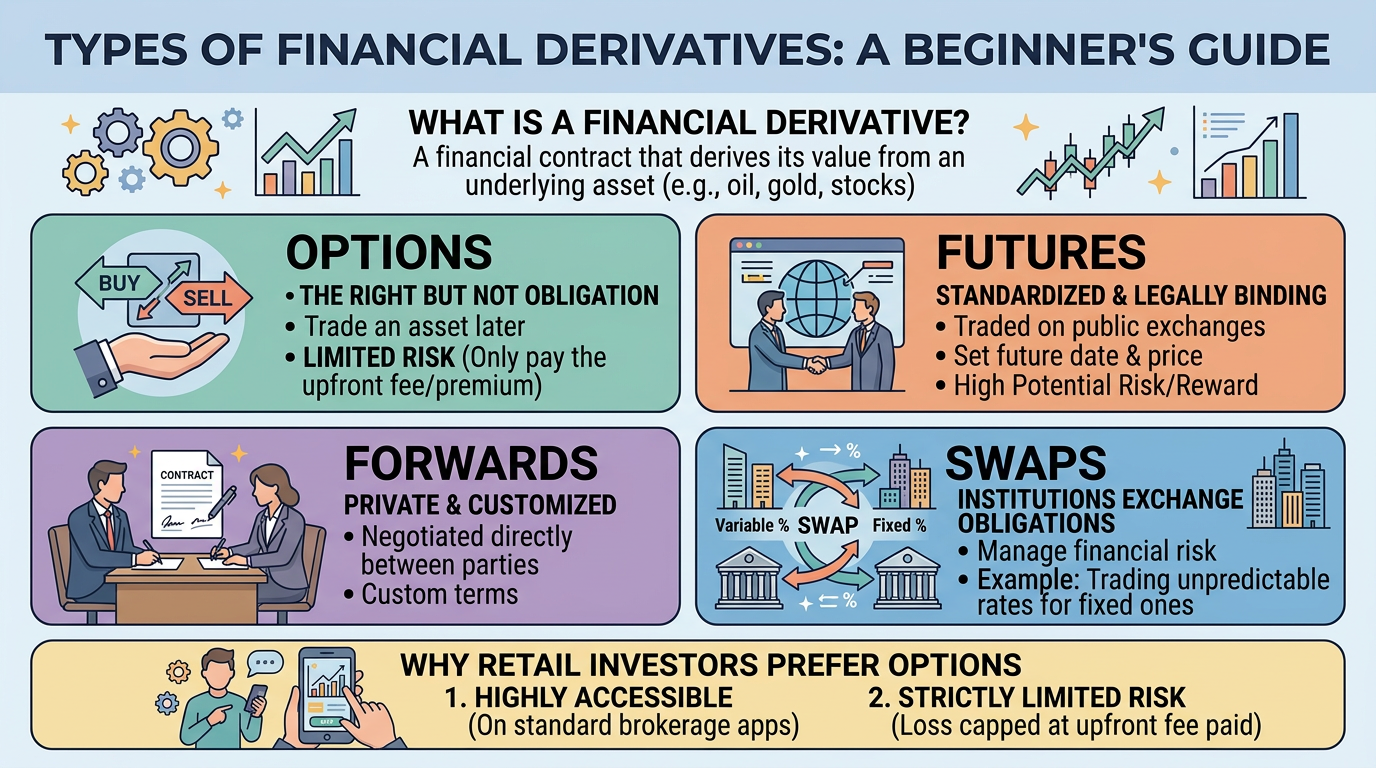
Options Contracts
An option is a contract that gives you the right to buy or sell an underlying asset at a specific price before a certain date. Surprisingly, an option is optional, meaning you are not forced to make the trade.
If you buy an option to purchase a stock at fifty dollars, but the stock suddenly crashes to twenty dollars, you can simply walk away. You are under no obligation to buy the losing stock. Your only penalty is the loss of the small upfront fee you paid to purchase the contract in the first place. This flexibility makes options incredibly popular for both protecting wealth and making calculated bets on the market.
Futures Contracts
A futures contract is a firm commitment. When you sign a futures contract, you agree to buy or sell an asset at a predetermined price on a specific date in the future. Unlike an option, a future is a strict obligation. You must follow through with the trade regardless of what the market is doing.
These contracts are highly standardized, meaning they always deal in set amounts, like exactly one thousand barrels of crude oil or five thousand bushels of corn. Because they are standardized, they are traded publicly on major financial exchanges. Airlines frequently use futures to lock in the price of jet fuel months in advance so they can accurately price their passenger tickets.
Forward Contracts
A forward contract is essentially the private, customized cousin of the futures contract. It is also a strict obligation to buy or sell an asset at a future date, but forwards do not trade on public exchanges. Instead, they are private agreements made directly between two parties.
Because they are private, forwards can be customized to fit the exact needs of the businesses involved. For example, a local bakery might sign a forward contract directly with a regional farm to buy exactly three hundred pounds of specialized flour on a specific Tuesday. It is a highly tailored business deal used to guarantee a supply chain.
Swap Agreements
Just as the name implies, a swap is a contract where two parties agree to exchange their financial obligations or cash flows.
The most common variation is an interest rate swap. Imagine one company has a massive bank loan with an unpredictable variable interest rate, and another has a loan with a predictable fixed rate. If the first company wants stability and the second company wants to gamble on rates dropping, they can use a swap derivative to trade their payment structures. They do not cancel their original bank loans. They simply agree to cover each other's payments, effectively swapping their financial exposure.
Why Regular Investors Stick to Options
Of these four derivative types, retail investors usually stick entirely to options. There are a few very practical reasons for this.
First and foremost is accessibility. Forwards and swaps are private, institutional level deals that are completely inaccessible to the average person. Futures are traded publicly, but they require massive amounts of capital and specialized margin accounts to trade safely.
Options, on the other hand, are highly accessible. Almost any standard brokerage app allows you to trade options with just a few clicks and a small amount of money.
The second reason is risk management. When you buy an options contract, your risk is strictly capped. The absolute most you can lose is the small premium you paid for the contract itself. If a trade goes terribly wrong, you simply let the option expire worthless. Futures contracts do not offer this safety net. If you are on the wrong side of a futures contract, you are still legally obligated to fulfill the deal, which can lead to catastrophic financial losses that far exceed your initial investment.
Summary
The derivative market is built on options, futures, forwards, and swaps. Futures and forwards are firm obligations to buy or sell assets, while swaps allow large companies to trade their financial liabilities. Options are the only derivative that gives the buyer a choice rather than an obligation. Because they offer capped risk and are easily accessible through standard brokerage accounts, options remain the only practical derivative tool for everyday retail investors.
