Market Summary (May 04- May 08, 2026)
Market Summary
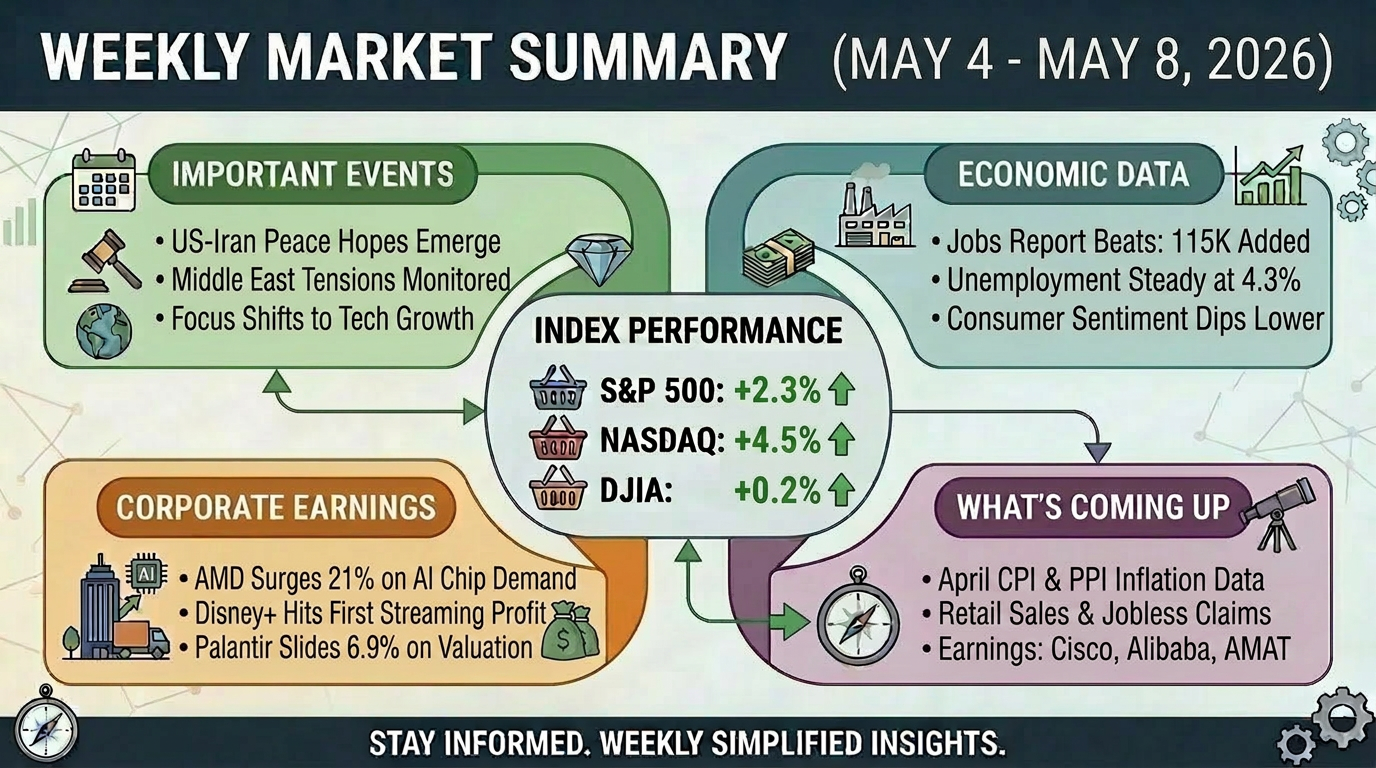
For the week ending May 8, 2026, the stock market continued its upward climb to reach fresh all-time highs, powered by a massive surge in technology stocks and unexpectedly steady labor data. The S&P 500 climbed 2.3% for the week to close at 7,398.93. The tech-heavy Nasdaq Composite jumped a massive 4.5% to a record 26,247.08, while the Dow Jones Industrial Average ended the week slightly up by 0.2% to 49,609.16. Ultimately, investors pushed past worries about global political conflicts and confidently invested their money into artificial intelligence (AI) and technology leaders.
Important Events
International relations remained a major focus. The market digested a fresh exchange of military blows in the Middle East, though this was quickly countered by headlines regarding U.S.-Iran peace hopes. While the region remains highly unpredictable, the prospect of stabilizing tensions kept markets from panicking. This lack of severe disruption allowed investors to focus primarily on underlying economic health and corporate growth.
Economic Data
The most critical economic data for the week came from Friday's official April jobs report, which revealed the U.S. economy added 115,000 jobs. This easily beat the expectations of financial experts and was supported by earlier data showing a strong jump in hiring by private companies. Despite this solid job growth, the overall unemployment rate held steady at 4.3%. Additionally, the weekly report tracking the number of Americans filing for unemployment benefits for the first time remained very low at 200,000, signaling that widespread corporate layoffs are not happening. However, everyday shoppers painted a gloomier picture to close out the week. A major survey measuring how people feel about the economy and their personal finances dipped lower, highlighting a growing disconnect between a surprisingly strong job market and how everyday consumers actually feel about their money.
Corporate Earnings
Palantir: The data company had its best quarter in years, with sales jumping 85.0%. Even though the business is booming, the stock fell 6.9%. Why? Investors felt the stock price had become too expensive compared to its actual earnings and decided to sell.
AMD: This chipmaker was the week's big winner. Its stock surged 21.0% after it proved it could compete with Nvidia by offering cheaper AI chips. Sales in its data center division grew by a massive 57.0%.
Arista Networks: Despite reporting high profits, the stock plummeted 12.6%. The company warned that it is getting harder (and more expensive) to find the parts needed to build networking gear, and its big customers are starting to demand lower prices.
HSBC: The bank’s stock rose 1.4%. Even though it missed its profit goal by 79.4% due to some one-time costs, investors were happy because the bank’s core business is strong and it is paying out more money to shareholders.
AppLovin: This advertising tech company saw its stock rise 4.1%. Their new AI software is making their ads much more effective, and the company spent $5.6 billion to buy back its own shares, which makes the remaining shares more valuable.
Uber: Uber proved it is no longer just a "startup" losing money. It reported a huge 8.5% stock jump after showing $1.9 billion in real profit. More people are taking rides and ordering food than ever before.
Arm Holdings: Even though the company made more money than expected, the stock fell 8.8%. The company admitted it might struggle to actually manufacture enough of its new AI chips to keep up with all the orders coming in.
Novo Nordisk: The maker of Ozempic and Wegovy saw its stock rise 2.1%. While their complicated accounting math looked messy, investors didn't care because the demand for their new weight-loss pill is sky-high.
Walt Disney: Disney’s stock jumped 7.5%. For the first time ever, its streaming business (Disney+) made a significant profit. this was great news for investors, as it helped cover up the fact that fewer people are visiting their U.S. theme parks right now.
McDonald's: The fast-food giant's stock dipped 2.9%. While they made a decent profit, they warned that lower-income customers are finally getting tired of high prices and are eating at home more often to save money.
Toyota: The automaker’s stock fell 2.2%. The company’s profits dropped 21.5%, but not because of their cars. Instead, they got hit by expensive new trade taxes (tariffs) and shipping delays caused by the conflict in the Middle East.
What’s Coming Up Next Week
During the week of May 11, the market focus will transition from employment data to inflation metrics. The most significant report will be Monday's release of the April Consumer Price Index (CPI), which tracks the average change in prices for consumer goods and services. This will be followed by the Producer Price Index (PPI) on Tuesday, providing insight into price changes from the perspective of manufacturers. On Thursday, the market will evaluate consumer spending through the U.S. Retail Sales report and assess the labor market via initial jobless claims. Additionally, participants will continue to monitor geopolitical developments. In terms of corporate earnings, Cisco, Alibaba, and Applied Materials (AMAT) are scheduled to report. While no other major earnings are expected this week, investors are positioning themselves for Nvidia's highly anticipated report on May 20, which is expected to have a significant impact on the technology sector.
