Market Summary (June 15- June 19, 2026)
Market Summary
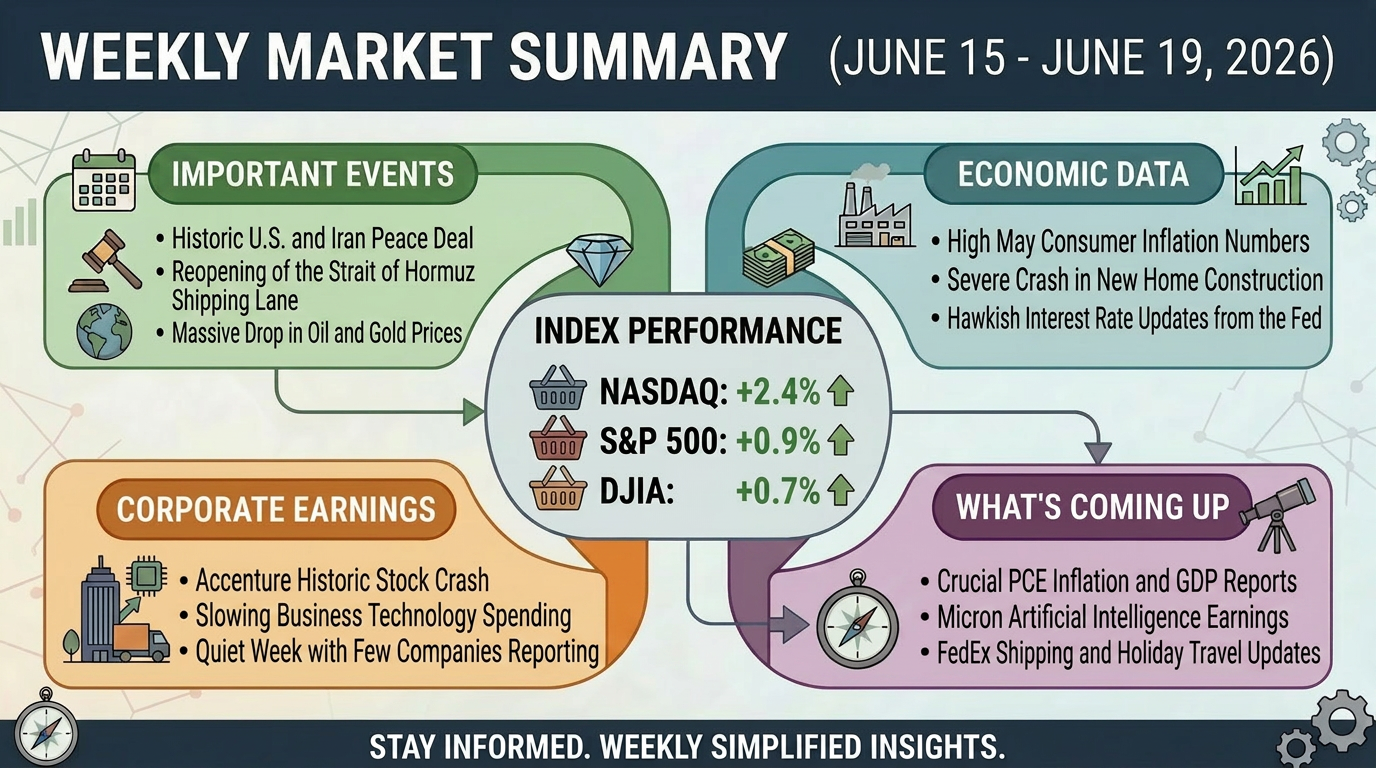
The stock market managed to secure solid gains over a holiday-shortened but incredibly busy week. Even though U.S. stock markets were closed on Friday for the Juneteenth national holiday, the four days before that were packed with action. The main event happened on Thursday, which was a massive day for financial contract expirations. Wall Street calls this day "triple witching," and it is a time when a huge number of investment contracts expire all at once, forcing big fund managers to shuffle their money around very quickly. This single-day scramble caused the total amount of buying and selling to jump more than 50.0% above normal levels.
By the time the closing bell rang on Thursday, the Nasdaq led the market higher, jumping 2.4% over the week. The S&P 500 also gained 0.9% over the active sessions, while the Dow Jones Industrial Average climbed 0.7% to finish the week on a positive note.
Important Events
A major peace breakthrough in international politics sent a wave of relief through global energy markets. In Geneva, Switzerland, the United States and Iran officially signed a historic 14-point preliminary peace agreement. This temporary deal creates a 60-day window for deeper talks, pauses heavy American trade penalties, and completely reopens the vital Strait of Hormuz shipping lane for toll-free commercial travel. Within hours of the signing, massive oil tankers began moving freely through the region again, unlocking millions of barrels of crude oil that had been trapped out of reach.
This sudden return to normal shipping completely wiped away the "fear premium," which is the extra price hike that happens when people worry about supply shortages. Because of this, global oil prices plunged more than 8.0% for the week to settle around $80.58 a barrel, a massive drop from its recent war-driven high of $107. Gold and silver, which investors usually buy as safe havens when they are scared, also took a heavy beating as global anxieties melted away. Gold prices plummeted to $4,143.49 an ounce, especially as the U.S. dollar grew much stronger.
Economic Data
While investors celebrated a more peaceful world, fresh economic reports showed that everyday citizens are still dealing with a painful mix of high prices and a slowing housing market. The government reported that consumer inflation for May accelerated to a three-year high of 4.2% over the past year. This was heavily driven by a harsh 7.0% monthly jump in prices at the gas pump. Meanwhile, retail sales looked strong on the surface by rising 0.9% for the month. However, most of that growth was just an illusion caused by inflation. People were not actually buying more physical goods; they were just paying higher prices for the basics.
At the same time, the housing market suffered a severe blow. Total housing starts, which measure the number of new home construction projects that actually broke ground, plummeted 15.4% in May to hit their lowest level since the 2020 pandemic. This crash was led by a massive 42.0% collapse in new apartment and multi-family buildings because high borrowing costs are making it too expensive for developers to build.
This challenging backdrop set the stage for Kevin Warsh's historic first meeting as the newly appointed Chairman of the Federal Reserve. The central bank voted unanimously to keep its foundational interest rate steady between 3.5% and 3.8%. However, Chairman Warsh took a very aggressive stance, completely erasing any hints that the Fed might lower interest rates anytime soon. Even worse for everyday borrowers, half of the Fed's policymakers now expect the central bank to actually raise interest rates before the end of the year to cool down inflation. This surprise sent borrowing costs climbing across the country, pushing the interest rate on 2-year government loans up to 4.2% and 10-year loans up to 4.5%.
Corporate Earnings
Because of the holiday-shortened schedule, it was a very quiet stretch for corporate financial updates, meaning very few companies reported their latest numbers. However, there was one massive standout from the technology world.
Accenture: The global technology consulting giant suffered its worst single-day stock crash in company history. While Accenture actually made slightly more profit per share than expected, its total quarterly sales of $18.72 billion missed Wall Street's targets. The real panic came because big corporations are starting to cut back or delay their spending on large digital consulting projects. Management also noted that regional conflicts directly swallowed up $100 million in expected revenue. Investors reacted with extreme fear, sending Accenture stock crashing 18.0% on Thursday alone, wiping billions of dollars off the company's total market value.
What’s Coming Up Next Week
Looking ahead to the final week of June, the market will be hyper-focused on whether everyday consumers can keep spending enough money to keep the economy afloat. On Wednesday, the government will release fresh data on New Home Sales to see if buyers are completely priced out. Then on Thursday, the government will release the PCE inflation report, which is the Federal Reserve's absolute favorite tool for measuring how much everyday items cost.
A heavy lineup of high-profile corporate earnings will also take center stage. Wall Street will get a direct look at the health of global shipping when FedEx reports on Tuesday, a pulse check on the housing market from homebuilder KB Home, and a reading on vacation spending from Carnival Cruise Line. But the biggest event of all will be on Wednesday, when computer chip giant Micron reports its earnings. This report will give investors the ultimate update on just how much stamina the artificial intelligence boom has left. Finally, retail giant Nike will round out the action the following Tuesday as its management team leads a major brand restructuring.
