Market Summary (July 6 - July 31, 2026)
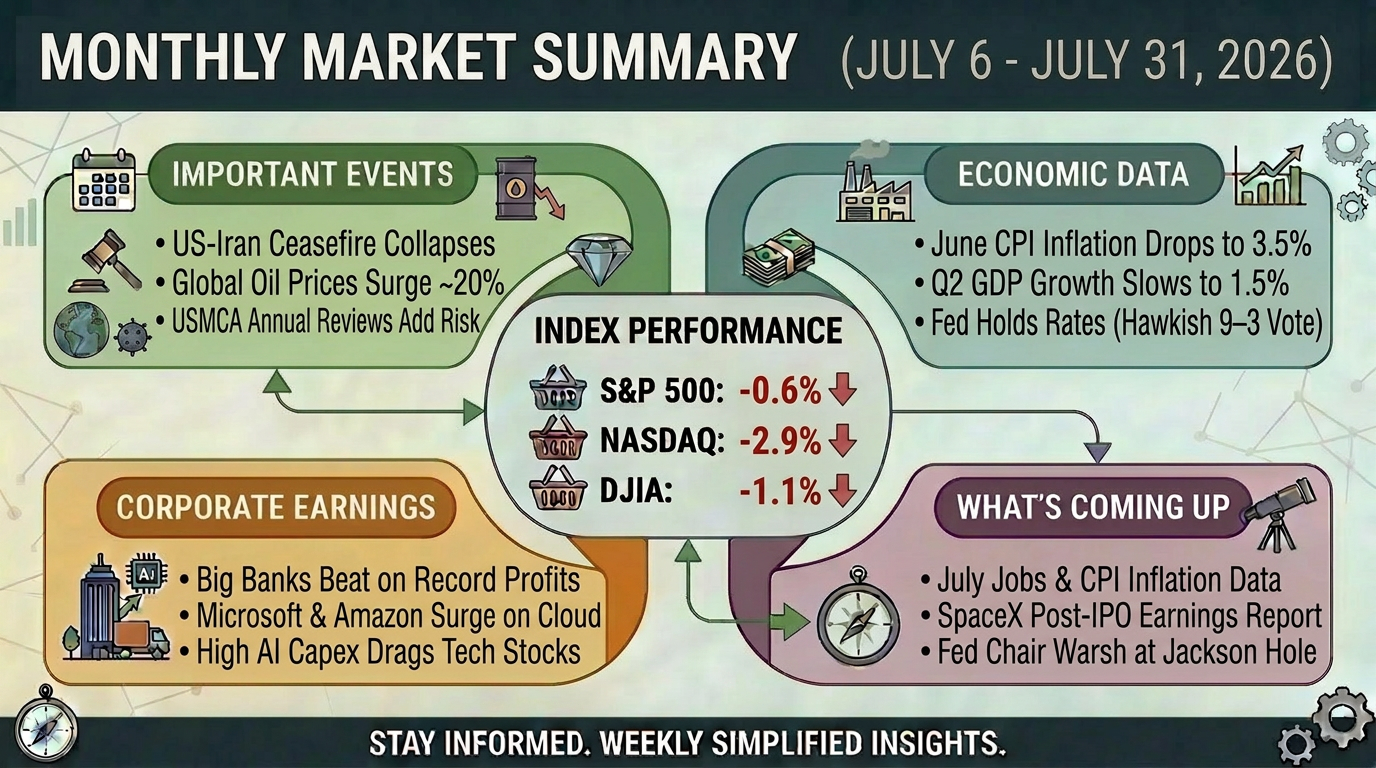
Market Summary
July was a month where the final scoreboard barely moved, but the ride was violent.
The month started at record highs. On Monday, July 6, the Dow Jones Industrial Average closed at a record 53,055.91, its first finish ever above 53,000, just days after Alphabet was added to the index. The S&P 500 ended at 7,537.43, the Nasdaq Composite at 26,121.16, and the small-company Russell 2000 closed above 3,000 for the first time at 3,009.54.
Then three storms hit. Artificial intelligence and computer chip stocks got hammered. The ceasefire with Iran collapsed and oil prices exploded higher. And the Federal Reserve told investors something they did not want to hear.
By the closing bell on Friday, July 31, the S&P 500 sat at 7,489.72, a loss of 0.6% from July 6 to July 31. The Nasdaq fell hardest over that stretch, dropping 2.9% to 25,373.85 as the technology trade came apart. The Dow slipped 1.1% to 52,485.03.
Those small numbers hide some brutal days. In the first full week of the month, chip stocks slid session after session and erased roughly $1.3 trillion in market value, with Intel alone falling 21.0% over seven trading days. On July 29, the day the Federal Reserve announced its decision, the Dow dropped 1,153 points, or 2.2%, to close at 51,594.14. That was its worst day since April 2025, and it left the Nasdaq more than 10.0% below its all-time high, a decline big enough that Wall Street calls it a correction. Then on July 30, the Nasdaq jumped 2.8% and snapped a six-day losing streak after Microsoft reported blowout results. Even after that bounce, the Nasdaq-100 index still finished July down about 7.0%, its steepest monthly drop since March 2025.
The bigger story was where the money moved. Investors sold expensive technology stocks and bought healthcare companies, banks, and other steady businesses instead. On several days, most stocks in the S&P 500 rose even while the tech-heavy Nasdaq fell. That is a healthy sign, because it means gains are spreading beyond a handful of giant companies.
Borrowing costs climbed too. The interest rate on 10-year government bonds rose from 4.5% to 4.8%, its highest level since January 2025. Rates on 2-year bonds reached 4.3%, and 30-year loans hit 5.3%, the highest since 2007.
Important Events
Oil was the biggest troublemaker, and the reason was war.
Back on June 17, the United States and Iran signed a 14-point agreement meant to formalize a ceasefire, end the U.S. naval blockade, and reopen the Strait of Hormuz, the narrow waterway that a huge share of the world's oil passes through. That deal fell apart in July. Iran struck three commercial ships that bypassed its approved route, the United States retaliated with strikes, and on July 8 President Trump declared from a NATO summit that the ceasefire was over. The fighting escalated from there. A July 17 missile attack in Jordan killed three American service members. On July 23, drones and missiles hit Saudi oil tankers in the Red Sea. On July 29, Iran rejected a compromise to reopen the strait, intercepted three oil tankers, and fired ballistic missiles at U.S. forces in Jordan.
Oil did exactly what you would expect. Brent crude, the global benchmark, closed at $100.69 a barrel on July 23, its first trip above $100 since May. American West Texas Intermediate crude settled at $92.19 that same day. Prices cooled as the month ended and shipping traffic showed signs of recovering, with Brent slipping just below $88 and WTI near $82. Even after that retreat, Brent finished July up about 20.0%, its biggest monthly gain since March.
This matters far beyond the gas pump. Energy costs get baked into the price of almost everything that is made, shipped, or flown, which is exactly the pressure the Federal Reserve is trying to remove from the economy.
Trade policy stayed unsettled. After the United States declined on July 1 to renew the United States-Mexico-Canada Agreement in its current form, the two sides met for a third round of bilateral talks in Mexico City during the week of July 20. The agreement itself has not been canceled and legally stays in place through July 2036, but it now gets reviewed every single year instead of every sixteen, so companies with cross-border supply chains face fresh political risk annually. Tariffs on imported steel, aluminum, cars, and lumber all remain in place, and Canada has signaled it will push for relief from them.
Economic Data
For the first time in months, the inflation news was actually good. The Consumer Price Index, which tracks what normal households pay for goods and services, fell 0.4% in June. That was the steepest one-month drop since April 2020. It pulled the yearly inflation rate down to 3.5% from 4.2% in May, better than the 3.8% economists expected. Core inflation, which removes jumpy food and energy prices to show the real underlying trend, was completely flat for the month and sits at 2.6% for the year. Almost all of the relief came from energy, where prices fell 5.7% in a single month and gasoline dropped 9.7%.
The catch is that this report covers June, before July's oil spike. That is exactly why economists refused to celebrate.
The Fed's favorite inflation measure, the Personal Consumption Expenditures index, told the same story when it came out on July 30. Prices fell 0.1% for the month. Yearly inflation eased to 3.7% from 4.1%, and core inflation slipped to 3.3% from 3.4%. Both are still far above the Fed's 2.0% goal. Household spending rose a modest 0.3%.
The economy itself is clearly slowing. The first estimate of second-quarter Gross Domestic Product, which measures the total value of everything the country produces, showed growth of only 1.5% per year. That is down from 2.1% in the first quarter and below what forecasters expected. Consumer spending, business investment, and exports all helped, but lower government spending and higher imports dragged the total down. This came right after June's jobs report, which showed the economy added just 57,000 jobs while 720,000 people quit looking for work entirely, pushing workforce participation to a five-year low of 61.5%.
None of that softened the Federal Reserve. At its meeting on July 28 and 29, the central bank held its benchmark interest rate steady between 3.50% and 3.75% for the fifth straight time. But the vote was a tense 9 to 3, and here is the important part: all three officials who disagreed wanted to raise rates, not cut them. They were Beth Hammack of Cleveland, Neel Kashkari of Minneapolis, and Lorie Logan of Dallas. It was the first time since September 2016 that three policymakers dissented in the same direction.
Chair Kevin Warsh said the cooler June inflation report did not weigh heavily on the decision, describing its influence in two words: "not much." He joked that he had asked for a good family fight and got one. He also drew a hard line, telling reporters there is no soft inflation target and no implicit target, only a target of 2.0%. Minutes from the June meeting, released July 8, had already exposed the split. Nine officials expected at least one rate increase in 2026, eight expected no change, and only one expected a cut.
Investors got the message. By July 30, the CME FedWatch Tool, which turns market betting into probabilities, put the odds of a quarter-point rate hike on September 16 at 61.4%, up from 50.6% a month earlier.
Corporate Earnings
Second-quarter earnings season produced the strongest headline numbers in five years, and also a lesson in reading past headline numbers.
Through July 31, about 61.0% of S&P 500 companies had reported, and 86.0% of them beat Wall Street's profit expectations, according to FactSet. Combined profits were up 47.4% from a year earlier, the fastest growth since 2021. But that figure is inflated. Alphabet and Amazon both booked enormous one-time paper gains from revaluing investments they own (such as Anthropic & SpaceX), not from selling more products. Strip those two out and growth drops to 28.8%, which is still excellent. The gap between 47.4% and 28.8% is the whole lesson: a reported profit number and an actual operating business are not always the same thing.
The banks kicked things off on July 14, when all five of America’s largest banks reported before the opening bell and beat expectations, together earning about $49 billion, up 39.0% from a year earlier.
Banks
JPMorgan Chase: Net income of $21.2 billion, the largest quarterly profit any U.S. bank has ever recorded, though $4.6 billion came from a one-time gain on its Visa stake. Excluding investment gains, it still earned $16.9 billion, helped by an 86.0% surge in trading revenue and a 30.0% jump in investment banking fees.
Goldman Sachs: Best quarter in its history: earnings per share nearly doubled to $20.98 on revenue of $20.34 billion, up 39.0%, boosted by fees from underwriting the SpaceX stock offering.
Bank of America: Earned $9.1 billion, up 27.0%.
Even so, JPMorgan’s Jamie Dimon flagged geopolitical instability, stubborn inflation, and stretched stock valuations as risks ahead.
Then came the last week of July, when investors ran out of patience with AI spending. Companies that spent heavily and could point to real revenue got rewarded; those spending heavily with little to show got punished.
Big Tech / AI Spending
Alphabet (Google): Reported July 22 with revenue of $119.8 billion, up 24.0%, and cloud revenue up 82.0%. Stock fell about 6.0% after the company raised its 2026 infrastructure spending plan to $195–$205 billion.
Meta: Stock dropped roughly 8.0% on its own multi-billion-dollar spending plans and a weaker sales forecast.
Microsoft: Stock jumped 16.0% on July 30, its biggest one-day gain since 2008, adding about $450 billion in value, after Azure grew 43.0% and crossed $100 billion in annual revenue for the first time.
Amazon: Delivered its first-ever $200 billion quarter ($200.6 billion, up 20.0%); cloud revenue grew 36.7%, the fastest pace in 18 quarters, and operating profit rose 43.0% to $27.5 billion. Raised its 2026 spending plan from $200 billion to $220 billion, citing rising memory-chip costs.
Apple: Record revenue of $109.4 billion, up 16.0%, with iPhone sales up 22.0% and EPS of $2.02, beating estimates. Stock still fell nearly 10.0% on July 31 (its worst day since March 2020, erasing about $475 billion in value) after Services revenue and Greater China sales missed estimates and guidance came in soft, blamed on memory-chip supply shortages. Marked Tim Cook’s final earnings call as CEO before he becomes executive chairman on September 1.
Taiwan Semiconductor Manufacturing (TSMC): Record quarterly revenue of $40.20 billion on July 16, up 36.0%, with profit up 77.0%. Announced another $100 billion investment in Arizona amid the memory-chip crunch nicknamed “RAMageddon.”
Consumer
PepsiCo: Revenue of $24.18 billion (July 9), topping forecasts, though adjusted EPS of $2.20 missed by a penny amid tighter household budgets and margin pressure in North America.
Delta Air Lines: Record adjusted revenue of $17.67 billion (July 10), up 14.0%, adjusted EPS of $1.56, and an affirmed full-year forecast of $6.50–$7.50 per share. For the first time ever, premium seats outearned main cabin seats.
Netflix: Revenue of $12.56 billion (July 16), up 13.4% and roughly in line with expectations, but the stock fell more than 8.0% to a 52-week low after guidance pointed to slower growth ahead.
What's Coming Up Next Month
August opens with the two reports that will settle the September rate debate. On Friday, August 7, the government releases July hiring numbers. A second weak month in a row, especially with more downward revisions to earlier months, would shift the conversation from inflation to the risk of a real slowdown. The bigger event is Wednesday, August 12, with the July Consumer Price Index. Since oil climbed about 20.0% during July, this is the first real test of whether that spike reached everyday prices. A hot reading would lock in expectations for a September rate hike. Another soft one would take pressure off the Federal Reserve.
The earnings calendar stays busy through the first week of the month, with results from Palantir, AMD, Caterpillar, Disney, Eli Lilly, and Uber. The most watched of all will be SpaceX, filing its first quarterly report since going public in June.
Later in the month, on August 28, the Bureau of Labor Statistics releases its preliminary benchmark revision, a yearly cleanup of the jobs data that could reveal the economy created far fewer jobs than previously reported. Finally, central bankers gather at the Jackson Hole Economic Policy Symposium in Wyoming from August 27 to 29. Chair Warsh is expected to speak, and investors will study every word for clues about the September 15 and 16 policy meeting, where a rate increase is currently the market's base expectation.
