Market Summary (June 22- June 26, 2026)
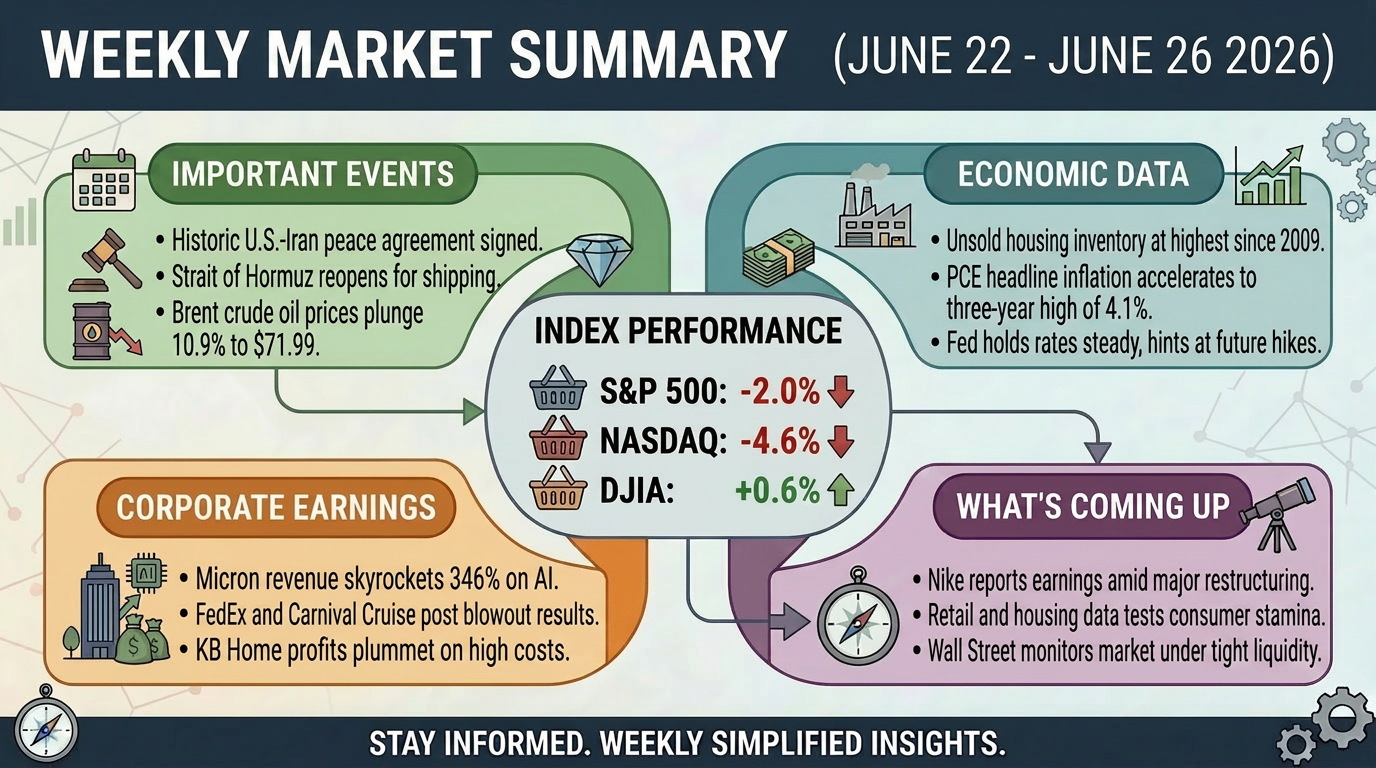
Market Summary
The stock market experienced an intense tug-of-war as excitement over artificial intelligence (AI) technology clashed with heavy economic roadblocks. While speculative technology giants faced a sharp wave of profit-taking, traditional industrial and blue-chip companies (large, well-established companies with a history of reliable performance) caught a strong wave of interest from investors. The week reached a dramatic climax on Friday with the annual "Russell reconstitution," which is the massive yearly shake-up when major index providers update their official lists of benchmark companies. This rebalancing (the process of adjusting a portfolio to maintain a specific level of asset allocation) forces automated funds to adjust their portfolios all at once, creating the single largest trading event of the year. In a stunning display of modern market speed, a record 4,594,880,616 shares, representing a record $334.027 billion in total value, changed hands in a mere 1.63 seconds.
By the time the closing bell rang on Friday, the tech-heavy Nasdaq led the market lower, tumbling 4.6% over the active sessions. The S&P 500 also slid 2.0% under the weight of stretched valuations, while the Dow Jones Industrial Average bucked the broader trend, climbing 0.6% to finish the week on a positive note.
Important Events
A monumental peace breakthrough in international politics sent a massive wave of relief through global energy markets. In Geneva, Switzerland, the United States and Iran officially signed a historic 14-point preliminary peace agreement. This temporary deal halted a three-month military conflict, creating a 60-day window for deeper diplomatic talks, pausing heavy trade penalties, and completely reopening the vital Strait of Hormuz shipping lane for commercial travel. Within hours of the electronic signing, massive oil tankers began moving freely through the region again, unlocking millions of barrels of crude oil that had been trapped out of reach.
This sudden return to normal shipping completely wiped away the "fear premium," which is the extra price hike that happens when investors worry about sudden supply shortages. Because of this, global oil prices suffered a dramatic reset, with Brent crude plunging 10.9% to settle at $71.99 a barrel and American West Texas Intermediate (the benchmark for oil prices in the U.S.) dropping 9.6% to $69.23 a barrel. Safe-haven assets like gold and silver also took a heavy beating as global anxieties melted away, with gold dipping to $4,013.13 an ounce and silver plummeting 10.1% to finish at $57.60 an ounce.
Economic Data
While investors celebrated a more peaceful world, fresh economic reports showed a deeply split American economy where everyday citizens are struggling with high prices while the housing market buckles. The government reported that new home sales for May fell 7.3% to an annualized rate of 580,000. Despite this slowdown, the median price of a new home rose 2.0% to $424,900, leaving homebuilders holding a massive backlog of 496,000 unsold homes. This represents a whopping 10.3 months' supply of inventory (a measure of how long it would take to sell all available homes at the current sales pace), which is the highest level of unsold real estate seen since the 2009 financial crisis.
The plot thickened on Thursday with the highly anticipated release of the PCE inflation report, which is the Federal Reserve's absolute favorite tool for measuring the cost of living. Driven by the lingering effects of the recent energy crisis, headline inflation accelerated to a three-year high of 4.1% over the past year, while core inflation climbed to a stubborn 3.4%. Even though nominal household spending rose 0.7% on the surface, inflation swallowed up most of that growth, forcing the personal savings rate down to a flat 3.0% as families dip into their savings just to buy basics.
This challenging backdrop intensified the policy dilemma for the Federal Reserve under its newly appointed Chairman, Kevin Warsh. While the central bank kept its foundational interest rate steady between 3.50% and 3.75%, central bank officials maintained a highly aggressive stance, with half of the Fed's policymakers now expecting an interest rate hike before the end of the year. To cool down inflation, the Fed has quietly tightened the amount of money available in the financial system by gradually reducing its routine asset purchases down to a disciplined $10 billion monthly pace.
Corporate Earnings
It was an incredibly telling week for corporate financial updates, as major companies revealed exactly how macroeconomic forces (large-scale economic factors like interest rates, inflation, and unemployment) and shifting consumer habits are altering their bottom lines (a company's net income or profit).
Micron Technology was the massive standout from the technology world, reporting revenues that skyrocketed 346% to $41.46 billion. The surge was driven by strict "take-or-pay agreements," which are contracts forcing customers to pay upfront to guarantee their supply of artificial intelligence memory chips. However, this hoarding triggered a broader supply chain shock nicknamed "RAMageddon," causing component costs to quadruple and forcing Apple and Microsoft to raise retail device prices. Meanwhile, FedEx reported strong revenue of $25.0 billion fueled by AI shipping demand, and Carnival Cruise Line posted blowout results as consumers prioritized vacation experiences. Conversely, homebuilder KB Home saw net income plummet to $27.3 million as high borrowing costs forced them to offer steep discounts to attract buyers.
What’s Coming Up Next Week
Looking ahead to the final stretch of June, the market will turn its hyper-focus toward corporate restructurings (when a company reorganizes its operations or structure to improve efficiency) and retail resilience to see if everyday consumers have enough stamina left to keep the economy afloat. On Wednesday, the market will look to housing data for signs of consumer stability, followed closely by retail updates to see how inflation is impacting shopping habits.
The primary event will take place on Tuesday, when athletic giant Nike steps into the earnings spotlight. Nike shares have languished near 52-week lows (the lowest price a stock has traded at in the last year) between $40.9 and $41.5 amid extreme market anxiety surrounding the company's massive, multi-year brand restructuring initiative under its leadership team. To help steady investor nerves ahead of the release, Nike announced that veteran executive David M. Denton will take over as global chief financial officer in August. However, Wall Street remains deeply skeptical, and analysts have slashed Nike's expected quarterly profit estimates by an aggressive 45.5% down to just $0.11 to $0.12 per share, providing the ultimate reading on whether consumer retail can survive a prolonged era of restricted central bank liquidity.
