Stock tickers are short letter-based symbols used to represent publicly traded companies on stock exchanges, and understanding them is an important part of learning how the market actually works. While they may seem simple at first, tickers serve as the foundation for how investors find, track, and trade stocks. Every time you look up a stock price, place a trade, or read financial news, you are using ticker symbols. In the United States, major exchanges like the New York Stock Exchange and the Nasdaq assign unique tickers to each listed company, allowing millions of investors to communicate and transact efficiently without confusion.
What Is a Stock Ticker
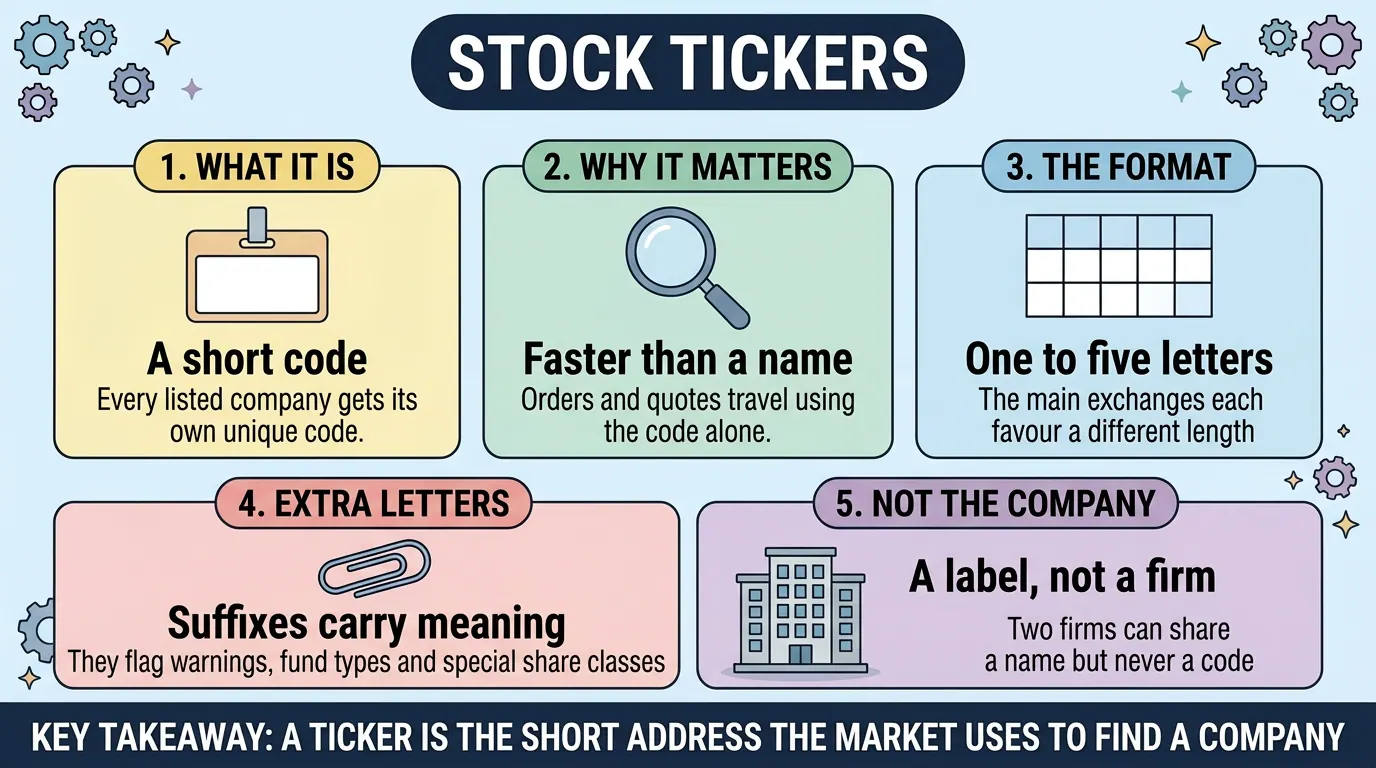
A stock ticker is a unique abbreviation, usually made up of a few letters, that identifies a specific company in the stock market. Instead of using long company names, investors use tickers to quickly access information and place trades. For example, Apple trades under “AAPL” and Microsoft trades under “MSFT”. These symbols are essential because many companies may have similar names, but each ticker is distinct, ensuring that investors are selecting the correct stock when buying or selling shares.
How Stock Tickers Are Used
Stock tickers are used throughout the investing process to quickly identify and access information about companies. When entered into a brokerage platform, a ticker displays key data such as price, performance, and trading activity, and it is also used across financial news, earnings reports, and stock charts. By providing a fast and precise way to reference stocks, tickers make the market more efficient and reduce confusion, especially given the large number of publicly traded companies. They also make it easier to follow the market, compare investments, and access real-time data, which is why learning how to recognize and use them is an important early step for investors.
Ticker Format and Structure
Stock tickers typically contain between one and five letters. In general, companies listed on the New York Stock Exchange tend to have shorter tickers, sometimes just one or two letters, while Nasdaq-listed companies often have four-letter tickers. Although this pattern is common, it is not a strict rule, and there are many exceptions. The letters in a ticker may relate to the company’s name, but they are mainly chosen for simplicity and recognition rather than strict abbreviation rules.
Special Letters and Suffixes
In some cases, tickers include extra letters that provide additional information about a stock. On the Nasdaq, a fifth letter can indicate specific situations, such as financial distress, bankruptcy proceedings, or a special type of security. These suffixes are not always relevant for everyday investing, but they can signal important details about a company’s status. Being aware of these variations can help investors avoid confusion and better understand what they are trading.
Multiple Share Classes
Some companies issue more than one class of stock, and each class has its own ticker symbol. These different share classes may offer different rights, such as voting power or dividend priority, even though they represent ownership in the same company. This is why you might see similar but slightly different tickers tied to a single company. Understanding this distinction is important, especially when comparing stocks that appear nearly identical at first glance.
A well-known example of multiple share classes is Berkshire Hathaway, led by Warren Buffett, which has two main tickers: BRK.A and BRK.B. Both represent ownership in the same company, but they are structured very differently. BRK.A shares are extremely expensive and carry full voting rights, while BRK.B shares are far more affordable and have reduced voting power. Each BRK.A share is equivalent to 1,500 BRK.B shares in terms of economic value, which allows smaller investors to invest in the company without needing to buy the much higher-priced Class A stock.
Ticker vs Company Name
A stock ticker is not the same as a company’s full name. The ticker is simply a trading symbol used for convenience, while the company name is its official legal identity. Beginners sometimes confuse the two, especially when companies have similar names or when a ticker does not clearly match the company it represents. Double checking both the ticker and the company name before making a trade helps prevent costly mistakes.
Summary
Stock tickers are short symbols that represent companies in the stock market and are used to identify, track, and trade stocks. They follow general patterns in length and structure, may include special letters for additional information, and can vary when companies have multiple share classes. Although simple in appearance, tickers are a core part of how the market operates, and understanding them helps investors navigate trading platforms and financial information more effectively.