How Your Filing Status Outlines Your Entire Tax Return
The tax preparation process begins long before calculating income or totaling deductions. The very first decision involves identifying your official filing status based on your marital and living situation on the final day of the tax year. This selection determines the specific rulebook the Internal Revenue Service applies to your financial profile, effectively setting the baseline for your entire tax liability. Selecting the incorrect status can lead to processing delays, missed tax breaks, or unintentional underpayments.
The Five Core Categories
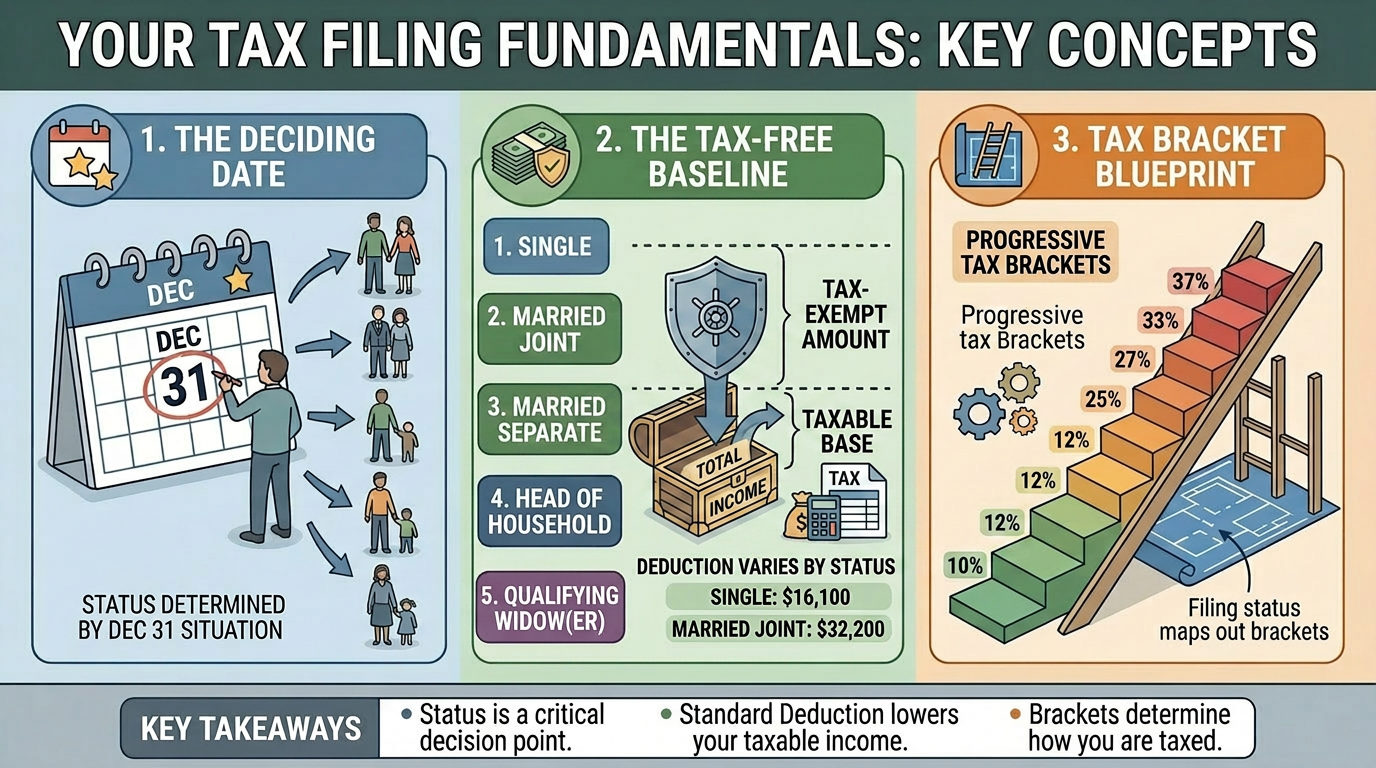
The government divides taxpayers into five distinct categories. Each status features strict eligibility criteria that must match your legal and domestic situation as of December 31.
Single
This is the default category for individuals who are unmarried, legally separated, or divorced at the close of the tax year. If you do not meet the specific requirements for any other status, you must file as single.
Married Filing Jointly
This option allows legally married couples to combine their income, exemptions, and deductions onto a single tax document. Most couples benefit from this status because it yields the lowest combined tax rate and unlocks the maximum number of federal tax credits.
Married Filing Separately
Married individuals can choose to file independent returns. This choice splits their financial responsibilities completely. While it generally results in a higher overall tax bill than joint filing, couples utilize it when they want to keep separate financial liabilities or when specific income-driven student loan payments make individual filing more advantageous.
Head of Household
This highly beneficial status applies to unmarried individuals who pay more than half the cost of maintaining a home for a qualifying child or dependent relative. It provides much larger tax breaks than the single status, recognizing the heavy financial burden placed on single parents and caregivers.
Qualifying Surviving Spouse
This temporary status supports individuals whose spouse passed away within the last two tax years. It allows the surviving spouse to retain the favorable tax rates and deduction amounts of a joint return, provided they maintain a household for a dependent child.
How Status Dictates the Standard Deduction
The standard deduction is a fixed, automatic bucket of income that the government completely exempts from taxes. Your choice of filing status directly dictates the precise size of this tax break. The baseline standard deduction amounts scale clearly across the different statuses:
Single: $16,100
Married Filing Separately: $16,100
Head of Household: $24,150
Married Filing Jointly: $32,200
Qualifying Surviving Spouse: $32,200
Filing jointly as a married couple provides a deduction that is exactly double the single amount. Choosing Head of Household grants an individual filer a significant boost over the standard single deduction, instantly lowering their taxable income without requiring them to track receipts or itemize specific expenses.
How Status Shifts Tax Bracket Boundaries
Filing status does more than just establish your automatic deductions; it maps out the boundaries of your tax brackets. The progressive tax system uses seven brackets, but the exact income levels where those tax percentages increase change based on your chosen status.
For example, the income thresholds for a married couple filing jointly are generally twice as high as the thresholds for a single filer. A single person might cross the threshold into a higher marginal tax rate at a relatively modest income level, whereas a married couple can pool their earnings and stay within a lower tax bracket for much longer. Similarly, Head of Household filers enjoy wider tax brackets than single filers, ensuring that more of their income is taxed at lower rates before spilling over into higher percentages. Miscalculating your status can accidentally place your income into a more aggressive tax bracket than necessary.
Summary
Choosing a tax filing status serves as the operational blueprint for your entire return because it establishes your standard deduction amount and dictates the specific income thresholds of your tax brackets. This foundational decision determines how much of your income remains completely tax-free and sets the exact rates applied to the rest of your earnings. By identifying your correct status based on your marital status and household responsibilities at the end of the year, you ensure compliance with federal guidelines while positioning yourself to claim the maximum possible tax savings.
