Tax Basics 101: What Are Taxes and Why Do We File a Return?
Every spring, a collective groan echoes across the country. Envelopes marked "Important Tax Document" start piling up on kitchen counters, tax software commercials take over your screen, and the overall vibe becomes distinctly stressful.
If you are new to the adult world, or have just managed to avoid thinking about taxes until now, the whole process can feel like a bizarre, mandatory math test where the government knows the answers but won't tell you. Spoiler alert: It is not actually that dramatic. Let us strip away the jargon and look at the absolute ground floor of taxes. By the end of this page, you will understand what taxes actually are, and why filing a return is not a punishment, it is just a financial squaring up.
What Actually Are Taxes?
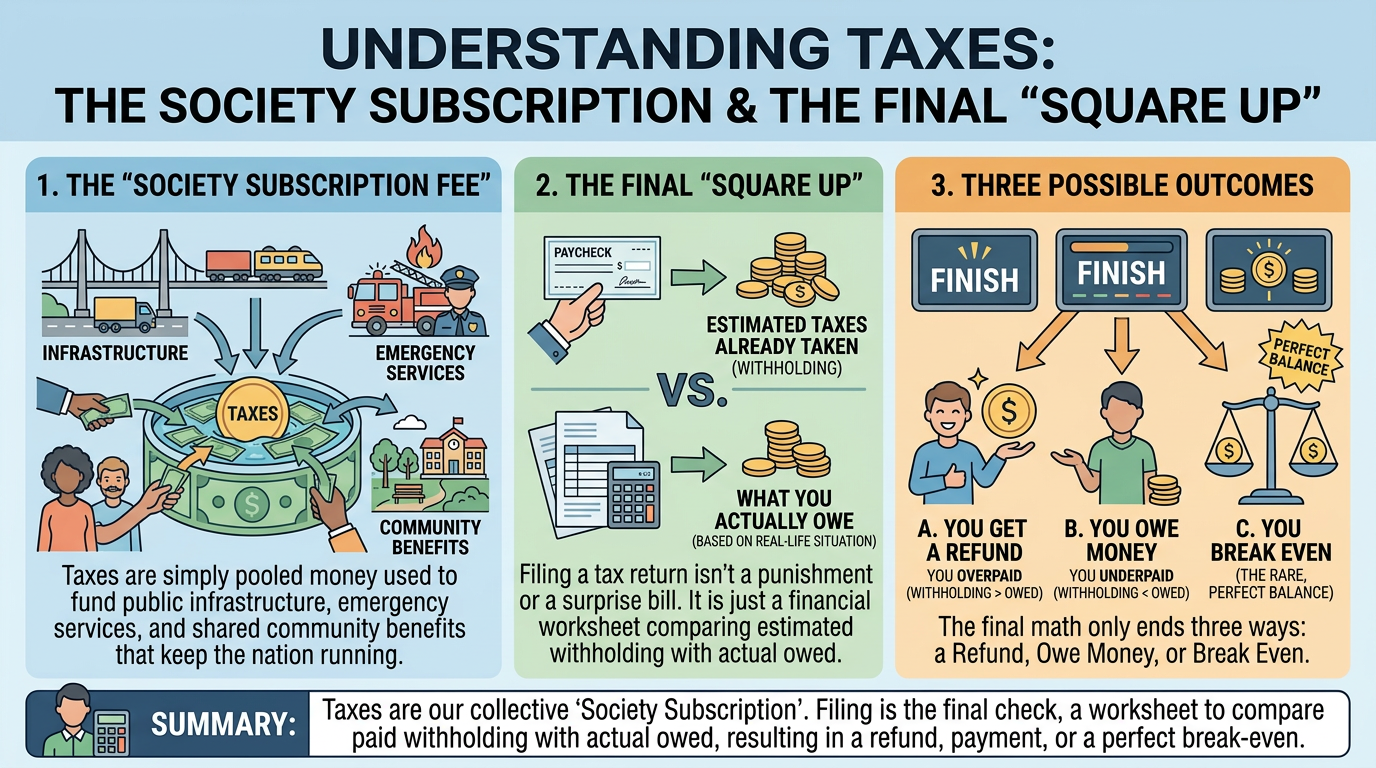
At its most basic level, taxes are the subscription fee for living in a civilized society.
Instead of every individual building their own roads, hiring their own personal firefighters, and funding their own military, we all pool our money together to pay for shared infrastructure. The government collects this money to keep the lights on for the nation.
While there are taxes on things you buy (sales tax) and things you own (property tax), the big heavyweight is income tax. This is the percentage of the money you earn, whether from a standard job, freelancing, or investments, that goes toward funding the federal and state governments.
The Mystery of the Tax Return
Many beginners think that "filing a tax return" means writing a giant check to the government every April. In reality, a tax return is just a grand final tally to see who owes who.
Throughout the year, money is automatically taken out of your paychecks and sent to the IRS (the Internal Revenue Service, the government’s collection agency). This is called withholding. Because the government does not want to wait until April to get its money, they take estimated bites out of your paycheck all year long.
However, your employer is just guessing how much you actually owe based on basic math. They do not know your whole life story. They do not know if you had massive medical bills, went to college, adopted a child, or donated to charity, which are all things that can lower your final tax bill.
Therefore, when you "file a tax return" between January and April, you are essentially filling out a giant worksheet that says:
"Hey IRS, here is exactly how much money I made last year, here is my life situation, and here is how much money you already took from my paychecks. Let's do the final math and square up."
The Three Final Outcomes
When you finish doing the math on your tax return, there are only three possible outcomes. It all comes down to a simple scale:
You get a Refund (The Government Owed You): If your employer withheld more money from your paychecks throughout the year than you actually owed, the IRS will send that extra money back to you. Keep in mind, this isn't free money, it's just a 0% interest loan you accidentally gave the government.
You Owe Money (You Owed the Government): If you didn't have enough money withheld from your paychecks, or if you made money from a side hustle where no taxes were taken out, you will have to pay the difference to the IRS.
You Break Even: In a perfect world, the amount withheld matches your exact tax bill down to the penny. This is rare, but it means you managed your money perfectly throughout the year.
Summary
In summary, taxes do not have to be terrifying when you understand that they are simply a community funding system where everyone chips in to keep society running. Because most of your taxes are taken out of your paycheck automatically during the year, filing a tax return isn't a punishment. Instead, it is just a final financial check-in to compare what you already paid against what you actually owe, allowing you to either claim a refund for overpaying or settle the difference if you underpaid.
