Speculative Assets: What They Are, Common Types, and Why They Matter
When you hear people talk about investing, they are usually talking about buying pieces of established companies or putting money into government bonds. These are traditional investments that grow slowly over time. However, there is an entirely different side of the financial world built around high risk and the potential for massive, rapid rewards. This is the world of speculative assets.
While they are not suitable for everyone, understanding how these assets work is crucial for grasping how the broader financial markets operate.
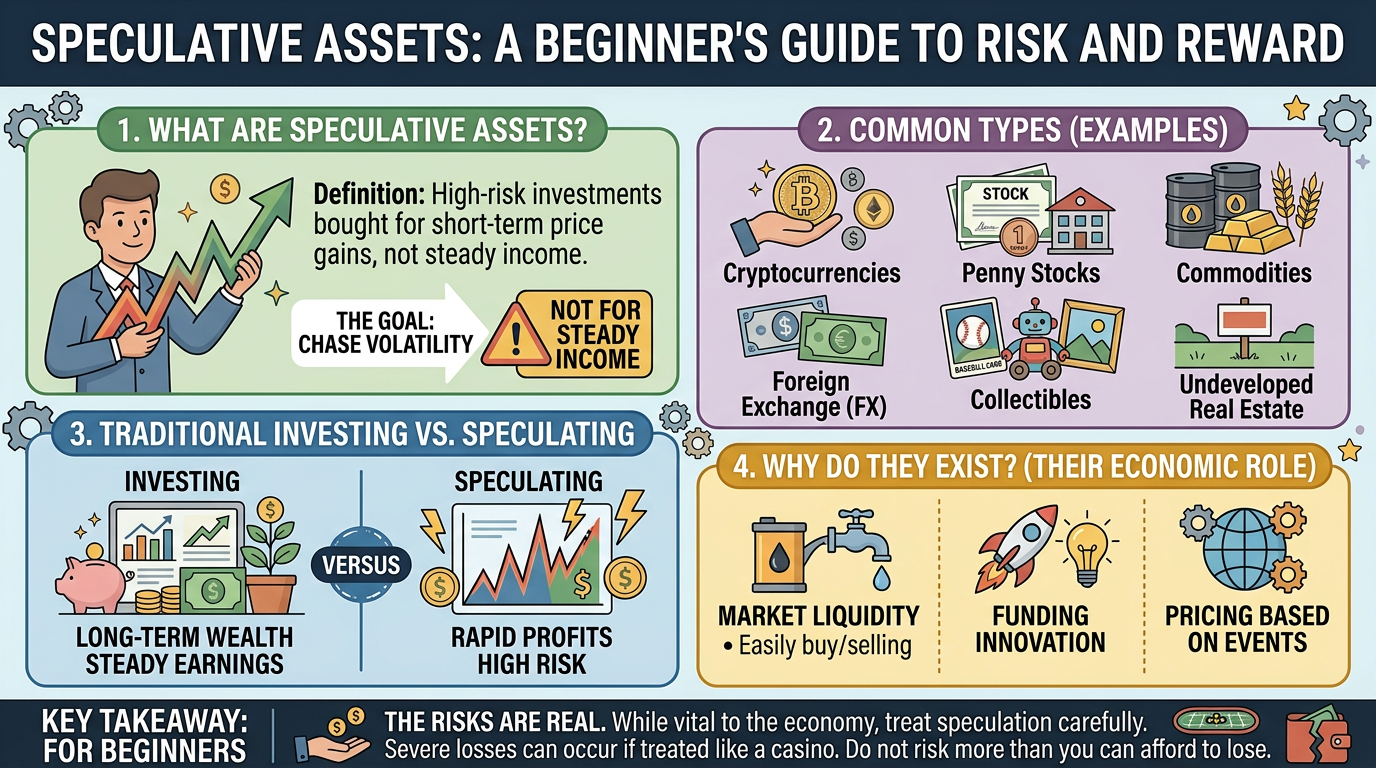
What is a Speculative Asset?
A speculative asset is an investment purchased primarily with the hope that its price will go up in the short term, rather than for the steady income it produces.
When you buy a traditional asset, like an apartment building or a stock in a major utility company, you expect to earn a steady stream of rent or quarterly dividends. The asset has value because it produces cash. Speculative assets, on the other hand, often do not produce any cash on their own. Instead, a speculator buys the asset believing they can sell it to someone else for a higher price in the near future. This is entirely driven by market trends, supply and demand, and momentum.
Common Types of Speculative Assets
Speculative assets come in many different forms, ranging from digital tokens to raw materials. Here are the most common types:
Cryptocurrencies: Digital currencies like Bitcoin and Ethereum are considered highly speculative. They do not produce earnings, and their prices fluctuate wildly based on peoples’ emotions and new technology trends.
Penny Stocks: These are very cheap shares (often trading for less than five dollars) of small, unproven companies. While they offer the chance to double your money quickly, the companies often fail, making them extremely risky. In this way, they are highly similar to angel investments, where rich individuals provide early-stage funding to brand new startups. In both scenarios, you are backing a highly unproven business with a high failure rate, operating on the gamble that a single massive success will wipe out your other losses.
Commodities: This includes physical goods like gold, silver, oil, and agricultural products. Traders speculate on commodities based on global events. For instance, if a speculator believes a harsh winter will destroy orange crops, they might buy orange juice futures (a contract to buy or sell an asset later at a price set today) hoping the price will spike.
Foreign Exchange (Forex): This involves trading the currencies of different countries. A trader might buy British pounds using US dollars, speculating that the value of the pound will rise compared to the dollar.
Collectibles and Fine Art: Rare coins, vintage cars, trading cards, and expensive paintings fall into this category. Their value is purely based on what a collector is willing to pay for them at any given time.
Empty Real Estate: Buying a plot of raw, undeveloped land and holding it in the hopes that a new highway or neighborhood will be built nearby is a form of real estate speculation.
Traditional Investing vs. Speculating
To make the difference completely clear, it helps to look at how a traditional investor and a speculator behave side by side.

The Importance of Speculative Assets
Because speculation involves so much risk, it is easy to assume it is just another form of gambling. However, speculators actually provide several vital services that keep the global economy functioning smoothly.
1. Adding Liquidity to the Market
Liquidity refers to how easily an asset can be bought or sold without affecting its price. Because speculators trade constantly, they ensure there is always money flowing through the market. If you want to sell a stock quickly, you can usually do so because a speculator on the other side of the trade is willing to buy it.
2. Transferring Risk
Many businesses use financial markets to protect themselves from risk, a practice known as hedging. For example, an airline company might want to lock in a specific price for jet fuel so a sudden spike in oil prices does not bankrupt them. They can lock in this price by trading with speculators. The speculator takes on the risk of the oil price changing, and the airline gets financial stability.
3. Funding Innovation
Speculators are willing to put their money into unproven ideas that traditional banks refuse to touch. Venture capitalists, who fund brand new startup companies, are essentially speculators. By taking a chance on risky new ideas, they help fund the technological breakthroughs and medical advancements of tomorrow.
4. Adjusting Prices
Speculators react instantly to new information. If a drought is announced in a major wheat-producing country, speculators will immediately start buying wheat. This drives the price up. While higher prices are frustrating for consumers, they act as an economic signal. The high price encourages people to conserve wheat and encourages farmers in other countries to plant more, which eventually solves the shortage.
5. A Warning Against Gambling
While speculators play a crucial role in the broader economy, it is vital to remember that participating in these markets on an individual level remains incredibly risky. The fact that speculation provides global financial benefits is not a justification to gamble with your own money. The vast majority of casual speculators lose their investments, and treating these highly volatile assets like a casino can quickly destroy your personal financial stability.
Summary
Speculative assets are high-risk investments bought with the hope of a quick profit rather than steady, long-term growth. While assets like cryptocurrencies, penny stocks, and commodities carry the real danger of massive losses, the people who trade them help keep the financial markets liquid, efficient, and innovative. They are the shock absorbers of the financial world, taking on the risks that everyday investors and businesses want to avoid.
