From Mine to Market: How Raw Materials Actually Reach You
The everyday objects you touch and use all trace their origins back to unrefined resources pulled directly from the ground. The copper wiring in your home, the steel frame of your car, and the plastic in your coffee maker all began their journey deep underground or out in a field. Getting these raw commodities out of the dirt and into your hands requires a global supply chain that operates around the clock.
Understanding this journey reveals the incredible scale of modern logistics, the physical reality of global trade, and the powerful economic incentives that make it all possible.
Extraction and Initial Processing
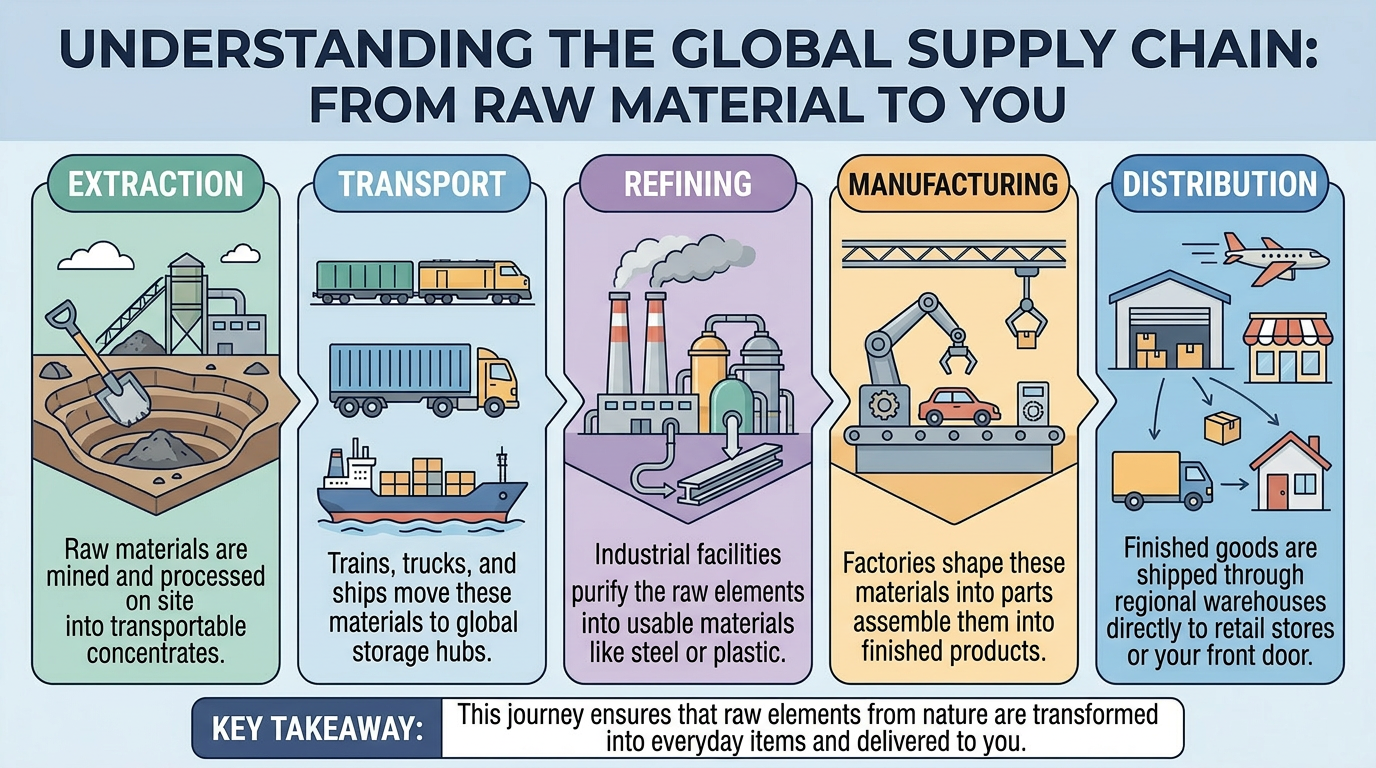
The journey begins at the source. Mining operations extract massive amounts of rock and ore from the earth. This is an incredibly capital intensive process, requiring billions of dollars in upfront investment for heavy machinery, labor, and geological surveys. Companies take on this massive financial risk for one simple reason: global demand. As populations grow and technology advances, the world is willing to pay a premium for the base elements of modern life.
However, raw ore is incredibly heavy and mostly composed of useless dirt. Transporting this completely raw material across the globe would be a massive waste of fuel and money. To solve this, companies crush and chemically treat the ore right at the mine site. This initial processing separates the valuable minerals from the waste rock. The result is a concentrated powder or slurry that is financially viable to transport over long distances, directly protecting the profit margins of the mining companies.
The Global Logistics Network
Moving thousands of tons of concentrated material from remote mines to industrial centers requires heavy lifting. This stage of the journey relies on a dedicated, high volume transport network.
You might wonder why a company would mine copper in South America just to ship it to Asia for processing. The answer comes down to an economic concept called comparative advantage. It is simply much cheaper to extract a mineral where it is naturally abundant and ship it to regions where factory labor and energy costs are highly competitive.
Specialized freight trains and heavy duty trucks haul the minerals from inland mines to coastal shipping ports. Once at the port, massive cranes load the materials directly into the deep holds of dry bulk carrier ships. These slow moving vessels cross the oceans and deliver the raw commodities to specialized storage terminals. Upon arrival, the materials wait in giant silos or outdoor stockpiles until refineries are ready to purchase and process them.
Refining and Component Manufacturing
Concentrated minerals are still not ready to be turned into consumer products. They must first go through complex refineries that use intense heat and chemical baths to purify them. During this stage, bauxite becomes aluminum, iron ore becomes steel, and crude oil becomes usable plastic.
This step is a prime example of value addition. By transforming raw dirt into a pure and usable material, refineries significantly increase the market price of the commodity. Once purified, these raw materials are sold to specialized manufacturers around the world.
A single factory rarely builds a product from scratch. Instead, various factories buy the refined metals and plastics to stamp, mold, and assemble them into specific components. Companies decentralize this manufacturing process to hunt for the lowest operational costs and the highest specialized skills, allowing them to keep final retail prices affordable for consumers. These components are then shipped to final assembly plants where they are put together to create the everyday items we rely on.
Distribution and Final Delivery
The final leg of the journey shifts from moving heavy bulk materials to transporting finished consumer goods. This is the critical moment where years of investment finally turn into realized profit.
Factories pack their completed products into standardized shipping containers. These recognizable steel boxes are stacked thousands high onto massive container ships and sent to regional distribution hubs across the globe. From the destination ports, trains and semi trucks move the goods to massive regional warehouses.
When you place an order online or a store needs to restock its shelves, the final step begins. Local delivery vans or retail supply trucks handle this last mile, bringing the finished products directly to your local store or your front porch. This final transaction fulfills the consumer demand that sparked the entire supply chain in the first place.
Summary
The path from a raw commodity to a finished product is a logistical and economic marvel. It requires an unbroken chain of heavy machinery, ocean crossing ships, high heat refineries, and precise factory assembly lines. Every time you purchase a new physical item, you are participating in the final step of a global journey. Your purchase provides the financial reward that motivates companies to keep moving literal mountains of earth halfway across the world.
