A Simple Guide to the Different Types of Commodities
The modern world is built on a foundation of raw materials. Before a product can be assembled, packaged, or sold on a retail shelf, its base components must be extracted from the earth or harvested from a field. These raw materials are known as commodities.
Because the global economy requires a massive variety of resources to function, the commodity market is broken down into specific categories. Understanding how these resources are classified makes it much easier to comprehend global trade, supply chains, and the daily price fluctuations that impact consumers everywhere.
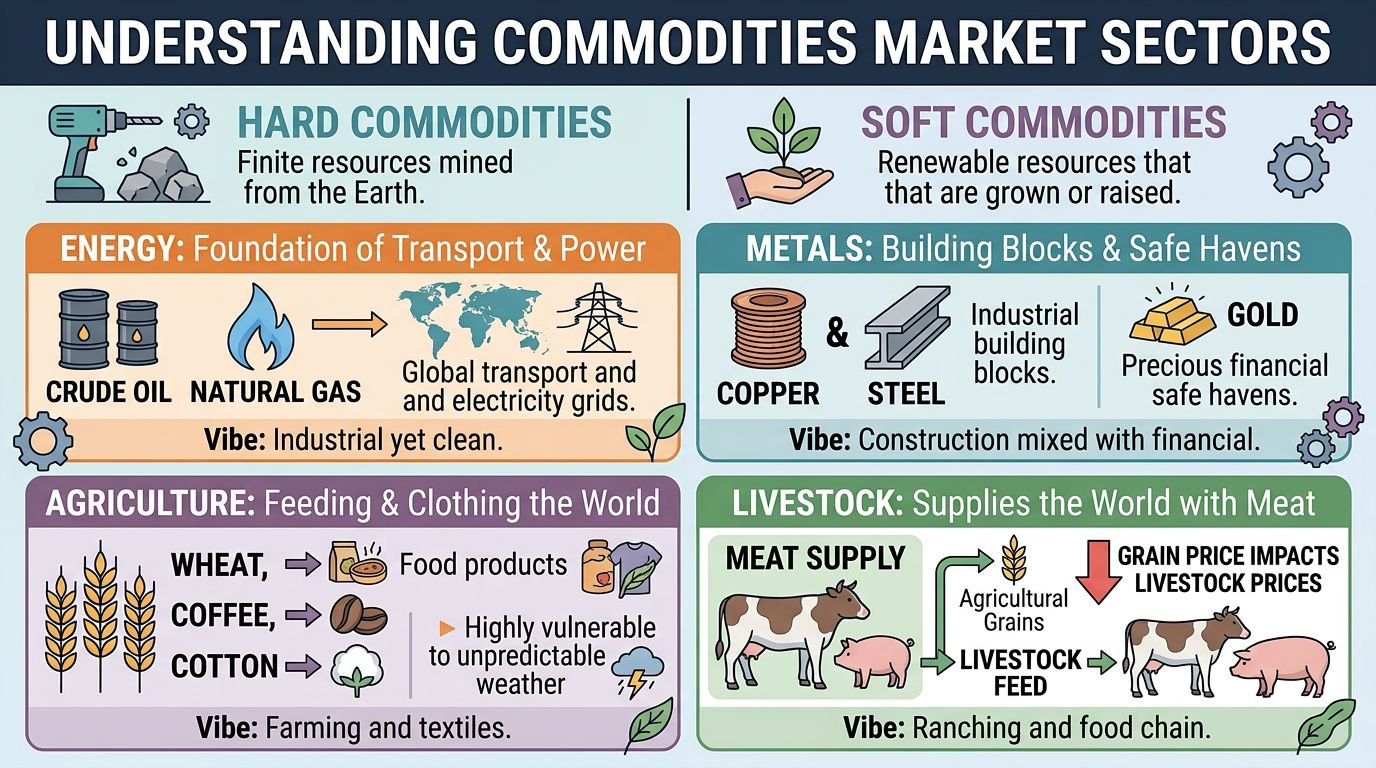
Understanding Hard Versus Soft Commodities
The most fundamental way to categorize global resources is to divide them into hard commodities and soft commodities. This split essentially defines how the material is produced and what kind of natural forces dictate its supply.
Hard commodities are resources that must be extracted or mined from the earth. These materials are heavily tied to geology. Because they take millions of years to form naturally, their supply is finite. Extracting them requires massive upfront investments in heavy machinery, drilling equipment, and refining infrastructure. The supply of hard commodities is generally predictable, but prices can fluctuate wildly based on geopolitics, labor strikes, or new technological demands. Oil, natural gas, copper, and gold all fall into this category.
Soft commodities are resources that are grown or raised. Instead of geology, these materials are entirely dependent on biology and climate. Soft commodities include agricultural crops and livestock. Because they are living things, their supply is renewable but also incredibly vulnerable to unpredictable forces. A sudden drought, a late frost, or an outbreak of disease can wipe out an entire season of production in a matter of days. This makes the pricing of soft commodities highly volatile and deeply tied to global weather patterns.
The Energy Sector and Powering the Economy
Energy is the undisputed anchor of the global commodity market. Without energy, it is impossible to mine other hard commodities, harvest agricultural fields, or transport goods across the ocean.
Crude oil is the most widely traded and influential commodity on the planet. It serves as the baseline for global transportation and logistics. The price of oil is so critical that the market actually tracks different grades of it. Brent Crude acts as the benchmark for oil produced in Europe, Africa, and the Middle East, while West Texas Intermediate serves as the standard for oil produced in the United States. When global conflicts threaten oil-producing regions, the entire global economy braces for impact because higher oil prices instantly increase the cost of shipping and manufacturing worldwide.
Natural gas and coal also play massive roles in this sector. Natural gas is the primary fuel used to generate electricity and heat homes during the winter. While the world is slowly transitioning toward renewable energy sources, the immediate daily functioning of the global grid still relies heavily on the constant extraction and burning of these fossil fuels.
Metals and the Building Blocks of Infrastructure
The metals sector encompasses everything from the structural bones of our cities to the microchips inside our smartphones. This category is generally divided into three distinct groups.
Industrial metals are the workhorses of the global economy. Copper, steel, and aluminum are required to build skyscrapers, lay electrical grids, and manufacture automobiles. Copper is especially important. Because it conducts electricity so efficiently, copper demand is often viewed as a reliable indicator of overall global economic health. When countries are building and expanding, the price of copper rises.
Precious metals serve an entirely different purpose. Gold and silver have industrial uses, but they are primarily traded as financial safe havens. When stock markets crash or inflation runs high, investors often buy gold to protect their wealth, treating it as a global currency that cannot simply be printed by a central bank.
Finally, the modern tech economy relies heavily on rare earth elements and specialized metals like lithium and cobalt. These materials are absolutely essential for manufacturing the high capacity batteries that power electric vehicles and consumer electronics. As technology advances, the rush to secure these specific metals has created an entirely new and highly competitive global mining market.
Agricultural Crops and the Global Trade of Softs
The agricultural sector feeds the world and clothes its population. These soft commodities are traded in massive volumes and are completely at the mercy of the changing seasons.
Grains like wheat, corn, and soybeans make up the bulk of this market. These crops are essential for human consumption, but they are just as important for maintaining global livestock populations. A poor corn harvest in the United States does not just make cereal more expensive. It disrupts the entire global food supply chain.
Beyond basic grains, the market trades heavily in what are traditionally known as softs. These are tropical or subtropical crops like coffee, cocoa, cotton, and sugar. These crops are geographically restricted, meaning they can only be grown in very specific climates near the equator. Because production is concentrated in a few specific regions, localized weather events have a magnified impact on global prices. If a severe frost hits the coffee growing regions of Brazil, the price of your morning cup of coffee will rise almost immediately worldwide.
Livestock and the Animal Protein Market
The final major category of commodities revolves around the animal protein market. This sector tracks the global trade of live animals and meat products, ensuring that grocery stores and restaurants stay supplied.
Trading in this sector is highly specific. The market separates animals based on their stage of development. For example, the cattle market trades both Feeder Cattle, which are younger cows that still need to gain weight, and Live Cattle, which are fully grown and ready for meat processing. The market also heavily trades Lean Hogs to supply global pork demand.
The livestock market is deeply interconnected with the agricultural crop market. Raising animals requires massive amounts of feed. If a drought causes the price of soybeans and corn to skyrocket, it becomes much more expensive for ranchers to feed their herds. To cut their financial losses, ranchers might sell their animals early, temporarily flooding the market with meat. However, this eventually leads to smaller herd sizes in the future, which drives the price of beef and pork higher over the long term.
Summary
The global commodity market is a vast and interconnected web of natural resources. Hard commodities like crude oil and copper provide the energy and infrastructure required to build modern civilization. Soft commodities like wheat, coffee, and livestock sustain the global population. While each sector reacts to different pressures, whether that is geopolitical conflict or unpredictable weather, they all work together to form the physical foundation of the world economy.
