A Comprehensive Yet Simple Guide to the FOMC and the Federal Reserve Chair
The United States economy is a massive, complex machine. To keep that machine running smoothly, the government relies on a central bank known as the Federal Reserve. Within the Federal Reserve, the most crucial decisions are made by a specialized group called the Federal Open Market Committee, often abbreviated as the FOMC. At the head of this committee is the Federal Reserve Chair, arguably the most powerful economic official in the world.
What is the FOMC?
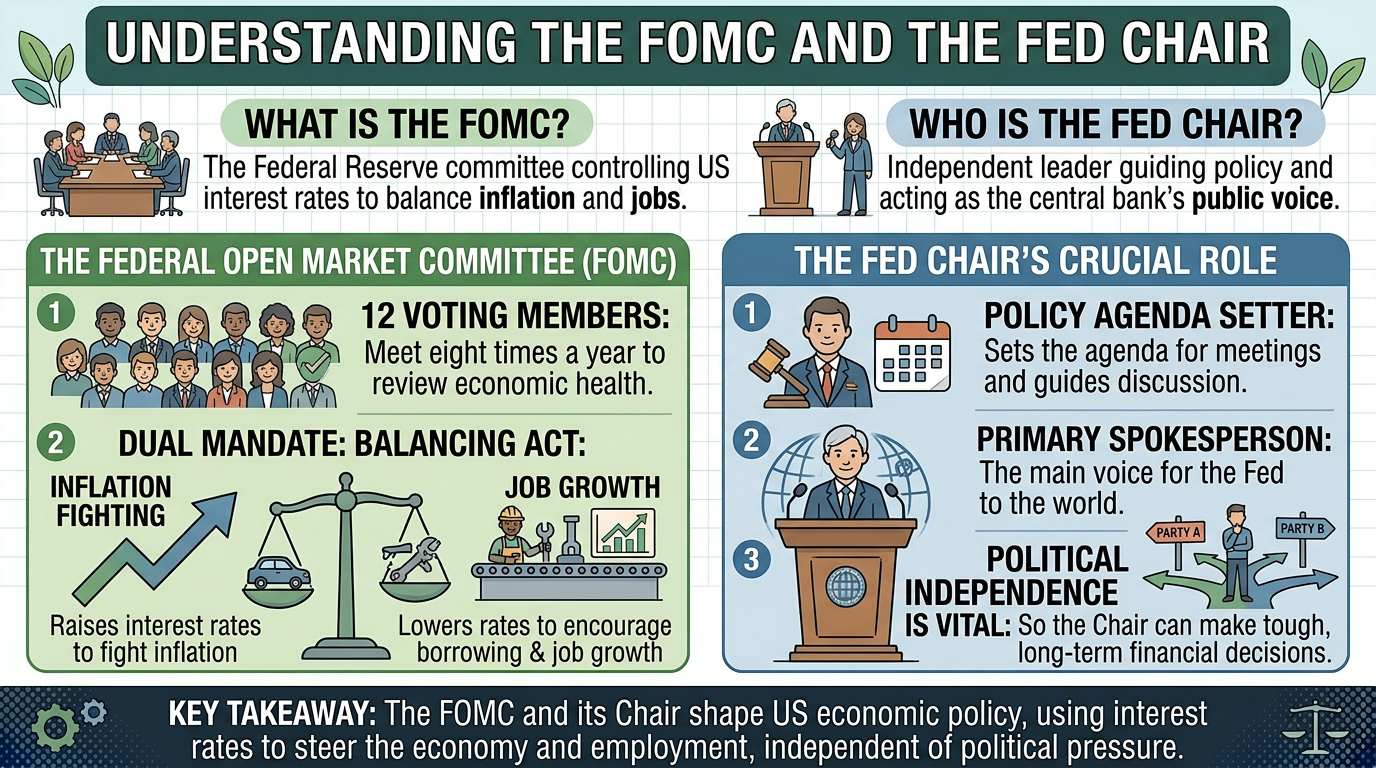
The Federal Open Market Committee is the branch of the Federal Reserve responsible for making key decisions about national interest rates and the growth of the United States money supply. You can think of the FOMC as the steering wheel for the entire economy.
Who Makes Up the Committee?
The FOMC consists of twelve voting members:
Seven Board of Governors: These individuals are appointed by the President of the United States and confirmed by the Senate to serve long terms.
The President of the New York Fed: Because New York is the financial capital of the country, this regional president always has a permanent voting seat.
Four Rotating Presidents: The remaining four voting spots rotate annually among the other eleven regional Federal Reserve Bank presidents.
What Does the FOMC Actually Do?
The committee meets eight times a year to assess the health of the economy. They look at job growth, inflation rates, consumer spending, and global risks. Based on this data, they decide whether to speed up the economy or slow it down.
Speeding Up: If the economy is doing bad and people are losing jobs, the FOMC will lower interest rates. This makes borrowing money cheaper, encouraging businesses to expand and consumers to buy homes and cars.
Slowing Down: If prices are rising too quickly (a situation known as inflation), the FOMC will raise interest rates. This makes borrowing more expensive, which cools down spending and helps stabilize prices.
The Role of the Federal Reserve Chair
If the FOMC is the steering wheel, the Federal Reserve Chair is the driver. The Chair is nominated by the United States President and confirmed by the Senate for a four-year term. While the Chair only casts one vote during FOMC meetings, their influence is massive.
Leading the Committee: The Chair sets the agenda for FOMC meetings, guides the debates, and works to build a consensus among the voting members.
The Face of the Fed: The Chair acts as the primary public spokesperson for the central bank. Their press conferences are watched globally, as every word they say can instantly move the stock market.
Testifying to Congress: The Chair regularly reports to the United States Congress on the state of the economy and explains the decisions the central bank is making.
The Importance of Independence
A crucial aspect of the Federal Reserve Chair is their political independence. Because politicians often want to keep interest rates low to please voters in the short term, the central bank operates independently to make difficult, long-term economic decisions without political interference.
How Their Decisions Affect You
The actions of the FOMC and the Chair are not just abstract financial concepts. Their decisions ripple directly into your wallet.
Mortgages and Auto Loans: When the FOMC raises its target interest rate, commercial banks immediately raise the rates on mortgages, car loans, and credit cards.
Savings Accounts: A higher Fed rate means banks will pay you more interest on your high-yield savings accounts and certificates of deposit.
Job Security: The delicate balance the FOMC attempts to strike directly impacts how aggressively businesses hire new workers or whether they begin laying people off to cut costs.
Summary
The Federal Open Market Committee is the specialized team tasked with managing the economic health of the United States. Guided by the Federal Reserve Chair, this group uses interest rates to balance inflation and employment. By understanding who they are and how they operate, you can better predict how global financial shifts will eventually impact your personal budget, savings, and borrowing costs.
