The Billion-Dollar Pixel: A Simple Guide to In-Game Economies
For decades, video games were simply a form of entertainment. You bought a game, played it, and that was the end of the transaction. Today, however, the landscape has completely transformed. Massive multiplayer games have developed their own complex, breathing economies where digital swords, virtual gold coins, and brightly colored weapon skins are actively traded for real-world money.
What began as a niche hobby for hardcore gamers has exploded into a multi-billion-dollar global financial sector. To understand how a purely digital item can be worth thousands of real US dollars, we have to look at the mechanics of in-game economies, why people value them, and how games like World of Warcraft and Counter-Strike 2 became virtual stock markets.
Why Do Virtual Items Have Real Value?
It is easy to dismiss virtual items as "just pixels on a screen," but in economics, value is dictated by human demand and scarcity. Virtual items hold real-world value for the exact same reasons physical items do:
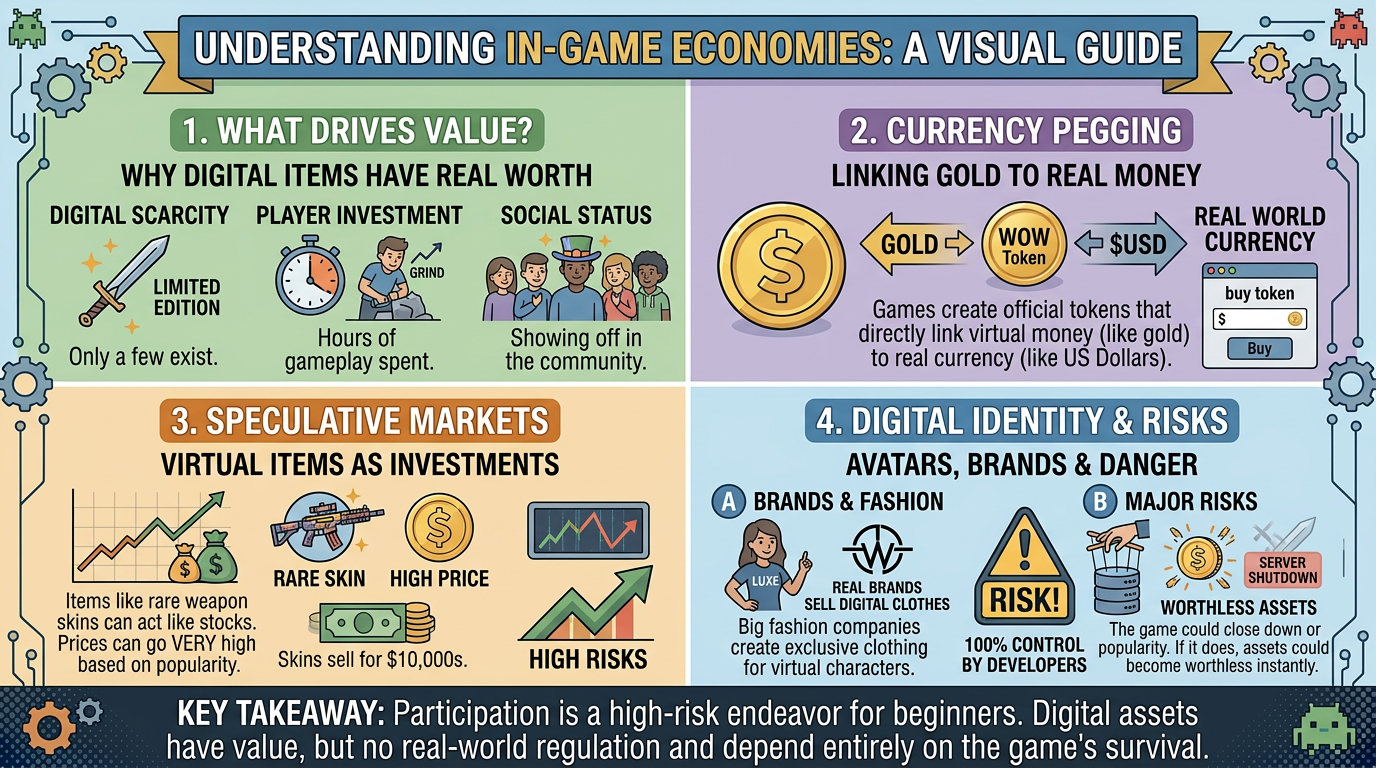
Scarcity and Rarity: Game developers intentionally limit the supply of certain items. If only 100 people in a game of 10 million players have a specific dragon mount, that mount becomes highly desirable.
Time and Effort: In many games, acquiring wealth requires hundreds of hours of repetitive tasks (known as "grinding" or "farming"). Players with high-paying real-world jobs are often willing to pay real money to skip the grind and instantly buy the items they want from other players.
Social Status: Just as people buy Rolex watches or designer handbags in the real world to signal wealth, gamers buy expensive digital cosmetics to stand out and signal status to their peers within virtual worlds.
World of Warcraft: The Blueprint of Virtual Gold
Launched in 2004, World of Warcraft (WoW) was one of the first games to demonstrate the massive real-world power of a virtual economy. In Azeroth (the game's universe), players use digital gold to buy armor, potions, and mounts.
The Rise of Gold Farming
Because earning gold takes significant time, a massive black market emerged early on. "Gold farmers", often workers in developing nations operating out of internet cafes, would play the game for 14 hours a day, amass huge amounts of digital gold, and illegally sell it to Western players for real US dollars. In some countries, farming WoW gold became a more lucrative real-world profession than local physical labor.
The WoW Token
To combat the black market, Blizzard Entertainment (the game's developer) legitimized the exchange of real money for virtual gold by introducing the "WoW Token."
A player can buy a WoW Token from Blizzard for $20 USD.
They can then sell that Token on the in-game auction house to another player for virtual gold.
The player who buys the Token with their in-game gold can redeem it for a month of actual game subscription time or real-world Blizzard account balance.
This officially pegged the value of WoW gold to the US dollar. Today, the WoW economy is tracked by financial analysts just like a real-world currency, complete with its own inflation rates, market crashes, and complex trading strategies.
Counter-Strike 2 (CS2): The Wall Street of Gaming
While World of Warcraft built an economy on currency, Counter-Strike 2 (CS2) built a multi-billion-dollar empire on pure cosmetic aesthetics.
In CS2, players can acquire "skins", which are digital paint jobs for their virtual guns and knives. These skins do not make the player shoot faster or aim better; they are purely for show. However, because players can freely trade these items with one another on the Steam marketplace and third-party websites, they have become highly speculative financial assets.
How the CS2 Market Works
The Loot Box System: Players pay real money to open digital "cases," which act like slot machines. You might get a common skin worth $0.03, or you might get an incredibly rare knife worth $2,000.
Market Dynamics: Because the supply of rare skins is strictly controlled by Valve (the game's developer), their prices fluctuate based on global supply and demand. Wealthy private collectors, known as "market sharks," routinely buy up hundreds of copies of a specific skin to artificially reduce supply and drive the price up.
Real-World Value: The CS2 market is staggering in its scale. Rare cosmetic knives routinely sell for $10,000 to $50,000, and the absolute rarest items, like specific patterns of the "Dragon Lore" sniper rifle or the "Blue Gem" knife, have been valued at over $1 million USD.
Throughout 2025 and 2026, the CS2 market saw extreme volatility. When the developer changed the rules on how certain items could be crafted, the prices of previously expensive knives plummeted, while other items skyrocketed. It operates exactly like a real-world stock market, complete with day traders, market manipulation, and sudden financial crashes.
The Metaverse and Digital Cosmetics: Fortnite and Roblox
Beyond hardcore economies like CS2 and WoW, the concept of virtual value has fundamentally shifted how younger generations view commerce. In platforms like Fortnite and Roblox, the economy is centered around digital identity.
Children and teenagers today socialize inside these games. Therefore, having a unique digital outfit (a "skin") is just as important as wearing trendy clothes to a physical school. Recognizing this, massive real-world brands like Nike, Gucci, and Balenciaga now design and sell exclusive digital clothing lines inside these games. A player might spend $15 of real money to buy a digital Gucci bag for their Roblox avatar, creating a massive new revenue stream for the fashion industry that requires zero physical manufacturing.
The Risks of Virtual Economies
While the idea of making real money from digital items is enticing, participating in these markets is incredibly risky.
Centralized Control: Unlike physical assets or cryptocurrency, in-game items belong to the game publisher. If Valve or Blizzard decides to ban your account, shut down the game servers, or change the drop rate of an item, your digital portfolio can drop to zero dollars overnight. You are entirely at the mercy of the developer.
Lack of Regulation: Virtual item markets operate largely outside the jurisdiction of the SEC or traditional financial regulators. This makes them breeding grounds for scams, market manipulation, and money laundering.
High Volatility: Because these items have no intrinsic real-world utility, their value is completely dependent on player sentiment. If a game loses popularity, the demand for its items vanishes, and the market crashes.
Summary
In-game economies have shattered the boundary between virtual entertainment and real-world finance. By leveraging scarcity, social status, and the desire to save time, games like World of Warcraft and Counter-Strike 2 have created billion-dollar markets where digital items are traded like precious metals and company stocks. While they represent a fascinating evolution in how humans assign value, they remain highly unregulated and volatile ecosystems controlled entirely by the corporations that built them.
