Cardboard Gold: A Guide to Trading Cards as Speculative Assets
When you think of investing, you probably picture Wall Street or digital crypto wallets. However, one of the most explosive speculative markets in recent years involves simple pieces of printed cardboard. Trading cards, spanning sports heroes and fantasy monsters, have transformed from childhood hobbies into high-stakes financial assets.
Understanding this market requires looking at what gives paper intrinsic value, how new releases shift the economy, and how different card communities drive demand.
Why is Cardboard Valuable?
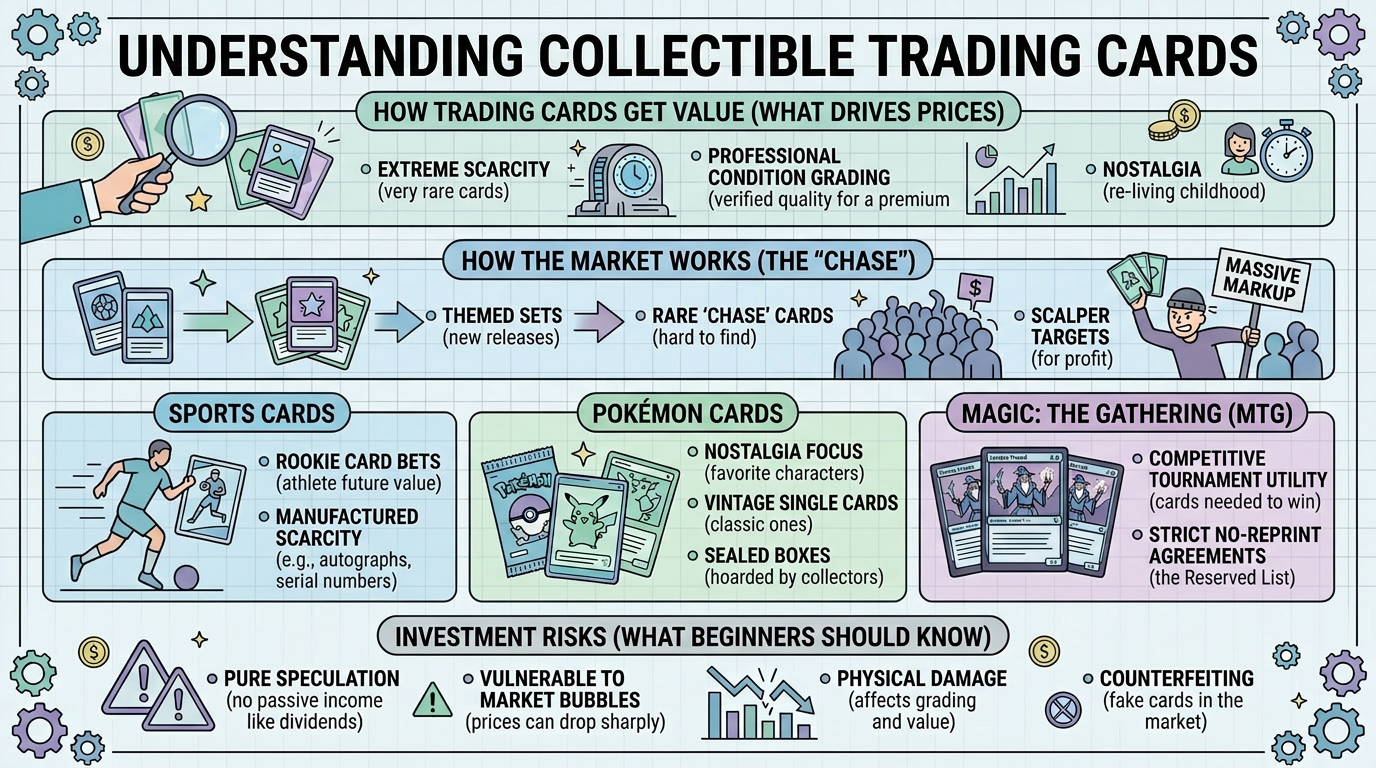
Before diving into specific types of cards, it is important to understand what gives a trading card real-world value. The market is heavily driven by three main factors: scarcity, condition, and nostalgia.
A card is worth more if very few copies exist. Manufacturers create scarcity by printing limited runs or including incredibly rare cards in randomized packs.
Condition is equally important. A card fresh out of a pack is worth exponentially more than one that was played with. Collectors use professional grading companies like PSA or Beckett to authenticate and assign a number grade to a card, usually from 1 to 10. A perfect grade can be worth ten times more than a slightly lower grade.
Finally, people spend large amounts of money to reclaim pieces of their childhood or to own a piece of cultural history.
The Engine of the Market: Sets and Scalpers
To understand trading card prices, you also need to understand how cards are brought into the world and who is buying them. Trading cards are not printed randomly. They are released periodically in themed waves known as sets. Each set features a specific checklist of cards. A set's overall popularity is usually driven by its chase cards. These are the rarest and most highly anticipated cards in that specific release. If a new set contains a highly desired chase card, the price of unopened packs from that set will surge.
Because of the massive hype surrounding popular new sets, the market frequently deals with scalpers. Scalpers are individuals who use automated bots online or physically line up at retail stores to buy out all the unopened boxes of a new set the moment it hits the shelves. By completely wiping out the retail supply, scalpers create artificial scarcity. This forces regular collectors and players to buy the boxes from them on secondary marketplaces like eBay or TCGPlayer at heavily marked-up prices.
Sports Cards: Betting on Human Performance
Sports cards are the original physical speculative asset. While baseball cards started as promotional items in cigarette packs, modern sports cards are highly engineered financial products. The most sought-after sports cards are Rookie Cards, which are printed during a player's first professional season. When a speculator buys a rookie card of a promising young basketball player, they are essentially buying stock in that player's future career. If the player wins a championship, the demand for their rookie card skyrockets. If the player suffers an injury, the card's value crashes.
Modern sports sets also feature manufactured scarcity. Companies print cards with actual pieces of player jerseys embedded in them or cards physically autographed by the athlete. Some cards are serialized, meaning only a specific number are ever printed globally.
Pokémon: The Pop Culture Behemoth
The Pokémon Trading Card Game represents the power of global nostalgia. Unlike sports cards, which rely on real-world athletic performance, Pokémon card values are driven entirely by character popularity and historical significance.
The most famous example is the First Edition Base Set Charizard from 1999. Because so many children played with these cards in the schoolyard, finding one in perfect, unplayed condition today is incredibly rare. High-grade versions of this specific card have sold for hundreds of thousands of dollars.
Speculators in the Pokémon market do not just buy individual cards. Many buy sealed products from popular sets, holding these unopened booster boxes in closets or vaults for years. They bet that as the set goes out of print, other collectors will eventually pay a premium just for the nostalgic thrill of opening old packs.
Magic: The Gathering (MTG): The Player's Economy
While Pokémon is primarily driven by collectors, Magic: The Gathering has an economy heavily influenced by the actual game being played.
In this game, cards are used to compete in tournaments. If a specific card from a new set proves to be incredibly powerful in the game, thousands of players will suddenly want to buy it to improve their decks, causing the price to spike instantly. When a card naturally rotates out of competitive play or is banned by the game creators, its price plummets.
However, the game also has high-end collector items, most notably the Reserved List. This is a legally binding promise made by the game developers never to reprint certain cards from the game's earliest sets. Because the supply is permanently capped, these cards function similarly to high-end art, often selling for massive sums.
The Speculative Reality and Risks
Treating trading cards as investments is a pure form of speculation. These items do not produce dividends or interest. Their entire financial premise is based on the idea that you can buy a piece of cardboard today and eventually find someone willing to pay more for it tomorrow based on hype, set popularity, or limited supply.
The risks in this market are severe and come in several forms:
Market Bubbles: During the pandemic, influencers, scalpers, and investors flooded the market, driving prices to record highs before demand collapsed.
Physical Damage: Physical assets come with physical risks. Cards can be ruined by sunlight, humidity, or accidental bends.
Fraud: The market is filled with sophisticated counterfeits, making professional authentication absolutely necessary before spending large amounts of money.
Summary
A trading card functions as a speculative asset because its price is dictated by strict scarcity, professional condition grading, and intense cultural nostalgia. Card values are heavily influenced by the release of new sets, which introduce highly sought-after cards and frequently attract scalpers who buy up retail inventory to resell at premium prices.
In the sports market, speculators buy rookie cards to bet on an athlete's future performance. Games like Pokémon are driven by global collector demand for historic cards and unopened boxes, while Magic: The Gathering prices fluctuate based on tournament utility and developer-enforced printing limits. Despite the potential for massive returns, this market is highly volatile, carries risks of physical damage, and does not generate traditional passive income, making it a pure gamble on future demand.
