Your paycheck lands somewhere, rent leaves from there, and your debit card is attached to it. You touch that account ten times a week, so the place holding it matters more than the interest it pays. Three kinds of institution compete for it, and underneath they are built very differently.
The Ownership Difference That Drives Everything Else
Most banks are companies. Shareholders own them, and they exist to earn those shareholders a profit through fees and through the gap between what they pay depositors and what they charge borrowers. A smaller group, called mutual savings banks, are owned by their depositors instead, but they are the exception.
A credit union is a cooperative owned by the people who keep money there. You do not really open an account, you buy a share, often for as little as $5. That makes you a part owner with one vote at the annual meeting, whether your balance is $80 or $80,000. No outside shareholders means a surplus has nowhere to go except back to members, as better loan rates, higher deposit rates or lower fees.
A neobank or money app is usually neither one. It is a technology company with a good app, and the deposits sit at one or more chartered partner banks it contracts with. The app is the front counter. Somebody else owns the vault.
What the Cooperative Structure Actually Buys You
Not-for-profit does not mean no profit. It means the profit belongs to members instead of investors. Credit unions also pay no federal corporate income tax, which lowers their costs, and federal ones work under a legal ceiling on the interest they can charge on most loans. Banks have no such ceiling.
You can check the result rather than trust it. The National Credit Union Administration, the federal agency that regulates them, publishes a quarterly table comparing average credit union and bank rates on the same products. Auto loans and credit cards are usually where the gap is widest.
The cost is reach. A credit union with eleven branches has eleven branches. Two things close most of that gap. Shared branching lets you walk into a different credit union's branch and transact on your own account. As of 2026 that network covers more than 5,000 branches and roughly 30,000 surcharge-free ATMs. Weak apps used to be the other complaint. Most small institutions now buy the same handful of vendor platforms, so that gap has narrowed. Read the app store reviews before you assume.
You Probably Already Qualify to Join One
Most people rule credit unions out over a rule that barely bites any more. Every credit union has a field of membership, meaning a defined group it is chartered to serve. There are usually four ways in:
Employer, either yours or a relative's.
Geography. Many charters accept anyone who lives, works, worships or goes to school in a set of counties.
Family. If a relative is already a member, you are generally eligible.
Association. Some charters include a nonprofit that anybody can join, occasionally for a small one-time donation.
Look for the "who can join" page on the website. Most credit unions let you stay a member after you move away or change jobs, so joining once tends to stick.
A Money App Is Usually Not a Bank
Deposit into a money app and your money moves to a partner bank, often into one large account held for the benefit of all that app's customers. The app keeps the ledger that says which of those dollars are yours.
This works fine most of the time. It explains three things. The name on the account agreement and the insurance is the partner bank, not the brand on your phone. The three types of institution are covered by different insurance programs, which the companion article on deposit insurance walks through. And when something breaks, the app's support chat is your only door. The partner bank has no relationship with you and will not take your call.
That last point is not hypothetical. Synapse, a middleware company sitting between several money apps and their partner banks, went bankrupt in April 2024, and its ledgers were wrong. More than 100,000 customers lost access to their money, some for over a year, and tens of millions were never accounted for. No bank had failed.
Choose By What You Actually Do With the Account
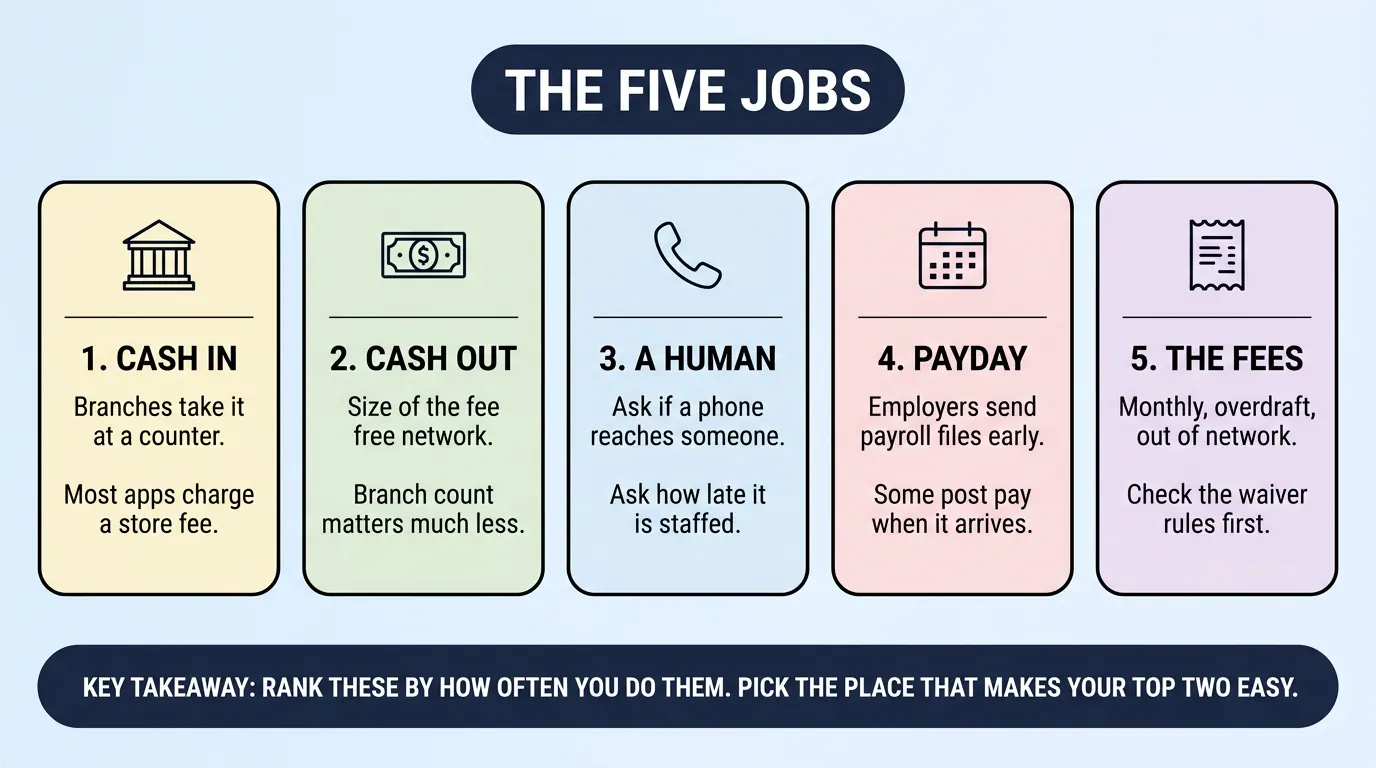
Rank these by how often you really do them, then pick the institution that makes the top two easy.
Deposit cash. Banks and credit unions take it at a counter. Most money apps route cash through a retail store network for a fee, and a few take none at all.
Take cash out. What matters is the size of the fee-free ATM network, not the branch count. Some accounts instead refund other banks' ATM fees up to a monthly cap.
Reach a person. Ask whether a phone number reaches a human, and how late it is staffed. You notice this on the night your card gets frozen.
Deposit checks. Mobile deposit is close to universal now. What varies is the hold, meaning how long before you can spend it.
Get paid early. Employers send payroll files ahead of payday. An institution that credits you when the file arrives, rather than on the settlement date, can post your pay a day or two early.
Fees. Monthly maintenance, overdraft, out-of-network ATM, and whatever balance or direct deposit you must keep up to get the monthly fee waived.
Using Two of Them on Purpose
Plenty of people end up with two, and it is a reasonable answer. A common split puts checking at a bank or credit union that takes the direct deposit and pays the bills, while a money app handles one narrow job.
If your main account is online-only, a small account at a local branch earns its keep the day you need to deposit cash, buy a cashier's check or get something notarized.
Two cautions. Transfers between institutions run on the ACH system and take one to three business days, so the balance has to sit in the account your rent leaves from. And each account has its own fee waiver rules, so splitting a direct deposit three ways can trigger a monthly fee at all three.