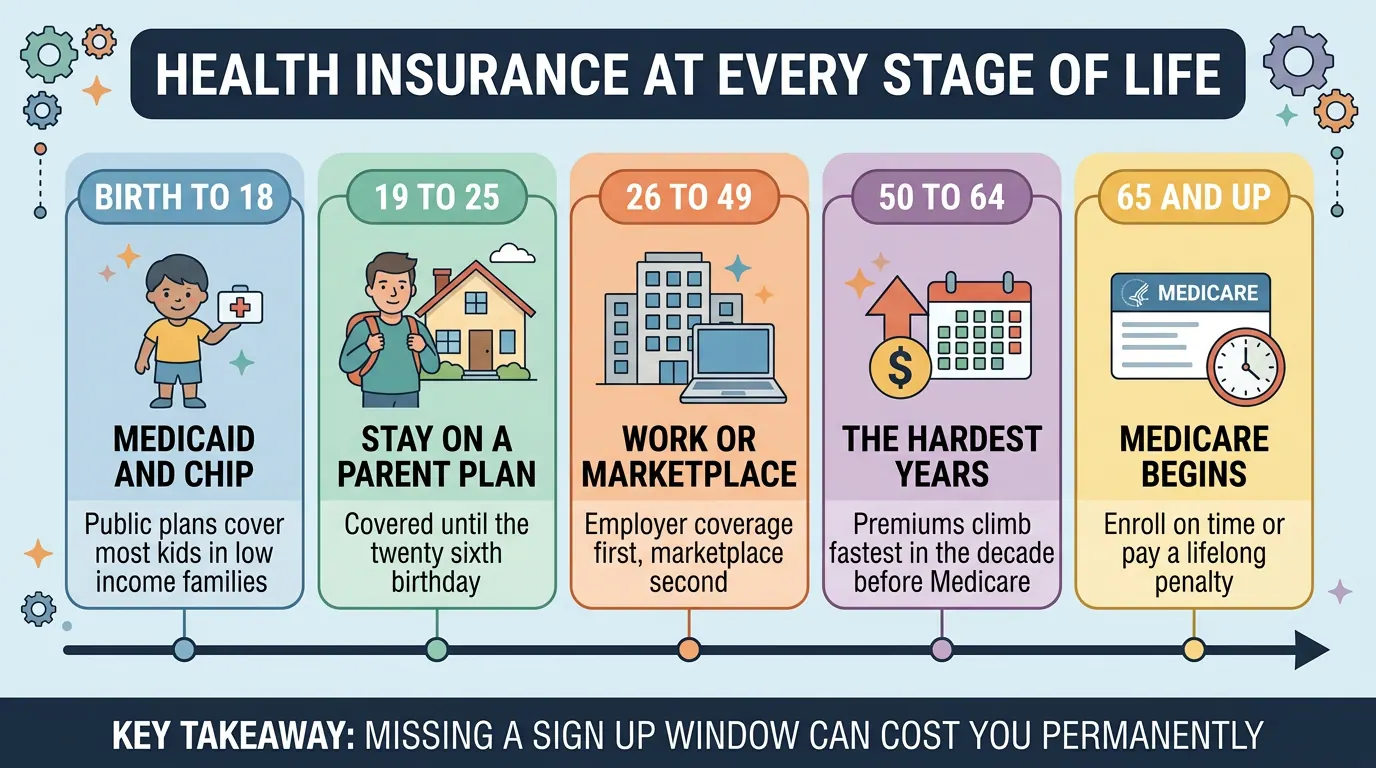
Health insurance is the only major purchase where the correct answer changes every decade of your life, usually without warning. The plan that made sense at 24 is unavailable at 27. The plan that worked at 45 becomes unaffordable at 60. At 65 the entire system you have been using gets replaced by a different one with its own vocabulary and its own deadlines.
Nobody tells you when these transitions arrive. Miss one and the penalty can follow you permanently.
This article walks through every life stage and what actually changes at each one.
Four Words You Will Need
Every option below is described with the same handful of terms, so they are worth pinning down first.
Premium. What you pay each month to have the plan, whether or not you use it.
Deductible. What you pay out of pocket for care before the plan starts paying. A $2,000 deductible means the first $2,000 of covered care is yours.
Coinsurance. After the deductible is met, the percentage split between you and the plan. At 20% coinsurance, you pay 20% of the bill and the plan pays 80%.
Out-of-pocket maximum. The annual ceiling on what you can pay for covered in-network care. Once you hit it, the plan pays everything for the rest of the year.
One more term appears constantly in eligibility rules. The federal poverty level, or FPL, is an income benchmark the government updates annually. For 2026 it is $15,960 for one person and $33,000 for a family of four. Almost every program below defines eligibility as a percentage of it, so "138% of FPL" means about $22,025 for a single person.
Birth to 18: Medicaid and CHIP
Children have the most generous eligibility rules in the American system, and most families who qualify do not realize it.
Medicaid covers children in low-income households. Above that, CHIP takes over, which stands for the Children's Health Insurance Program. CHIP exists precisely for families who earn too much for Medicaid and cannot afford private coverage.
The income cutoffs are much higher than people assume. The national median CHIP eligibility level is 255% of the federal poverty level, and some states extend to 317% or beyond. For a family of four, 255% is roughly $84,000 in 2026. A household earning that would almost certainly assume it does not qualify for anything.
CHIP is not free but it is close. States may charge modest premiums, often $20 to $50 per month for the whole family, with total costs capped at 5% of household income.
Two practical notes:
Pediatric dental and vision are required benefits under the Affordable Care Act, so children's coverage includes them even when adult plans do not.
A newborn triggers a special enrollment window, and coverage backdates to the date of birth. That window is usually 30 days on an employer plan and 60 on a Marketplace plan, so filing the paperwork a couple of weeks after the delivery is fine, but do not assume you have two full months.
There is no enrollment season for Medicaid or CHIP. You can apply any day of the year.
19 to 25: Stay on a Parent's Plan
Federal law requires any health plan that covers dependent children to keep covering them until they turn 26.
The rules are more generous than most families believe. You can stay on a parent's plan even if you are married, do not live with your parents, are not financially dependent on them, are not a student, or have a job that offers its own insurance. None of those disqualify you. Age is the only test.
This is usually the best coverage available to anyone in this age band, because someone else is paying the premium.
Coverage generally ends on your 26th birthday, though some plans run to the end of that month or that plan year. Find out the exact date at least a few months ahead, because losing it opens a 60-day window to buy your own plan and that window has a hard deadline.
26 to 49: Employer Coverage or the Marketplace
At 26 you are on your own, and for most people the answer is a job.
Employers with 50 or more full-time equivalent employees are required to offer coverage that meets federal affordability and value standards. For 2026, "affordable" means the employee's share costs no more than 9.96% of household income, which is the highest that threshold has ever been.
The reason to take employer coverage even when the deductible looks unappealing is that your employer pays most of it. In 2025, the average annual premium for single coverage was $9,325, and the average worker contributed $1,440. The employer covered the remaining $7,885, roughly 85% of the cost. That subsidy is real compensation and it does not exist anywhere else.
Two complications in this age band:
Waiting periods. New hires often wait up to 90 days for coverage to begin, and part-time work frequently does not qualify at all.
Self-employment. Freelancers and gig workers buy through the marketplace at HealthCare.gov and can deduct their premiums from taxable income. Be careful with products marketed as cheap alternatives. Short-term limited-duration insurance was capped by a 2024 federal rule at a three-month initial term and four months total, but regulators paused enforcement of that limit in August 2025 while they write a new rule, so the terms actually on offer may run longer depending on the insurer and your state. It can still deny you for pre-existing conditions, and it is not required to meet Affordable Care Act standards. It is a bridge across a genuine gap, not a substitute for coverage.
When you do shop a marketplace or employer menu, the plan type matters as much as the price:
HMO. In-network only, referrals required to see a specialist, no out-of-network coverage except emergencies. Cheapest.
PPO. No referrals, partial out-of-network coverage. Most flexible and usually most expensive.
EPO. In-network only like an HMO, but usually no referrals needed.
POS. Referrals required like an HMO, but some out-of-network coverage like a PPO.
50 to 64: The Hardest Years
This is the expensive gap, and in 2026 it got considerably worse.
Two forces stack against you here. The first is structural. Insurers are permitted to charge a 64-year-old up to three times what they charge a 21-year-old for the identical plan. That ratio is written into the law and it means your premium climbs every year regardless of your health.
The second is recent. Enhanced premium subsidies that had been in place since 2021 expired on December 31, 2025, and as of August 2026 Congress had not restored them. That restored what is called the subsidy cliff: earn one dollar over 400% of the federal poverty level, about $62,600 for a single person, and your premium tax credit drops to zero.
The cliff does not phase out. It falls off. Consider two 60-year-olds shopping the same plan:
Earning $62,000, roughly 396% of FPL, one pays about $6,175 for the year with a reduced credit.
Earning $64,000, roughly 409% of FPL, the other pays about $14,931 with no credit at all.
An extra $2,000 of income costs about $8,750 in premiums.
For couples the numbers get worse. A 60-year-old couple earning $85,000 saw their annual premium payments rise by more than $22,600, bringing coverage to roughly a third of their total income. Under the enhanced credits it had been about 8.5%.
Underlying premiums rose too. The benchmark silver plan went from an average $497 per month in 2025 to $625 in 2026, a 26% increase and the largest since 2018.
What to actually do about it:
Because subsidies are calculated on your projected income for the coverage year, reducing that income below the cliff can be worth five figures. Contributions to a health savings account or a traditional retirement account lower the figure that counts. For someone hovering near 400%, this is the highest-value hour of financial planning available to them.
If you are retiring before 65, your options are COBRA, a marketplace plan, or a spouse's employer plan. COBRA lets you keep your old employer coverage for up to 18 months but you pay the full premium plus a 2% administrative charge, which for family coverage can exceed $27,000 a year. Do not assume retiree coverage will be there either. Among large firms offering benefits to active workers, the share offering health benefits to Medicare-age retirees fell from 66% in 1988 to 24% in 2024.
65 and Up: Medicare
At 65 you leave the private system and enter Medicare, which has four parts and a vocabulary of its own.
Part A covers inpatient hospital stays, skilled nursing care, and hospice. About 99% of people pay no premium for it, because ten years of Medicare-covered work earns it outright.
Part B covers doctor visits, outpatient care, equipment, and preventive services.
Part C, called Medicare Advantage, is a private plan that bundles A and B together, usually with drug coverage included.
Part D covers prescription drugs.
What it costs in 2026:
Part A charges a $1,736 deductible per benefit period, which is per hospital admission rather than per year, so a bad year with two separate stays means paying it twice. Days 61 through 90 of a stay cost $434 per day. Skilled nursing days 21 through 100 cost $217 per day.
Part B costs $202.90 per month with a $283 annual deductible, after which you pay 20% coinsurance on most services. That 20% has no ceiling. Original Medicare contains no out-of-pocket maximum at all, which is the single most important thing to understand about it. A serious illness produces an unlimited 20% share.
Part D has a deductible of up to $615 and, since recent reform, a hard annual out-of-pocket cap of $2,100. Insulin is capped at $35 for a month's supply. The old coverage gap known as the donut hole is gone.
Higher earners pay surcharges on Parts B and D, and the surcharge is based on your income from two years earlier. Your 2026 premium is set by your 2024 tax return. The first threshold is $109,000 for a single filer and $218,000 for a couple, and crossing it by one dollar raises the Part B premium from $202.90 to $284.10, about $974 more over the year.
The Choice You Make Once
Because Original Medicare has no out-of-pocket ceiling, nearly everyone adds something to it. There are two paths.
Original Medicare plus Medigap plus Part D. Medigap, also called Medicare Supplement, is private insurance that pays the deductibles and coinsurance Medicare leaves behind. Plans come in standardized letters, and Plan G and Plan N are the usual choices now. Plans C and F are closed to anyone who became eligible on or after January 1, 2020. This path costs more monthly and lets you see any provider in the country who accepts Medicare, with no referrals and no prior authorization.
Medicare Advantage. A private plan, often with no premium beyond Part B, frequently including dental, vision, and hearing benefits Medicare itself excludes. It does have an out-of-pocket maximum, averaging $5,421 in-network in 2026. The tradeoffs are provider networks and prior authorization requirements. A majority of beneficiaries now choose this route: 35.2 million of 64.2 million eligible people, about 55%.
A rough cost picture for the first path. A 67-year-old earning $45,000 pays $202.90 monthly for Part B, about $2,435 for the year, plus the $283 deductible, plus roughly $150 monthly for a Plan G policy, plus about $35 monthly for a drug plan. That comes to roughly $4,900 annually, after which nearly all remaining hospital and medical cost-sharing is covered. Medigap and drug plan premiums vary widely by state and age, so treat those two as estimates.
What Medicare Does Not Cover
Long-term custodial care, most routine dental, routine vision and eyeglasses, hearing aids, and most care outside the United States.
That first exclusion is the expensive one. Medicare pays for up to 100 days of skilled nursing after a qualifying hospital stay, and nothing beyond that. Ongoing custodial care in a nursing home runs roughly $11,000 per month in 2026, and assisted living about $5,900. Medicaid covers long-term care but only after you have spent down your assets, subject to a five-year look-back on transfers.
If your income is limited, two programs help substantially. Extra Help reduces drug costs for people under 150% of the federal poverty level, about $23,940 for an individual in 2026. Medicare Savings Programs help pay Part A and Part B premiums, and qualifying for one automatically qualifies you for Extra Help.
Two Deadlines That Are Permanent
Most enrollment mistakes are recoverable. These two are not, and they both land at 65.
The Medigap window is six months long and does not reopen. It begins the first month you are both 65 and enrolled in Part B. During those six months, no insurer can deny you a Medigap policy, charge you more, or exclude you for any health condition. After it closes, most states allow full medical underwriting. A diagnosis in your late sixties can leave you unable to buy the coverage at any price. This is also why moving from Medicare Advantage back to Original Medicare years later can fail: the Advantage plan will take you back, but Medigap may not.
The Part B late enrollment penalty never expires. Delay without a valid reason and your premium rises 10% for every full twelve months you could have enrolled, for the rest of your life. Part D works similarly, adding 1% of a national base premium per uncovered month.
There is a legitimate exception. If you are still working at 65 and covered by an employer with 20 or more employees, that plan pays first and you can delay Part B penalty-free, with an eight-month window after the job ends. Below 20 employees, Medicare pays first and you should enroll on time. Get written confirmation of creditable coverage from your employer either way, because the burden of proof is yours.
Summary
Health insurance changes hands roughly five times across a life. Children qualify for Medicaid and CHIP at income levels far above what most families expect, with a median CHIP cutoff of 255% of the federal poverty level. Anyone under 26 can stay on a parent's plan regardless of marriage, residence, or having their own job offer. From 26 to 49 employer coverage is usually best because employers pay roughly 85% of single-coverage premiums. The years from 50 to 64 are the most expensive, made worse in 2026 by the expiration of enhanced subsidies and the return of a hard cliff at 400% of the federal poverty level. At 65, Medicare takes over, and two of its deadlines are permanent: the six-month Medigap window that never reopens, and a Part B late-enrollment penalty that raises your premium for life.