When gasoline jumps 40 cents in a month, the explanation on the news is usually that OPEC did something. Sometimes that is right. Often the group announced nothing at all, and the move came from a refinery fire in Texas or an inventory report that missed expectations by a few million barrels.
The commodities section covers how these markets work in general. This piece is about the machinery behind the number quoted for a barrel of crude.
What OPEC Is, and What OPEC+ Added
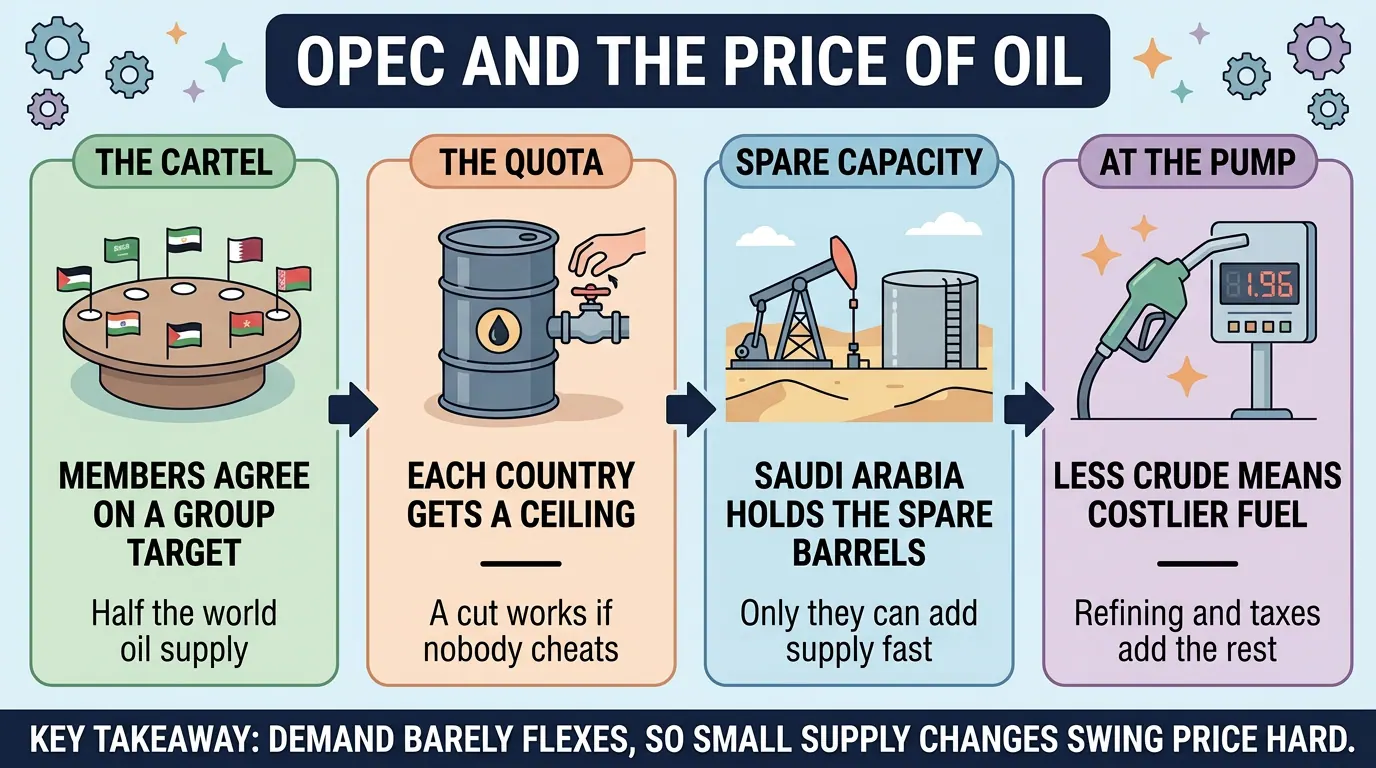
The Organization of the Petroleum Exporting Countries was founded in 1960 by five governments that wanted to face the international oil companies as a bloc rather than one at a time. It is a cartel in the plain sense: sellers coordinating output to influence price.
Membership churns. Angola left at the end of 2023, and the United Arab Emirates announced its exit effective May 1, 2026, the first departure by one of the group's largest producers. Saudi Arabia, Iraq, Iran, and Kuwait carry most of the remaining weight.
OPEC alone produces about 35 percent of the world's crude oil, and a smaller share of all liquid fuels once biofuels and natural gas liquids are counted, not enough to set a price by itself. That is why OPEC+ exists. Since 2016 the core group has coordinated with about ten non-members, Russia by far the most important. Together they account for something like 40 percent of global supply, which is enough to matter.
How a Quota Works
The group agrees on a total production target and divides it into a quota for each country, a ceiling on barrels per day. Cuts are announced as reductions from a baseline rather than as absolute output, which is why a headline about a "2 million barrel cut" rarely means 2 million fewer barrels reach the market.
Spare Capacity, and Why Saudi Arabia Matters Most
Spare capacity is oil a country could produce within about a month and sustain, but is choosing not to produce. It is the world's shock absorber, and probably the most important number in the market. When a war or a hurricane removes supply, spare capacity refills the gap.
Saudi Arabia holds most of it. Its maximum sustainable capacity is around 12 million barrels per day, and it has often produced two to three million below that. No other producer is close, which is why Saudi statements move prices more than anyone else's.
The relationship runs backwards from how people expect. Large spare capacity keeps the market calm during disruptions, because everyone knows the barrels exist. When it shrinks toward zero, a small outage anywhere can send prices up violently.
The Cartel's Permanent Problem
Every cartel faces the same trap. The agreement raises the price for everyone, and once the price is high, each member does best by quietly producing extra at that price. There is no court to sue in and no written penalty.
Enforcement runs on monitoring and reputation. Compliance is tracked through secondary sources, meaning independent tanker-tracking and survey estimates rather than each country's own reported figures, because members have obvious reasons to shade their numbers. Overproducers are asked to make compensating cuts later. Whether they do is another matter.
The deeper strain is that members want different things. A producer with a young population and heavy budget needs wants the highest price it can get now. One with large reserves and low costs would rather keep prices moderate to protect long-run market share.
Shale Changed the Game
OPEC's old pricing power rested on new supply taking years to arrive. A deepwater or oil sands project needs five to ten years and billions of dollars before the first barrel flows.
US shale broke that. A horizontal well in the Permian Basin can go from decision to production in months, and it declines quickly, so operators are constantly deciding whether to drill again. When prices rise, rigs go back to work within a year. When prices fall, drilling stops almost as fast. The United States is now the world's largest crude producer, so OPEC+ shares the swing-producer role with thousands of independent companies that answer to no quota.
WTI and Brent
West Texas Intermediate is light, low-sulfur crude priced at a landlocked tank farm in Cushing, Oklahoma. Brent is a blend of North Sea grades priced on the water, and it underpins most internationally traded crude. Brent usually trades a little above WTI, and the gap widens when US pipeline capacity is tight.
Why Small Supply Changes Move Price So Much
Oil demand is inelastic in the short run, meaning quantity barely responds to price. If gasoline doubles tomorrow, you still have to get to work. Estimates of short-run price elasticity generally land around minus 0.05 to minus 0.1, implying consumption falls a fraction of a percent when price rises 10 percent.
Turn that around and the consequence is stark. If supply drops 1 percent and consumers will not cut back, price has to rise a long way to squeeze out that last barrel of demand. A disruption of one or two million barrels per day, under 2 percent of world supply, can move crude 20 percent or more. Over years demand does adjust, which is why spikes usually fade.
Inventories and the SPR
Between production and consumption sits storage. The US Energy Information Administration publishes commercial crude inventories weekly, and a build or draw of a few million barrels against expectations routinely moves prices the same morning.
The Strategic Petroleum Reserve is separate: government-owned crude in salt caverns along the Gulf Coast, with physical capacity around 714 million barrels. It was drawn down heavily starting in 2022 to counter price spikes and has since run far below capacity. Refilling is slow and needs appropriated money, so it is best understood as an emergency buffer that has already been partly spent.
From Crude to the Pump
Crude oil is not gasoline. Getting from one to the other adds cost and delay.
Refining. A refinery buys crude and sells fuel, and the margin between them (the crack spread) widens when refining capacity is tight, which can raise pump prices while crude sits flat.
Taxes. The federal gasoline tax has been 18.4 cents per gallon since 1993, and state taxes add anywhere from a few cents to more than 60 cents. Two stations in different states can differ by half a dollar on tax alone.
Distribution and lag. Fuel already in the tank was bought at an older price, so pump prices follow crude by several weeks. The lag is asymmetric: prices tend to rise quickly when crude rises and fall more slowly when it falls, a pattern nicknamed rockets and feathers.
Summary
OPEC and its OPEC+ partners set quotas covering roughly 40 percent of world supply, with Saudi Arabia holding most of the spare capacity that absorbs shocks. Their power is limited by each member's incentive to cheat and by US shale, which adds or cuts barrels in months rather than years. Because short-run demand barely responds to price, small supply changes produce large price moves, and that price reaches your pump only after refining margins, taxes, and a lag of several weeks.