Gold is supposed to be the thing that holds its value when money does not. That is the entire pitch, and it is old enough that most people repeat it without ever looking at the record.
So look. Gold peaked near $850 an ounce in January 1980. Twenty years later it traded in the high $270s, having dipped as low as about $253 the year before, while US consumer prices roughly doubled. Anyone who bought gold in 1980 to protect against inflation lost about 70 percent of their money in plain dollar terms, and much more after adjusting for the inflation they were hiding from.
Now widen the window. Adjusted for inflation, that 1980 peak was not matched again until roughly 2025. Forty-five years is a long wait for break-even, but the metal got there, and across centuries gold has held its purchasing power reasonably well. Both stories are true. The space between them is the part worth understanding.
The commodities section already covers what makes something a commodity, so this piece takes gold on its own terms.
Why Gold Got the Job
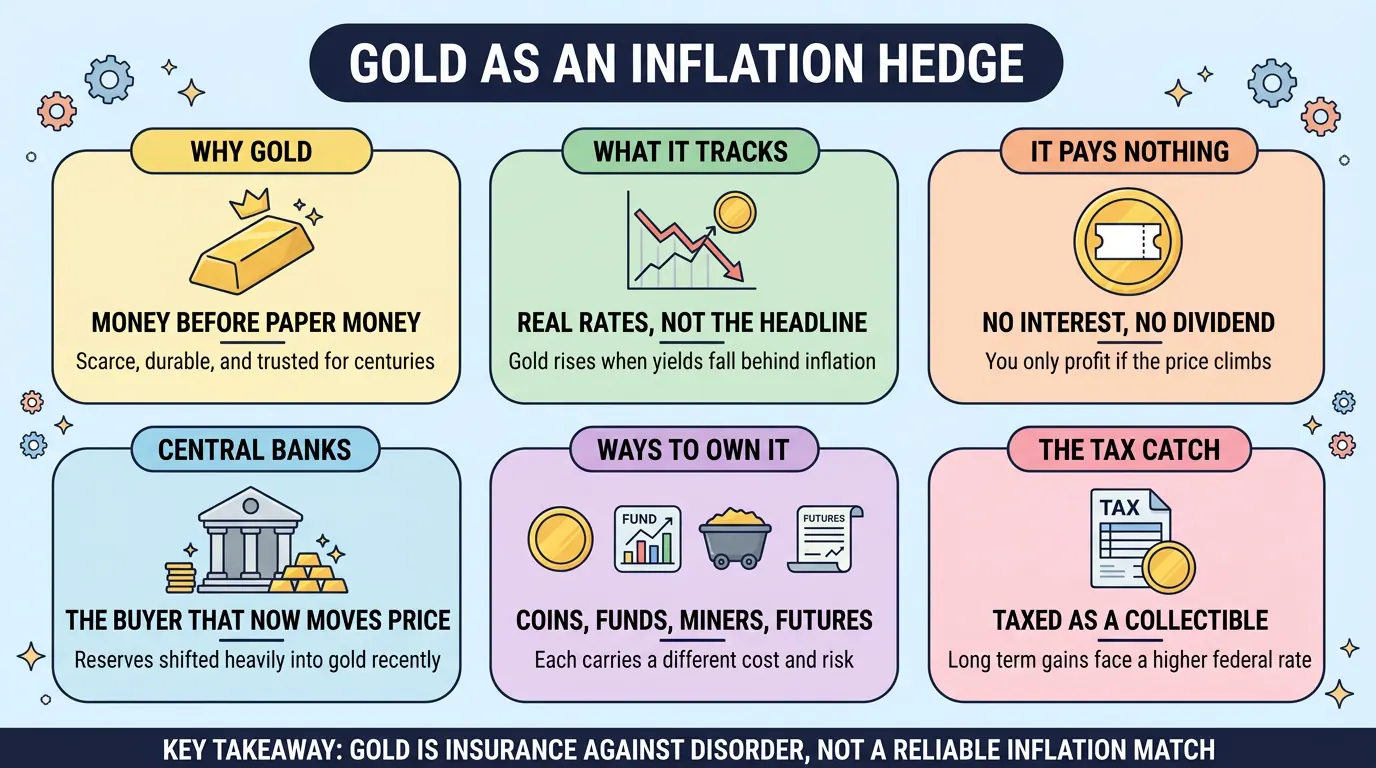
Gold does not rust or decay. It is scarce without being impossibly rare, anyone with basic equipment can melt, split, weigh, and verify it, and a great deal of value fits in a small space. Those physical facts are why so many unrelated societies landed on the same metal.
The financial argument is narrower. A bond is a promise from a borrower, a deposit is a promise from a bank, and a dollar is a liability of a central bank. Gold is nobody's promise, so no issuer can default on it, inflate it away, or freeze it. That absence of counterparty risk (the risk that whoever owes you fails to pay) is the honest core of the case.
The same feature is the cost. Because gold is nobody's obligation, nobody owes you anything for holding it. No interest, no dividend, no rent. A bar sitting in a vault for thirty years is still one bar.
What Gold Actually Tracks
Gold does not follow the consumer price index in any way you could trade on. Claude Erb and Campbell Harvey examined this in a 2013 paper called "The Golden Dilemma" and found that gold's inflation-adjusted price wanders enormously far from its own long-run average and comes back only over decades. Over five or ten years, the horizons investors actually care about, the link to realized inflation is weak.
Two other variables explain the price far better.
Real interest rates. The real rate is the yield on a safe bond minus expected inflation, roughly what an inflation-protected Treasury pays. When real rates are high, holding a metal that yields nothing is expensive and gold tends to struggle. When they fall toward zero, gold's zero stops looking like a penalty.
The US dollar. Gold is quoted in dollars worldwide, so when the dollar weakens against other currencies the dollar price of gold tends to rise even if nothing about gold has changed.
Treat both as tendencies rather than laws. The real-rate relationship broke down after 2022, when gold climbed through a stretch of high real yields that should have hurt it.
The Price of Owning Something That Pays Nothing
Put $10,000 into gold when Treasury bills yield 4 percent and you have given up about $400 of interest in the first year. Gold has to rise 4 percent just to match the boring alternative.
The drawdowns are real too. Past the twenty-year slide after 1980, gold fell from roughly $1,900 an ounce in 2011 to about $1,050 by late 2015, down around 45 percent, with no dividend arriving to soften it.
Central Banks Became the Buyer That Matters
Something changed in 2022. Central banks, which spent the 1990s selling gold, started buying it in volume, exceeding 1,000 tonnes a year in 2022, 2023, and 2024. The World Gold Council put 2025 net official purchases at 863 tonnes, down 21 percent from the prior year but far above the 2010 to 2021 average of about 473 tonnes. Poland was the largest single buyer in 2025.
The usual explanation is reserve diversification after Russia's foreign exchange reserves were frozen in 2022, which showed that reserves held as claims on other governments can be switched off. Gold in your own vault cannot be. For an individual investor the practical point is that a large share of demand now comes from buyers who are not watching CPI prints and will not sell because gold had a bad quarter.
Four Ways to Own It, and What Each Costs
Coins and bars. You pay a dealer premium above spot, commonly a few percent on large bars and more on one-ounce coins and small denominations, then sell back at a lower bid. That round trip is a real cost before storage and insurance.
Physically backed ETFs. A fund holds bullion in a vault and you own shares of the trust. Annual expense ratios generally run in the low tenths of a percent and tracking is close, but you own a share, not a bar.
Futures. Exchange-traded contracts carrying heavy leverage, covered in the derivatives section, where the risks are serious.
Mining shares. These are stocks, with management, debt, and political risk attached, and they can fall in years when gold rises.
The Tax Rate That Catches People Out
In the United States, gold is a collectible for tax purposes. Long-term gains on collectibles are capped at 28 percent rather than the 20 percent that applies to most other long-term capital gains.
That treatment follows the metal into the fund. Gold ETFs organized as grantor trusts holding physical bullion are taxed the same way, because the IRS looks through the trust to what it owns. Investors who assumed their ETF was taxed like a stock have been surprised at filing time.
Three qualifications. The 28 percent figure is a ceiling, not a flat rate, so a taxpayer in a lower bracket pays less. The 3.8 percent net investment income tax can apply on top for higher earners. And gold futures fall under a different regime entirely (Section 1256, with its 60/40 split between long-term and short-term treatment), which is one reason the vehicle you choose changes your after-tax result. Inside an IRA, none of this applies.
Summary
Gold has roughly kept pace with inflation over very long periods and failed at it for decades at a time, including the twenty years after 1980. Its price responds more to real interest rates and the dollar than to inflation directly, and since 2022 to central bank buying. It pays nothing, so each year you hold it you give up whatever safe interest you could have earned instead, and in a taxable US account long-term gains on bullion and on physically backed ETFs are taxed at up to 28 percent.