When the economy stalls, two different sets of people go on television and promise to fix it. One set is elected. The other is not. Both are trying to change how much money is moving through the economy, and they use completely different equipment to do it.
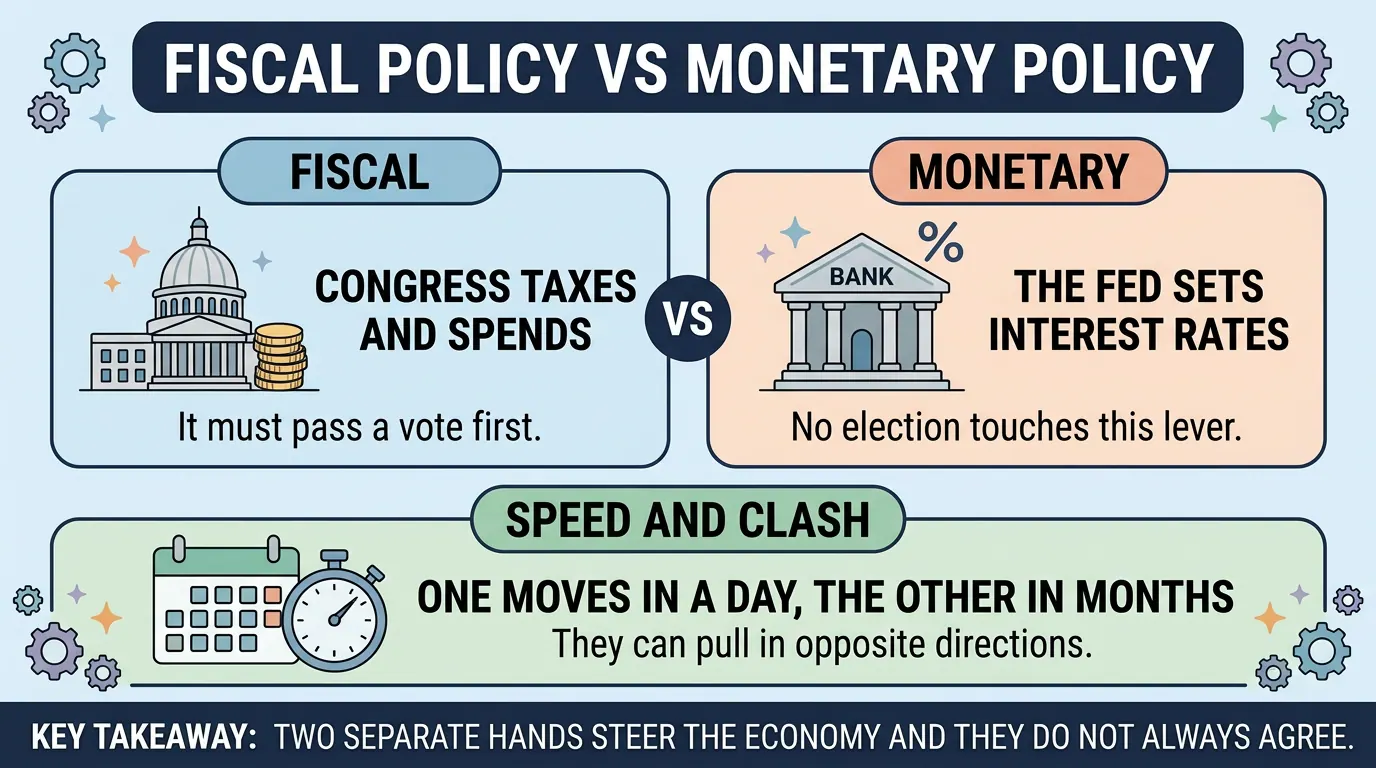
Those two toolkits have names. Fiscal policy is taxing and spending, run by Congress and the President. Monetary policy is the cost and supply of money, run by the Federal Reserve. Mixing them up is why a lot of economic news reads as noise.
The split between them was built on purpose.
What Each Side Actually Controls
Fiscal policy works through the federal budget. Congress writes tax law and decides what the government buys, and the President signs or vetoes it. The levers are tax rates, direct payments to households, unemployment benefits, defense purchases, and every other line in the budget. Money is either pulled out of the private economy through taxes or pushed into it through spending. The gap between the two is the deficit, covered by selling Treasury bonds.
Monetary policy works through the banking system. The Fed sets a target for the federal funds rate, the overnight rate banks charge each other, and it holds a large portfolio of bonds it can grow or shrink. It cannot tax anyone and it cannot mail a check to a household. All it can do is change what borrowing costs, then wait for banks and buyers to react.
A quick test for any policy you read about. If it needed a vote in Congress, it is fiscal. If it was announced by a committee nobody elected, it is monetary.
Why the Fed Is Kept Away From the Ballot Box
The Fed's seven governors serve 14-year terms, staggered so no single President appoints all of them quickly. It does not go to Congress for its budget either, funding itself out of interest earned on the bonds it holds. Those arrangements are not decoration.
The reason is timing. Cutting interest rates feels good immediately and costs something later, usually in the form of higher inflation. Elections happen every two years. Any official who controlled both the interest rate and their own reelection would face a standing temptation to make the economy feel warm right before November and leave the bill for whoever came next. Economists call this the time-inconsistency problem. Across countries, governments that set interest rates directly have tended to end up with higher average inflation.
The independence is operational, not constitutional. Congress created the Fed in 1913 and can change it by passing a law. What the Fed has is freedom over the rate decision, not immunity.
One Can Move on a Tuesday, the Other Takes Months
The Fed's rate-setting committee meets eight times a year and can act between meetings. In March 2020 it cut rates to near zero in two emergency moves, one of them announced on a Sunday afternoon, before most of the country had absorbed what was happening.
A spending bill cannot move like that. It has to be drafted, scored by the Congressional Budget Office, passed by both chambers, signed, and then actually spent by agencies that need contracts and staff. Infrastructure money can take years to reach a job site. A common criticism of the 2009 stimulus was exactly this, that much of the money went out after the recession had already ended.
The two tools have their lags in opposite places. Fiscal policy is slow to decide and fast to hit once the money goes out. Monetary policy is fast to decide and slow to hit, because a rate change works through borrowing decisions that take a year or more to reach hiring and prices.
The Part That Runs Without Anyone Voting
Some fiscal policy happens on its own. These pieces are called automatic stabilizers, and they are the fastest-acting part of the budget precisely because nobody has to agree on anything first.
Unemployment insurance. When people lose jobs, benefit payments start going out under existing law. No new bill required.
The progressive income tax. When incomes fall, tax bills fall faster than incomes do, so households keep more of what they still earn.
Programs such as SNAP and Medicaid, where enrollment rises automatically as incomes fall.
They run in reverse too. As employment recovers, benefit spending drops and tax receipts climb with no vote to withdraw support. Stabilizers cushion a downturn rather than reversing it, and they are one reason postwar recessions have been shallower than the contraction of the 1930s.
When the Two Pull Against Each Other
Nothing forces the elected side and the Fed to point the same direction. Congress can cut taxes and raise spending while the Fed is raising rates to slow inflation. Both are doing the job as they understand it, and the effects partly cancel.
The Fed treats the budget as an input it has to live with. If a spending package adds demand, the standard response is to hold rates higher than they otherwise would be. Total demand may land near where the Fed wanted it, but the mix inside it changes. High rates fall hardest on the parts of the economy that run on borrowed money, so housing, construction, and business investment absorb the squeeze while government-funded activity continues. Higher rates also strengthen the dollar, which makes American exports more expensive abroad.
The early 1980s are the textbook case. The Fed under Paul Volcker held rates high to break double-digit inflation while federal deficits widened. Inflation came down, the dollar rose sharply, and exporters took the brunt of it.
2020 to 2022, When Both Fired at Once
The pandemic response is the cleanest example of both tools moving hard in the same direction. Within weeks of March 2020 the Fed had cut its target to near zero and restarted large-scale bond buying. Congress passed the CARES Act, roughly $2.2 trillion, then another package that December, then the American Rescue Plan, roughly $1.9 trillion, in March 2021.
Output and employment recovered far faster than they had after 2008, when fiscal support was smaller and was pulled back sooner. Inflation then rose to its highest level in four decades.
How much of that came from the demand these policies created, and how much from the supply side (closed factories, snarled shipping, a semiconductor shortage, an energy shock after the invasion of Ukraine), is still contested among economists. Both were plainly present. Anyone who tells you the split has been settled is going further than the evidence does.
Summary
Fiscal policy is taxes and spending, controlled by elected officials who move slowly but can put money directly into people's hands. Monetary policy is the price of borrowing, controlled by a central bank kept at arm's length from elections so it can raise rates when doing so is unpopular. When the two work against each other, the composition of the economy shifts even if the total does not. When they work together at full strength, the effect can be large enough that economists are still arguing about it years later.