Leverage is usually explained with a sentence about how it cuts both ways, and then everyone moves on. That sentence is true and useless. It hides what actually ruins accounts: the two directions are not symmetric in time.
When a leveraged position moves your way, nothing happens. Nobody calls. When it moves against you, a clock starts, and it does not care whether you turn out to be right in six months.
This piece assumes you have read the options and futures articles. It is about what borrowed exposure does to a position, whatever instrument carries it.
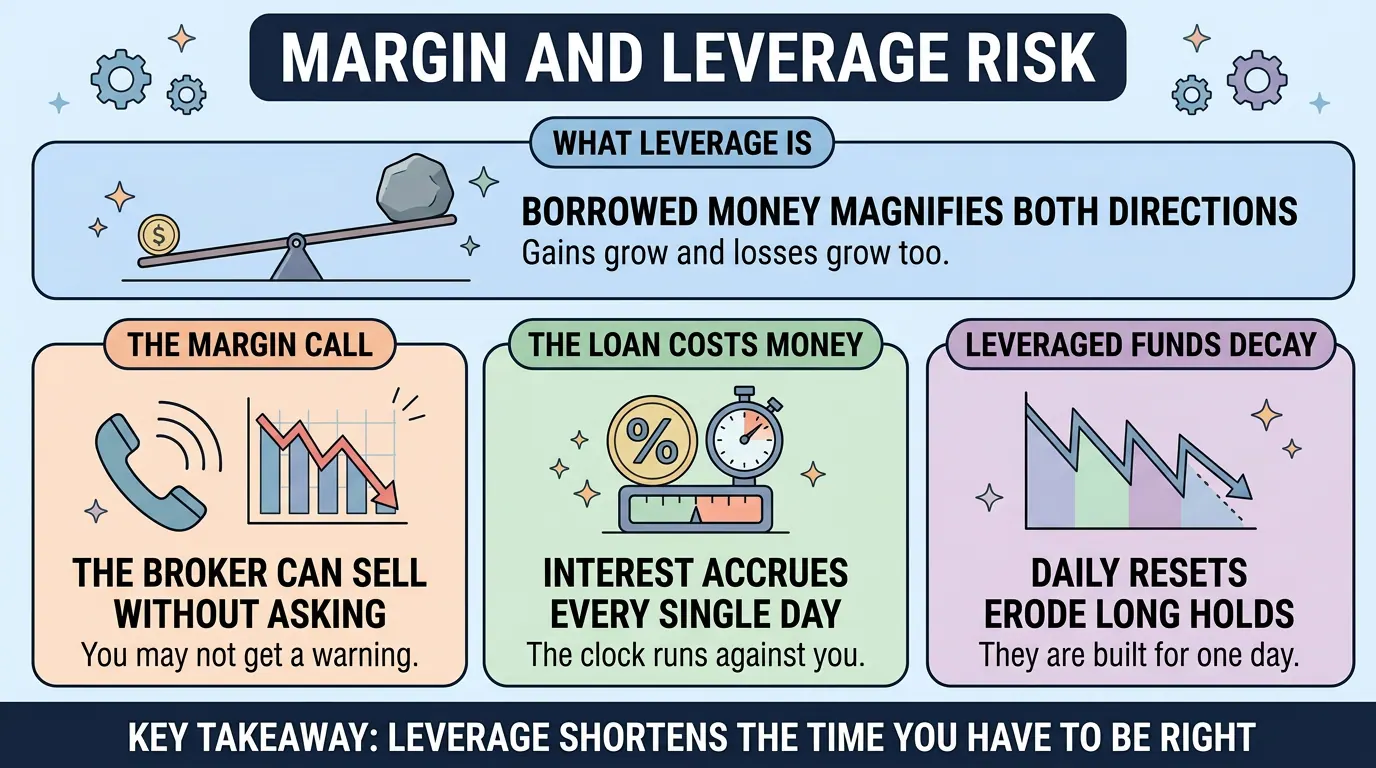
What Leverage Is
Leverage means controlling more asset value than you have put up in cash. The extra exposure comes from borrowing, either explicitly (a margin loan from your broker) or structurally (a futures contract, an option, or a fund that borrows for you).
Put up $10,000, borrow $10,000, and buy $20,000 of stock. That is 2 to 1 leverage. The stock rises 10 percent, the position is worth $22,000, and your $10,000 of equity has become $12,000. A 10 percent move produced a 20 percent gain.
Run it backwards. The stock falls 25 percent, the position is worth $15,000, the loan is still exactly $10,000, and your equity is $5,000. You lost half your money on a 25 percent decline. The loan does not shrink when the asset does, so every dollar of loss comes out of your slice first.
The Rules for Stocks
In the United States, Regulation T from the Federal Reserve sets initial margin for stock purchases at 50 percent. You must put up at least half the purchase price, so a margin account tops out near 2 to 1 on ordinary stock.
FINRA rules then require equity of at least 25 percent of the position's market value at all times. Most brokers impose house requirements above that, commonly 30 to 40 percent, and higher on volatile names. Brokers can raise the requirement on a specific stock overnight, so the rules can change while you are in the trade.
Find the trigger point with that same $20,000 position and $10,000 loan. Your equity is the position value minus the loan. At the 25 percent minimum, the call comes when equity divided by value falls to 0.25, at a position value of $13,333, roughly a 33 percent decline. At a 30 percent house requirement it comes at $14,286, a decline of about 29 percent.
Futures Play by Different Numbers
Futures margin is neither a loan nor governed by Regulation T. Exchanges set it as a performance bond sized to a plausible one-day move, which in practice often lands between 3 and 12 percent of the contract's face value.
The arithmetic is unforgiving. Post $5,000 against a contract with $70,000 of face value and you are at roughly 14 to 1, so a 7 percent move against you consumes the entire deposit. Futures also settle in cash daily, so the loss leaves your account that evening rather than sitting on a statement.
The Margin Call and the Forced Sale
A margin call is a demand to restore your equity, either by depositing cash or by selling positions. Investors underestimate what happens next.
Your broker need not give you time. Margin agreements almost always permit liquidation without prior notice, and firms use that right in fast markets.
You do not choose what gets sold. The broker does, and usually sells whatever is easiest.
The timing is guaranteed to be bad. Calls cluster at market bottoms, because that is when equity is lowest. Forced selling at the low turns a paper loss into a permanent one and removes you from the recovery.
If the liquidation does not cover the loan, you owe the remainder. Margin debt survives the position, and the broker can pursue it like any other debt.
The Loan Charges Interest
Margin loans accrue interest daily at a rate tied to the broker's base rate, tiered so small balances pay more than large ones. The rate moves with short-term rates, and nothing is locked in.
That interest is a hurdle rate. A borrowed $10,000 at 8 percent costs $800 a year, so the leveraged half of the position must earn 8 percent before it contributes anything. It is why a leveraged position held for years needs a much stronger thesis than a quick trade does.
Notional Exposure Versus Account Equity
Notional exposure is the full market value of what you control. Equity is what you actually own. Traders who watch only the second number get surprised.
A $25,000 account holding four crude oil contracts controls roughly $280,000 of oil. The useful question is not how much you posted. It is what a normal one-day move does to $280,000, and whether $25,000 can absorb it. A 3 percent day, routine for oil, is $8,400, a third of the account.
Why Leveraged ETFs Decay
A leveraged ETF promises a multiple of an index's return for one day. The prospectus means that literally. A 3x fund targets three times the index's daily move, and rebalances its exposure at the end of every session to hold that ratio.
Daily rebalancing has a mathematical consequence called volatility drag. Two days show it. Start with an index at 100 and a 3x fund at $100.
Day one: the index falls 10 percent to 90. The fund falls 30 percent to $70.
Day two: the index rises 11.1 percent, back to 100 exactly. The fund rises 33.3 percent, from $70 to $93.33.
The index is precisely where it started. The fund is down 6.7 percent, and it did nothing wrong: it delivered 3x on both days as promised. The loss came from compounding a larger percentage decline against a smaller base, which is arithmetic, not a fee and not tracking error.
Repeat that over a choppy quarter and the gap widens badly. These funds can lose money in a market that ends flat, and can trail three times an index's return over a year even when the index rose. They are built for a one-day horizon.
Leverage Shortens the Time You Have to Be Right
An unleveraged investor who buys a stock at $50 and watches it fall to $30 has lost money on paper and owns what they owned before. They can wait five years. Nobody can make them sell.
A leveraged investor holding the same view meets a margin call somewhere on the way down, has to fund it or be sold out, and pays interest the whole time. The correct forecast and the profitable trade become different things. Leverage does not change whether you are right. It changes how much room you have to be wrong first.
Summary
Leverage multiplies percentage gains and losses by the same factor, but only the losses come with a deadline. US stock margin is capped near 2 to 1 by Regulation T, with a 25 percent regulatory maintenance floor and higher broker requirements, while futures margin can be under a tenth of face value. Margin calls force sales at the worst prices, interest runs the whole time, leveraged ETFs decay in volatile sideways markets, and the loss can exceed the money you put up.