Most people insure their car, their apartment, and their life. Very few insure the thing that pays for all three.
Your ability to earn income is almost certainly your largest financial asset. A 25-year-old earning $60,000 who works to 65 will earn roughly $2.4 million before raises, and considerably more with them. That figure dwarfs the house, the car, and everything else on the balance sheet.
Disability insurance protects it. It replaces a portion of your income if illness or injury stops you from working.
The Odds Are Not What You Think
The usual objection is that disability is something that happens to other people, and specifically to people in dangerous jobs.
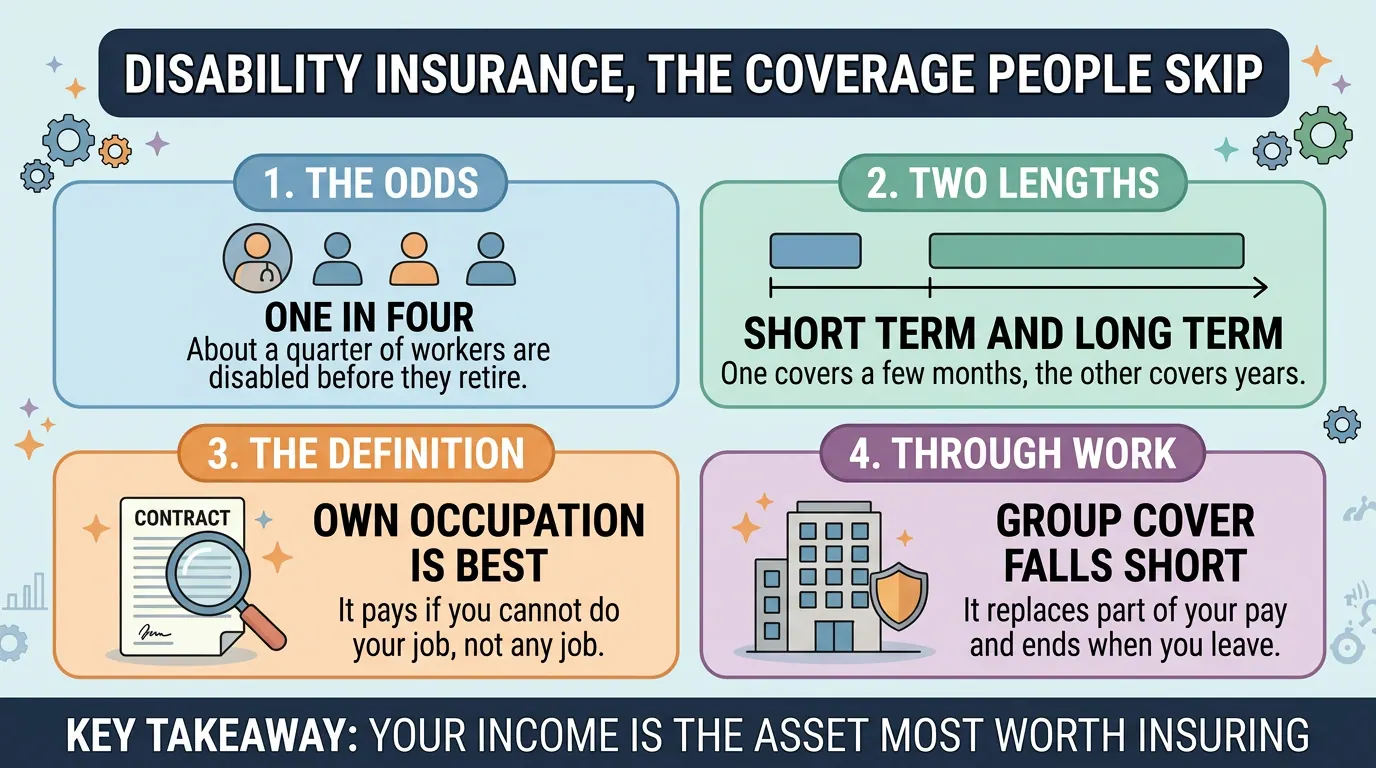
The Social Security Administration estimates that a 20-year-old worker has roughly a one in four chance of becoming disabled before reaching full retirement age.
One in four. That is not a rare event.
The second misconception is about cause. Most long-term disability claims come from ordinary illness rather than dramatic accidents: back and musculoskeletal disorders, cancer, heart disease, arthritis, and mental health conditions. A desk job protects you from falling off scaffolding. It does not protect you from a herniated disc or a cancer diagnosis.
Short-Term and Long-Term
Two products, doing different jobs.
Short-term disability replaces income for a period usually measured in weeks to a few months, often up to three or six. It commonly covers recovery from surgery, an injury, or childbirth. Many employers provide it, and a handful of states mandate it.
Long-term disability begins after short-term ends and can run for years or until retirement age. This is the one that matters financially, because a three-month gap is survivable with an emergency fund while a five-year gap is not.
If you have to choose one, choose long-term. Short-term disability insures against something savings can handle. Long-term insures against something savings cannot.
The Definition That Determines Everything
Buried in every policy is the definition of "disabled," and the wording changes the value of the contract more than any other term.
Own-occupation pays benefits if you cannot perform the duties of your specific occupation. A surgeon who develops a hand tremor cannot operate, so an own-occupation policy pays even if she can still teach or consult.
Any-occupation pays only if you cannot perform any job you are reasonably suited for by education and experience. That same surgeon, capable of teaching, would collect nothing.
Own-occupation costs more and is substantially stronger. Many policies use a hybrid, applying own-occupation for the first two years and switching to any-occupation afterward, which is worth catching before you sign.
Read this section of any policy before comparing prices. A cheap any-occupation policy and an expensive own-occupation policy are not the same product.
The Other Terms That Set the Price
Elimination period. How long you must be disabled before benefits begin, commonly 30, 60, 90, or 180 days. It functions like a deductible measured in time. A longer elimination period lowers the premium, and 90 days is a common choice, but it only works if you have savings to bridge those three months.
Benefit period. How long payments continue: two years, five years, or to age 65 or 67. To-retirement coverage costs more and is the version that actually protects against the catastrophic scenario.
Replacement percentage. Typically 50% to 70% of your income. Insurers deliberately refuse to cover 100%, because a policy paying your full salary removes the incentive to return to work.
Residual or partial benefits. Pays proportionally if you can work reduced hours or at reduced capacity. Worth having, since partial recovery is far more common than total permanent disability.
Non-cancelable and guaranteed renewable. Means the insurer cannot raise your premium or drop you as long as you pay. Worth paying for on an individual policy.
A Tax Detail Worth Real Money
This one is small in print and large in consequence.
If your employer pays the premium, your benefits are taxable income. If you pay the premium with after-tax dollars, your benefits are tax free.
Work through it. A policy replacing 60% of a $100,000 salary pays $60,000 per year. Employer-paid, in a 22% federal bracket plus state tax, that might net around $43,000. Self-paid, you keep the full $60,000.
Effective replacement rates: roughly 43% versus 60% of your former income. Same policy, same benefit, entirely different outcome.
If your employer offers the option of paying the premium yourself, or of having the premium counted as taxable income to you now, taking it is usually correct. You pay tax on a small premium instead of on a large benefit.
Why Employer Coverage Is Usually Not Enough
Group long-term disability through work is inexpensive and better than nothing, and it has three limitations.
It typically replaces 50% to 60% of base salary only, excluding bonuses and commissions, which for many people is a large share of total compensation.
It usually caps monthly benefits at a fixed maximum, so higher earners are effectively replaced at a much lower percentage.
It is not portable, ending when your employment does, and it frequently uses the weaker any-occupation definition after an initial period.
An individual policy costs more, follows you between jobs, and can use own-occupation language. A common approach is to keep the group coverage and add an individual policy on top.
Do Not Count on Social Security
Social Security Disability Insurance exists, and it is a genuine backstop, but planning around it is a mistake for three reasons.
The standard is strict. You must be unable to engage in substantial gainful activity, and the condition must be expected to last at least twelve months or result in death. Partial or short-term disability does not qualify.
Approval is difficult. Per the Social Security Administration's own statistics, roughly 18% to 21% of applications are awarded at the initial level, with the final award rate across all appeal levels averaging near 29% for recent filing years.
The process is slow. Initial decisions take months, and appeals can extend the timeline by a year or more.
The typical benefit also lands well below what most working people need.
Summary
Your future earnings are likely your largest asset, and the Social Security Administration estimates a 20-year-old has roughly a one in four chance of becoming disabled before retirement, most often from ordinary illness rather than accident. Long-term coverage matters more than short-term, because savings can bridge three months but not five years. The own-occupation versus any-occupation definition changes the value of a policy more than any other term, and own-occupation is substantially stronger. Paying the premium yourself with after-tax dollars makes benefits tax free, which on a $60,000 benefit can be worth roughly $17,000 a year compared with employer-paid coverage.