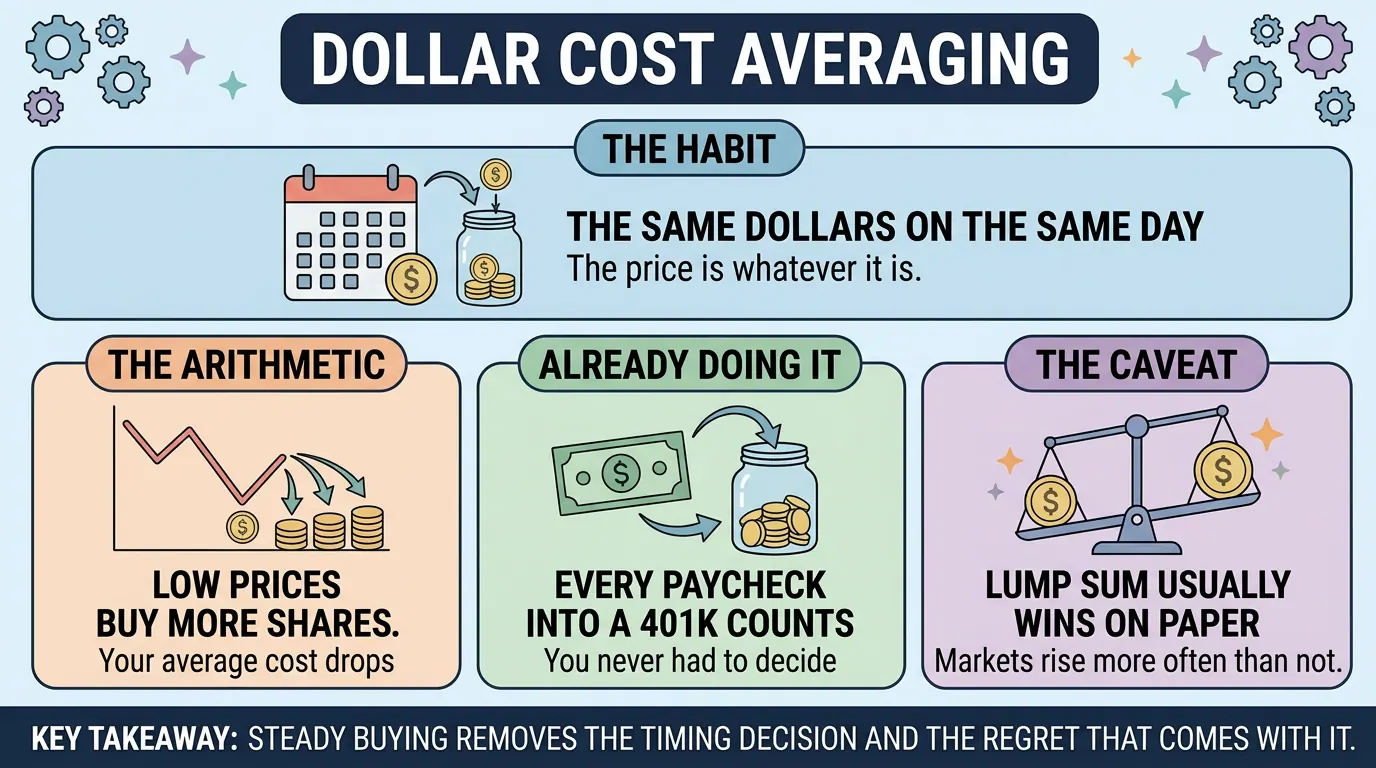
If you contribute to a 401(k) out of every paycheck, you are already dollar-cost averaging. You just do not call it that, and nobody made you decide anything.
Dollar-cost averaging, usually shortened to DCA, means investing a fixed dollar amount on a fixed schedule regardless of the price that day. Not a fixed number of shares. A fixed number of dollars. That distinction is the whole idea.
It is one of the few pieces of investing advice that is genuinely simple, and also one of the few where the honest research does not fully support the usual sales pitch. Both of those are worth knowing.
The Arithmetic, With Real Numbers
Say you invest $300 on the first of every month into the same fund, and the price bounces around:
Month 1, price $60. Your $300 buys 5.0 shares.
Month 2, price $50. Your $300 buys 6.0 shares.
Month 3, price $40. Your $300 buys 7.5 shares.
Month 4, price $50. Your $300 buys 6.0 shares.
You invested $1,200 and own 24.5 shares, so your average cost is $48.98 per share.
Now average the four prices themselves. $60, $50, $40, and $50 average out to $50.00. You paid less per share than the average price of the thing you were buying, without predicting anything.
That is not luck. Fixed dollars automatically buy more shares when the price is low and fewer when it is high, so the cheap months carry more weight in your average. Whenever prices move at all, your average cost comes out below the average price. The only way to tie is for the price to never change.
One warning attached to that result. A lower average cost is not the same as more money. Had the price kept sliding to $20, your average cost would look great and your account would still be down. DCA improves your entry price relative to the path prices took. It does not make a falling investment profitable.
You Are Probably Already Doing It
A 401(k) is a dollar-cost averaging machine. A fixed percentage of a fixed salary goes into the same funds on the same day each pay period, at whatever price the market happens to be quoting. Nobody logs in to decide.
That is most of the value. Not the arithmetic, which is modest, but the fact that the decision was made once and then taken out of your hands. Automatic recurring transfers into a brokerage account do the same thing.
The Research That Complicates the Story
Most articles about DCA stop before this part.
Vanguard ran the comparison in three markets: 1,021 rolling 12-month periods in the US going back to 1926, plus shorter histories in the UK starting in 1976 and Australia starting in 1984. The question was simple: if you have a sum of cash today, are you better off investing all of it now, or splitting it into monthly pieces over a year? Investing the whole amount immediately produced more money about two thirds of the time in each of the three markets, and it beat the spread-out approach by roughly 2.3 percentage points in the US, 2.2 in the UK and 1.3 in Australia.
The reason is not complicated. Stock markets finish up in most years, not just most decades. Money held back to invest later is money sitting out of a market that is usually rising. Spreading a lump sum out is, in expectation, a partial decision to stay in cash.
So if the only thing you care about is expected ending wealth, the evidence says put it in now. Anyone telling you DCA reliably beats lump-sum investing is repeating something that is not true.
Why DCA Still Earns Its Place
Look at the other 32%. Those are the periods when the market fell right after you would have invested, and they are not spread evenly across ordinary years. They cluster in exactly the stretches that scare people out of investing for good.
Put $60,000 into an index fund on a Monday and watch it fall to $48,000 over the next month, and the relevant question stops being about expected returns. It becomes whether you sell. People who sell in a drawdown and wait for things to calm down often stay out for years, and that gap costs far more than the 2.3 points lump-sum investing earns on average.
Regret runs asymmetric here too. Investing everything the day before a crash feels like a mistake you personally made. Investing gradually and missing some upside feels like the market being the market. Not rational, but real, and it changes what people do.
A defensible way to hold both facts at once: lump-sum investing has the better math, and DCA has the better odds of you still being invested in five years.
Two Different Things Both Called DCA
Most of the confusion in this debate comes from mixing up two situations.
The first is DCA as an ongoing habit: investing part of each paycheck as you earn it. There is no alternative to compare it against, because you cannot lump-sum money you have not been paid yet. Everyone investing from income does this by definition, and the Vanguard finding has nothing to say about it. This is just called investing.
The second is DCA as a way to deploy a lump you already hold: an inheritance, a signing bonus, proceeds from selling a house. This is where a real choice exists and where the research applies.
If you do spread a lump out, set the schedule before you start. Four equal pieces on the first of each month, or six, whatever you pick. The failure mode is starting a plan and then pausing because prices look high or waiting for a dip. That is not dollar-cost averaging, it is market timing wearing a disguise, and it is the version that leaves money in cash for years.
What DCA Does Not Do
The SEC says this plainly in its investor materials, and it bears repeating. Dollar-cost averaging does not guarantee a profit and does not protect you from loss in a declining market.
The common misconception is that DCA permanently lowers risk. It does not. It reduces exposure only while you are still phasing money in. The moment the last contribution lands, you hold the same investment carrying the same risk as someone who bought it all at once. What you got along the way was a smoother ride and a slightly better average entry price, not a safer asset.
Summary
Dollar-cost averaging means putting a fixed dollar amount in on a fixed schedule, which automatically buys more shares when prices are low and pulls your average cost below the average price. Every payroll retirement contribution already works this way. For a lump sum you already hold, history favors investing it all immediately about two-thirds of the time, so DCA there trades a little expected return for a much better chance of staying invested through a bad stretch. It smooths the experience; it does not remove the risk.