Buying a rental property takes a down payment, a mortgage, a tenant, and a phone that rings when the water heater fails. Most people who want real estate exposure do not want that job.
A REIT (real estate investment trust) is the workaround. It is a company that owns income-producing property, and you buy shares of it the way you buy shares of any other company. Congress created the structure in 1960 so ordinary investors could own large commercial real estate the way wealthy ones already did.
What separates a REIT from a normal company is a bargain it strikes with the IRS: follow a set of rules, and skip corporate income tax almost entirely.
The Rules That Make a REIT a REIT
To qualify, a company has to pass several tests every year. The main ones:
At least 75% of its assets must be real estate, cash, or US government securities.
At least 75% of its gross income must come from rents, mortgage interest, or property sales.
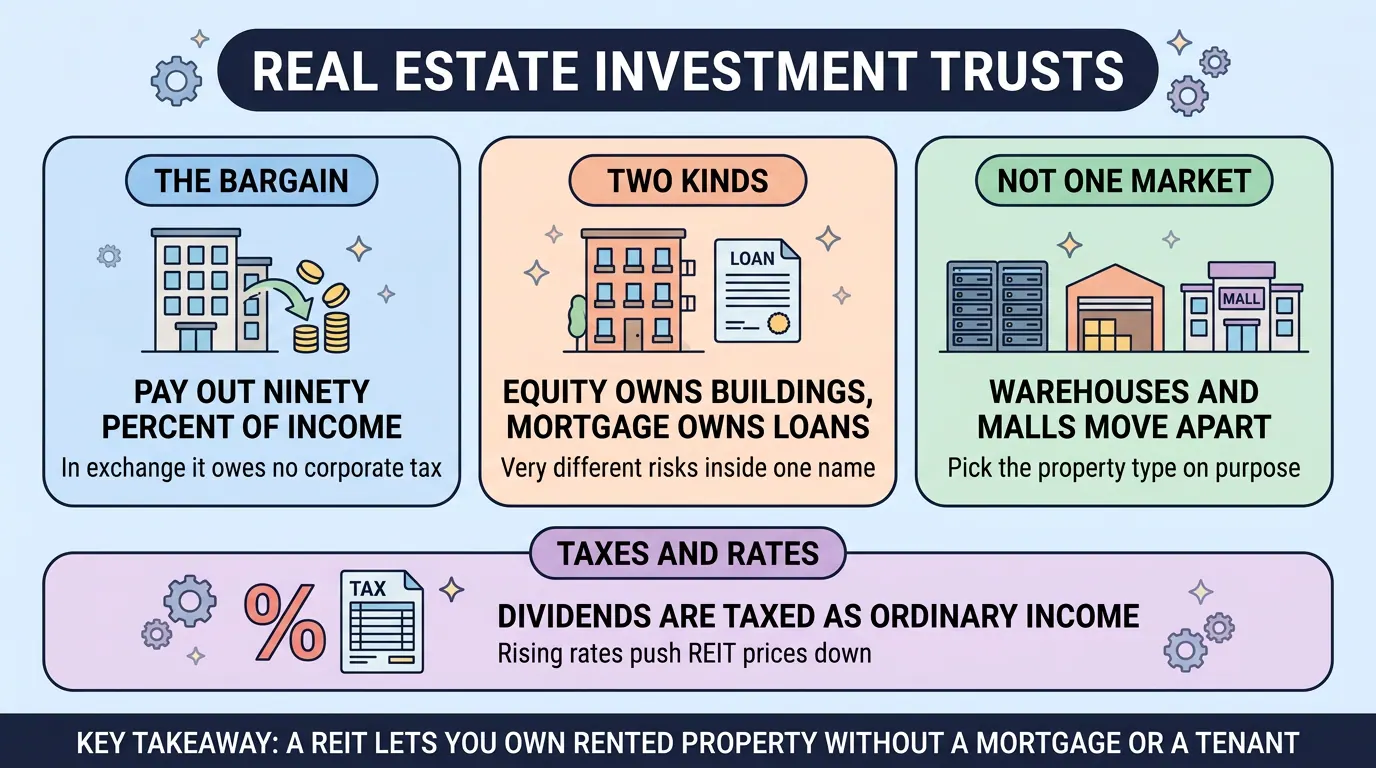
It must distribute at least 90% of its taxable income to shareholders as dividends each year.
It must have at least 100 shareholders, and five or fewer individuals cannot own more than half the shares during the second half of the tax year. That one is called the 5/50 rule.
In exchange, the REIT deducts the dividends it pays from its own taxable income. A normal corporation pays tax on its profit, then you pay tax again on the dividend. A REIT skips the first layer, so the income gets taxed once, at your rate.
The 90% rule has a consequence people miss. A company forced to pay out nearly all its income cannot fund growth from retained profits the way Apple does. REITs grow by issuing new shares and borrowing, which leaves them unusually dependent on capital markets staying open and borrowing costs staying reasonable.
Equity REITs and Mortgage REITs
An equity REIT owns buildings and collects rent, earning the spread between rent and the cost of operating and financing the property. Almost the entire REIT market by value is equity REITs, and this is what people mean when they say REIT without qualifying it.
A mortgage REIT, or mREIT, owns mortgages and mortgage-backed securities instead of buildings. It borrows short-term money cheaply, lends long-term at higher rates, and pockets the difference, usually with heavy leverage. When short-term rates rise faster than long-term rates, that spread compresses and the model strains. They advertise high yields and have been far more volatile than equity REITs, with dividend cuts that arrive without warning.
Publicly Traded vs. Non-Traded
A publicly traded REIT is listed on an exchange like the NYSE. You can sell any trading day at a price the market sets, and it files public financial reports.
A non-traded REIT is registered with the SEC but not listed anywhere, and it is sold through brokers and advisors. Fees are the first problem. Non-traded REITs have historically carried heavy upfront sales commissions and offering costs, in some cases close to a tenth of your investment before a dollar reaches a property.
Liquidity is the second. With no exchange, the only exit is the sponsor's share repurchase program, and those come with caps, often around 5% of net asset value per quarter. The cap is harmless until everyone wants out at once, which is exactly when you would. Starting in late 2022, Blackstone's large non-traded REIT (BREIT) hit its redemption limits and rationed withdrawals for months. The share price is also set by the sponsor's valuation process rather than by buyers and sellers, so a smooth price chart reflects appraisal timing as much as reality.
Real Estate Is Not One Asset
REITs specialize, and the sectors can move in opposite directions in the same year.
Residential: apartments, single-family rentals, manufactured housing.
Industrial: warehouses and distribution centers, tied to e-commerce volume.
Data centers: buildings full of servers leased to cloud and AI companies, where the binding constraint is often electricity rather than land.
Healthcare: senior housing, skilled nursing, medical offices, hospitals.
Retail: malls, strip centers, freestanding stores.
Cell tower, self-storage, timberland, and casino REITs exist too. A bet on real estate can quietly be a bet on one sector.
Why Analysts Use FFO Instead of Earnings
Accounting rules require a company to record depreciation, an annual expense reflecting the assumption that a building wears out on a schedule. For a factory machine that is reasonable. For a maintained apartment tower in a growing city it is often backwards, since the building may be worth more than it was a decade ago.
Depreciation is also non-cash. No money leaves the building. But it is large enough to make a profitable REIT look barely profitable on a net income basis, which is why a REIT's price-to-earnings ratio is close to meaningless.
The industry replacement is funds from operations (FFO), defined by Nareit as net income with real estate depreciation added back and gains from property sales taken out. A tighter version, adjusted funds from operations (AFFO), also subtracts the recurring spending needed to keep properties leasable. REITs get quoted at a multiple of FFO, and payout ratios are measured against it.
How REIT Dividends Are Taxed
Because the REIT never paid corporate tax on the income, most of the dividend does not qualify for the lower rates that apply to ordinary stock dividends. It is taxed as ordinary income, at the same rate as your paycheck.
There is a partial offset. Under Section 199A of the tax code, qualified REIT dividends get a 20% deduction, which the law signed in July 2025 made permanent, pulling the top effective federal rate on those dividends to roughly 29.6%. Part of a distribution can also count as return of capital, which is not taxed now but lowers your cost basis and raises the gain when you sell.
The mechanical result: REITs throw off a large, regular, ordinary-income stream that gets taxed every year in a brokerage account whether you spend it or reinvest it. Inside an IRA or 401(k), the character of that income stops mattering.
Interest Rates Push From Three Directions
REITs borrow heavily, so rising rates raise financing costs as debt matures and gets refinanced. Rising rates also lift bond yields, and an investor who can get a safe 5% from a Treasury demands more from a REIT, pushing REIT prices down until the yield competes. Higher rates raise the capitalization rate buyers apply to property income too, which lowers what the buildings are worth.
REITs are still not bond substitutes. Leases reset and rents can climb with inflation in a way a fixed coupon cannot, which is why REIT performance during rising-rate stretches has been inconsistent rather than uniformly bad.
The Simple Route
Picking individual REITs means underwriting specific buildings, tenants, and balance sheets. A REIT index fund or ETF holds most of the listed US REIT market in one position for an expense ratio in the neighborhood of 0.1% a year.
One caveat before adding one. A total US stock index fund already owns REITs at their market weight, low single digits. A dedicated REIT fund on top of that is a deliberate tilt toward real estate, not exposure you were missing.
Summary
A REIT owns income-producing real estate and avoids corporate tax by distributing at least 90% of its taxable income. Equity REITs own buildings, mortgage REITs own loans, and the two behave very differently. Non-traded REITs carry heavy fees and can gate withdrawals when everyone heads for the exit at once. Value them on FFO rather than earnings, expect ordinary-income taxation softened by the 20% Section 199A deduction, and treat a broad REIT index fund as the low-effort way in.