Once you have a retirement account, you face a single decision that generates more confusion than everything else combined: Roth or traditional?
The question sounds technical. It is not. Underneath the vocabulary, you are being asked one thing.
Do you want your tax break now, or later?
That is the whole decision. Everything else follows from it.
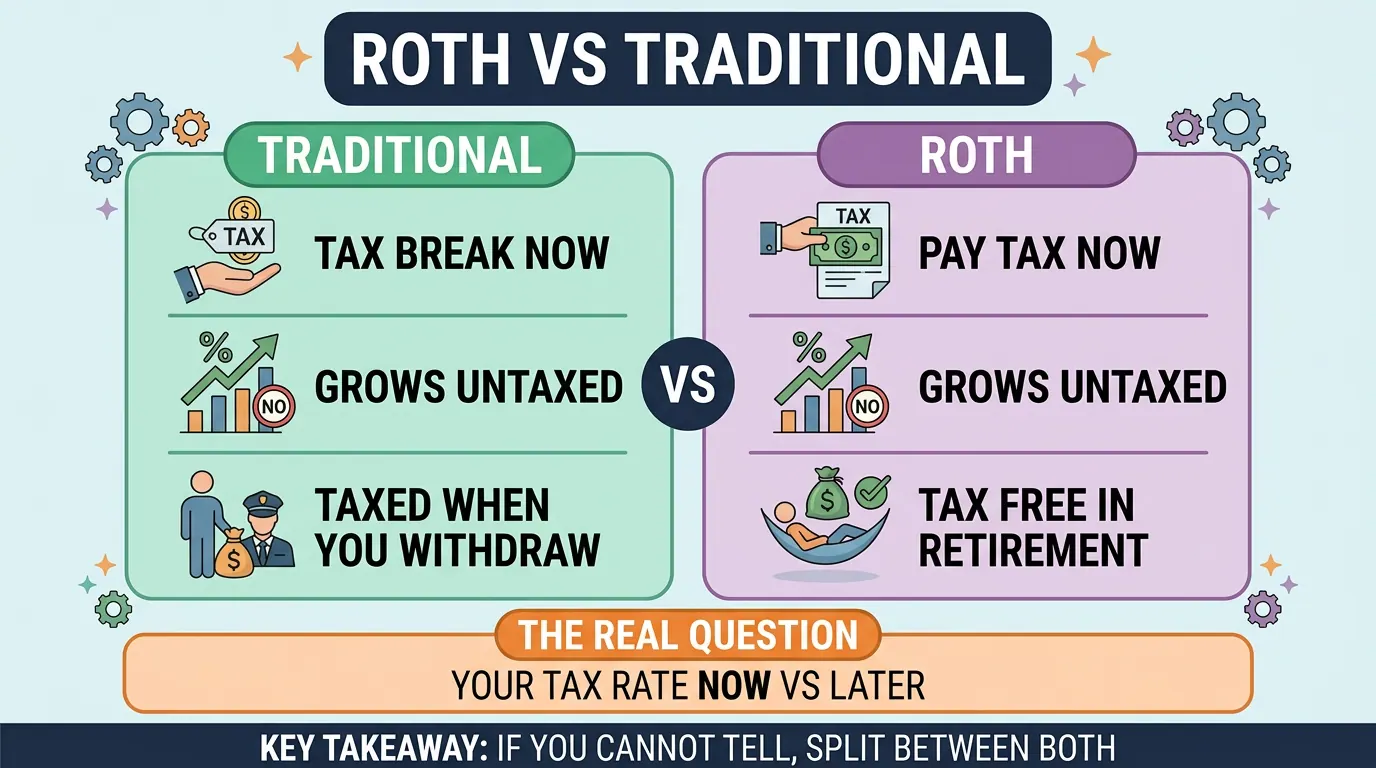
Traditional: Tax Break Now
With a traditional account, your contribution is made with pre-tax dollars. It reduces your taxable income in the year you contribute, so you pay less tax immediately. The money grows without being taxed along the way. When you withdraw it in retirement, the entire withdrawal is taxed as ordinary income.
You get a discount today and settle up later.
Roth: Tax Break Later
With a Roth account, your contribution is made with money you have already paid tax on. There is no deduction and no immediate savings. The money grows without being taxed, and qualified withdrawals in retirement are completely tax free, including all the growth.
You pay full price today and owe nothing later.
Watching Both Play Out
Say you contribute $6,000 this year, you are in the 22% federal tax bracket, meaning the top slice of your income is taxed at 22%, and the money grows to $60,000 over 30 years.
Traditional:
You save $1,320 in taxes this year
The account grows to $60,000
You withdraw it in retirement and owe tax on the full $60,000
In a 22% bracket at withdrawal, that is $13,200 in tax
Roth:
You save nothing on taxes this year
The account grows to $60,000
You withdraw it and owe $0
If your tax rate is identical in both years, the two are mathematically equivalent. Same result, different timing. That surprises people, but it follows from the arithmetic.
The choice only matters because your tax rate almost certainly will not be identical.
The Actual Question You Are Answering
Because the two are equivalent at equal tax rates, the decision reduces to a prediction:
Will your tax rate be higher now, or in retirement?
If you expect a higher rate later, choose Roth. Pay tax at today's lower rate and take the withdrawals tax free.
If you expect a lower rate later, choose traditional. Take the deduction at today's higher rate and pay tax later when your rate has fallen.
For most people early in their careers, Roth is the reasonable default. A 24-year-old in an entry-level job is likely in one of the lowest tax brackets they will occupy in their lifetime. Paying tax on that money now, at that low rate, and never paying tax on its growth again, is usually the better bet.
For someone at their peak earnings in a high bracket, the traditional deduction is often worth more, because they are deducting against a high rate and will likely withdraw at a lower one.
Nobody knows future tax law, which is a genuine limitation on this reasoning. It is also an argument for having some of each if you have the option, so that your retirement income is not entirely dependent on one set of tax rules staying put.
Roth Has a Flexibility Advantage
There is one practical difference that has nothing to do with tax rates.
With a Roth IRA, you can withdraw your own contributions at any time, for any reason, with no tax and no penalty. Not the growth, just the money you put in.
If you contributed $18,000 over three years and the account grew to $24,000, you can take out up to $18,000 whenever you want. The remaining $6,000 of growth is what stays locked until you qualify.
This is why some people treat a Roth IRA as a backup emergency reserve. It should not be your primary emergency fund, since withdrawing money permanently removes it from decades of tax-free compounding. But knowing the option exists makes contributing less frightening for someone worried about locking up money they might need.
Traditional accounts have no equivalent. Early withdrawals are taxed and penalized.
The Rules You Need to Know
Qualified Roth withdrawals require two conditions to be met: the account has been open at least five years, and you are at least 59½. Death, disability, and a $10,000 lifetime first-home allowance also qualify. Converted money follows a separate rule: each conversion starts its own five-year clock, so pulling converted funds out early can trigger the 10% penalty even when the Roth account itself is older than five years.
The five-year clock starts on January 1 of the first year you funded any Roth IRA. Opening one at 22 and contributing even a small amount starts the clock permanently.
Traditional accounts have required withdrawals. Starting at age 73, you must take a required minimum distribution each year, whether you need the money or not. Roth IRAs have no such requirement during your lifetime, and neither do Roth 401(k)s.
Roth IRAs have income limits. For 2026, eligibility phases out between $153,000 and $168,000 of income for a single filer, and between $242,000 and $252,000 for a married couple filing jointly. Roth 401(k) accounts have no income limit at all, which makes the workplace version available to high earners who cannot contribute to a Roth IRA.
Summary
Traditional accounts give you a tax deduction now and tax your withdrawals in retirement, while Roth accounts give you no deduction now and make qualified withdrawals entirely tax free. At identical tax rates the two produce the same result, so the decision comes down to whether you expect your tax rate to be higher today or in retirement. Early-career savers in low brackets usually favor Roth, and Roth IRAs add real flexibility because your own contributions can be withdrawn anytime without tax or penalty. Roth IRAs carry income limits in 2026 that phase out at $153,000 for single filers, and traditional accounts require withdrawals beginning at age 73 while Roth accounts do not.