A 401(k) is a retirement account you get through your job. The strange name comes from the section of the US tax code that created it, section 401, paragraph k, which tells you something about how much thought went into naming it.
Functionally, it is a container. It is not an investment itself, and this confuses a lot of first-time participants. Money goes into the container, and then you choose what to buy inside it. Opening the account and stopping there is like renting a storage unit and never putting anything in it.
How Money Gets In
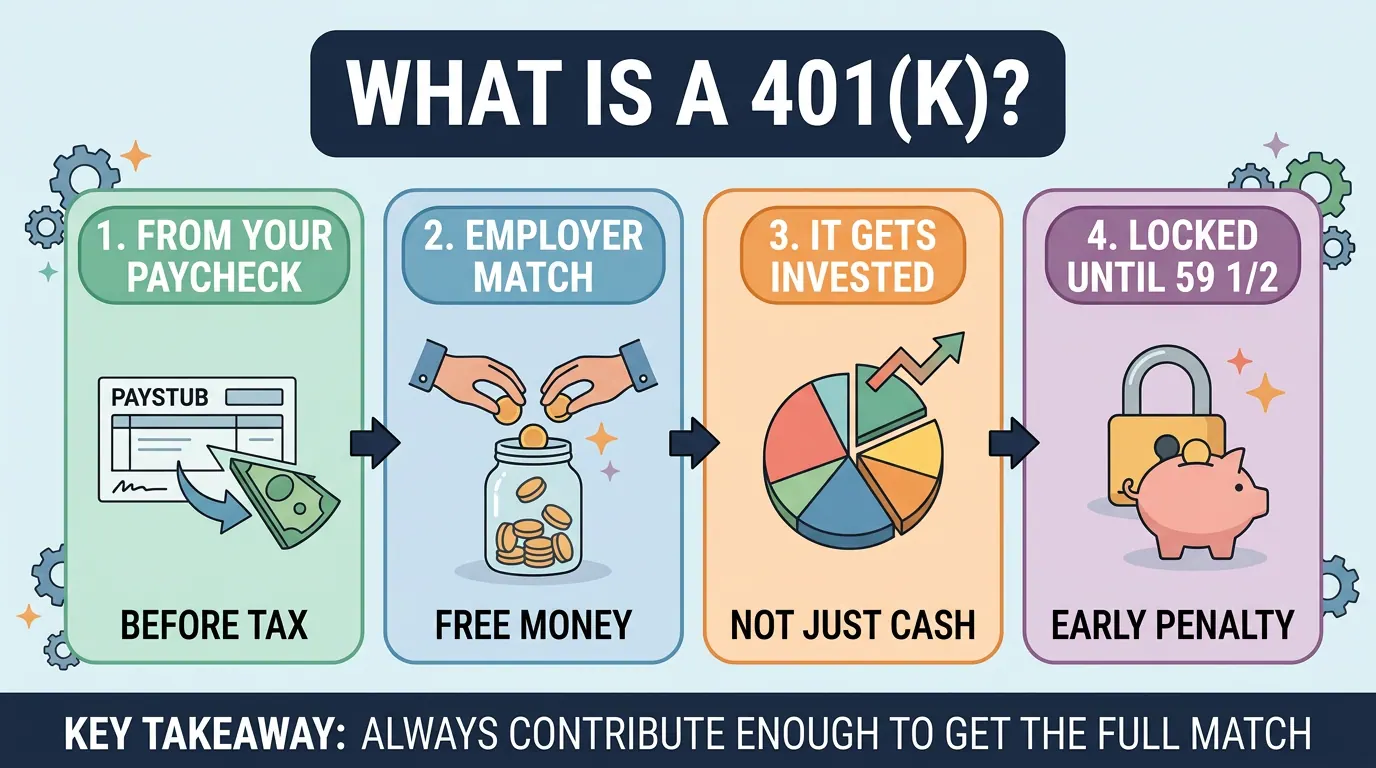
Your contributions come out of your paycheck automatically, before the money ever reaches your bank account. This is called a payroll deferral, and it is the main reason 401(k) plans work as well as they do. You never see the money, so you never have to resist spending it.
You choose a percentage of your pay, and your employer's payroll system does the rest every pay period.
Most plans are pre-tax, sometimes called traditional. The money is taken out before income tax is calculated, which lowers your taxable income for the year.
Here is what that looks like on a $60,000 salary with an 8% contribution:
You contribute $4,800 over the year
Your taxable income drops from $60,000 to $55,200
In the 22% federal bracket, that saves you roughly $1,056 in taxes this year
You did not avoid the tax. You postponed it. When you withdraw the money in retirement, it gets taxed then as ordinary income.
How Much You Can Put In
The IRS sets an annual cap, and it rises most years with inflation.
For 2026, you can contribute $24,500 of your own money. If you are 50 or older, you can add a catch-up contribution of $8,000, bringing your personal limit to $32,500. A newer rule allows people aged 60 through 63 to contribute an even larger catch-up of $11,250 instead. Starting January 1, 2026, those catch-up contributions have to be made as Roth (after-tax) money if your FICA wages from that employer were more than $150,000 in the prior year, a threshold that is indexed for inflation. High earners still get the catch-up, they just no longer get the upfront deduction on it.
There is a second, larger limit that covers everything going into the account, including your employer's contributions. For 2026 that combined ceiling is $72,000. Very few people come close to it, but it is the reason a generous employer contribution never pushes you over your personal limit.
Both limits are adjusted annually, so check the current year's figure rather than assuming last year's number still applies.
The Part Almost Everyone Gets Wrong
Signing up for a 401(k) does not invest your money. It moves your money into the account, where it may sit in a low-return holding option until you choose investments.
People discover this years later, having diligently contributed to what turned out to be an expensive savings account.
Most plans offer somewhere between ten and thirty investment choices, typically mutual funds, which are pooled baskets holding many different stocks or bonds that you buy as a single share. The default option in most modern plans is a target-date fund, which is a single fund named for the year you expect to retire, such as a "2065 Fund."
A target-date fund handles the allocation decision for you. It holds mostly stocks when you are young and gradually shifts toward bonds as the target year approaches, a process called a glide path. You buy one fund and stop thinking about it.
For a beginner, a target-date fund is usually the correct answer, and their popularity reflects that. They are offered in roughly 95% of large plans, and about 60% of participants hold a single one.
Your Money Is Locked Up, Mostly
The tax break comes with strings. Withdraw money before age 59½ and you generally owe income tax plus a 10% penalty on top.
There are exceptions, including disability, certain medical expenses, a $1,000 annual emergency withdrawal, and a provision called the Rule of 55 that applies if you leave your job in or after the year you turn 55. Those exceptions have real conditions attached, and they are covered separately.
Treat the general rule as the operative one: this money is not available until 59½. That inaccessibility is a feature. It is much harder to raid an account that charges you a penalty for raiding it.
What Happens When You Leave the Job
Your own contributions are always yours, immediately and completely. Changing jobs does not put them at risk.
You will generally have four options: leave the money in the old plan, roll it into your new employer's plan, roll it into an IRA, or cash it out. Cashing out is almost always the worst choice, because you pay income tax plus the 10% penalty and permanently lose decades of compounding, which is the process by which your investment earnings generate earnings of their own and produce most of an account's eventual growth.
There is one detail worth knowing now. If your balance is small, your former employer can move it out without your permission. Balances under $1,000 can be cashed out, and balances between $1,000 and $7,000 can be rolled into an IRA chosen by the plan. Small forgotten accounts get moved, so keep track of them.
Summary
A 401(k) is an employer-provided retirement container funded automatically from your paycheck, usually with pre-tax dollars that lower your taxable income now and get taxed on withdrawal later. For 2026 you can contribute $24,500 of your own money, with larger limits for people 50 and older, and $72,000 total including employer contributions. Enrolling is not investing, so you must choose investments inside the account, and a target-date fund is the standard beginner choice. Withdrawals before 59½ generally trigger income tax plus a 10% penalty, and cashing out when you change jobs is the most expensive option available to you.