Most financial advice tells you to save more money. That is reasonable advice, but it hides the single most important fact about retirement saving, which is that when you start matters more than how much you save.
This sounds like motivational filler. It is not. It is arithmetic, and the gap it creates is enormous.
Two Savers, One Difference
Imagine two people who save the exact same amount every month: three hundred dollars, never more, never less. Both earn an average return of 7% per year.
The only difference between them is their start date.
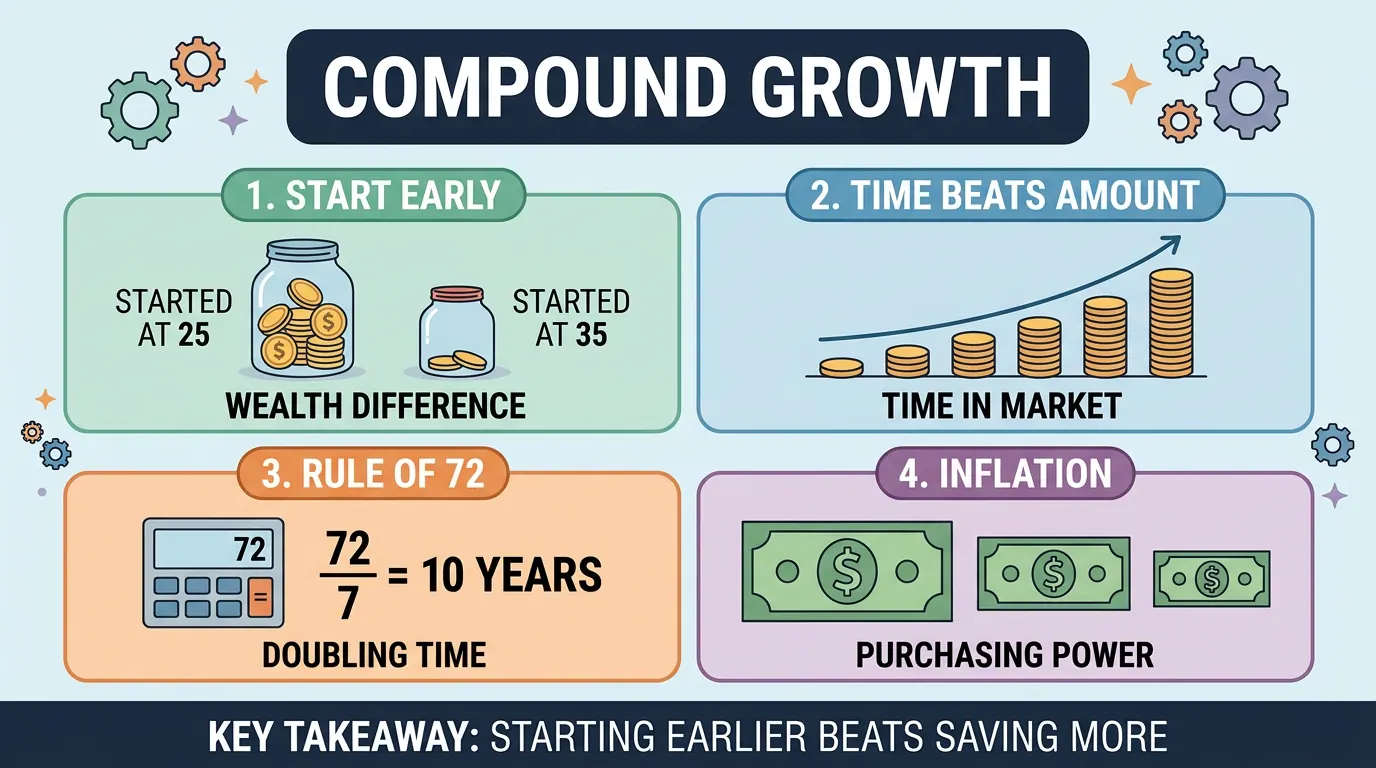
Anna starts at 25 and saves for 40 years. She ends up with roughly $719,000.
Ben starts at 35 and saves for 30 years. He ends up with roughly $340,000.
Ben contributed $108,000 of his own money. Anna contributed $144,000. She put in about a third more, and ended up with more than twice as much.
Those ten missing years did not cost Ben $36,000 in contributions. They cost him roughly $379,000 in final balance. The money he never invested in his twenties would have spent four decades multiplying, and multiplication is where almost all of the growth comes from.
Why the Math Works This Way
The reason is a process called compounding. When your investments earn a return, that return gets added to your balance. The next year, you earn a return on the larger balance, including on the returns you earned previously. Your growth starts generating its own growth.
In the early years this is almost invisible. A $5,000 balance earning 7% gains $350, which is not life changing. But the effect accelerates, because each year's gain is calculated on a bigger number than the year before.
Look at what a single one-time $10,000 investment does at 7%:
After 10 years: about $19,700
After 20 years: about $38,700
After 30 years: about $76,100
After 40 years: about $149,700
Notice the pattern. The account gains about $9,700 in the first decade and about $73,600 in the fourth decade, from the same original $10,000 and the same return rate. The last ten years produced more than seven times the growth of the first ten, because compounding had a much larger balance to work on.
This is why the decade of your twenties is the most valuable decade you will ever have as an investor, and also the decade almost nobody uses.
The Rule of 72
There is a shortcut for estimating how fast money doubles, and it is worth memorizing because it takes five seconds and requires no calculator.
Divide 72 by your annual return percentage. The answer is roughly how many years it takes your money to double.
At 7%, money doubles in about 10 years (72 ÷ 7 ≈ 10.3)
At 9%, money doubles in about 8 years
At 3%, money doubles in about 24 years
The rule reframes retirement saving in a useful way. If you are 25 and money doubles every decade, a dollar you invest today has about four doublings ahead of it before you turn 65. One dollar becomes roughly sixteen. If you wait until 45, you get two doublings, and that dollar becomes four.
Every decade you delay does not subtract from the total. It halves it.
What Return Should You Actually Assume?
The 7% figure used above is not a promise, and any article that presents it as one is misleading you.
It comes from the historical record. Over the long run, US large company stocks have returned roughly 10% per year on average, measured since 1928. Inflation has averaged roughly 3% per year over long periods. Subtract one from the other and you get about 7% in real terms, meaning growth in actual purchasing power rather than in raw dollars.
Two things to understand about that number:
It is an average across a very long period, not a prediction for any single year. Stocks lost roughly 37% in 2008 and gained roughly 32% in 2013. The average only shows up when you hold through both kinds of years.
Shorter time horizons are far less reliable. Over a single year, stocks might do anything. Over 30 or 40 years, the historical range narrows considerably. This is another argument for starting early: a long horizon is what makes the average return something you can reasonably plan around.
Inflation Is Working Against You the Whole Time
If you keep retirement money in a checking account, you are not standing still. You are losing ground.
At 3% annual inflation, a dollar loses about half its purchasing power in 24 years. Money sitting in cash for a 40 year career would keep its dollar value and lose most of its actual value.
That is the real risk beginners misjudge. Investing feels risky because balances go up and down visibly. Cash feels safe because the number never drops. Over 40 years, the account that never drops is the one that reliably loses.
Summary
Compounding means your investment returns generate their own returns, and the effect accelerates the longer money stays invested. Two people saving $300 a month at 7% end up roughly $379,000 apart based only on whether they started at 25 or 35. The Rule of 72 estimates doubling time by dividing 72 by your return rate, which shows why each decade of delay roughly halves your result. Long-run US stock returns have averaged about 10% nominally and about 7% after inflation, and cash held for decades loses purchasing power even though its dollar value never falls.