In 2022, plenty of people watched a fund labeled Treasury lose about a third of its value. Nothing defaulted. Nothing went wrong with the credit. The loss came entirely from interest rates rising, and its size was predictable in advance from one number sitting on the fund's own web page.
That number is duration. It is the most useful thing to know about a bond holding and the most commonly misread, because it is quoted in years and is not really about time.
Duration Is Not Maturity
Maturity is a date. It is when the issuer hands your principal back and the bond ends.
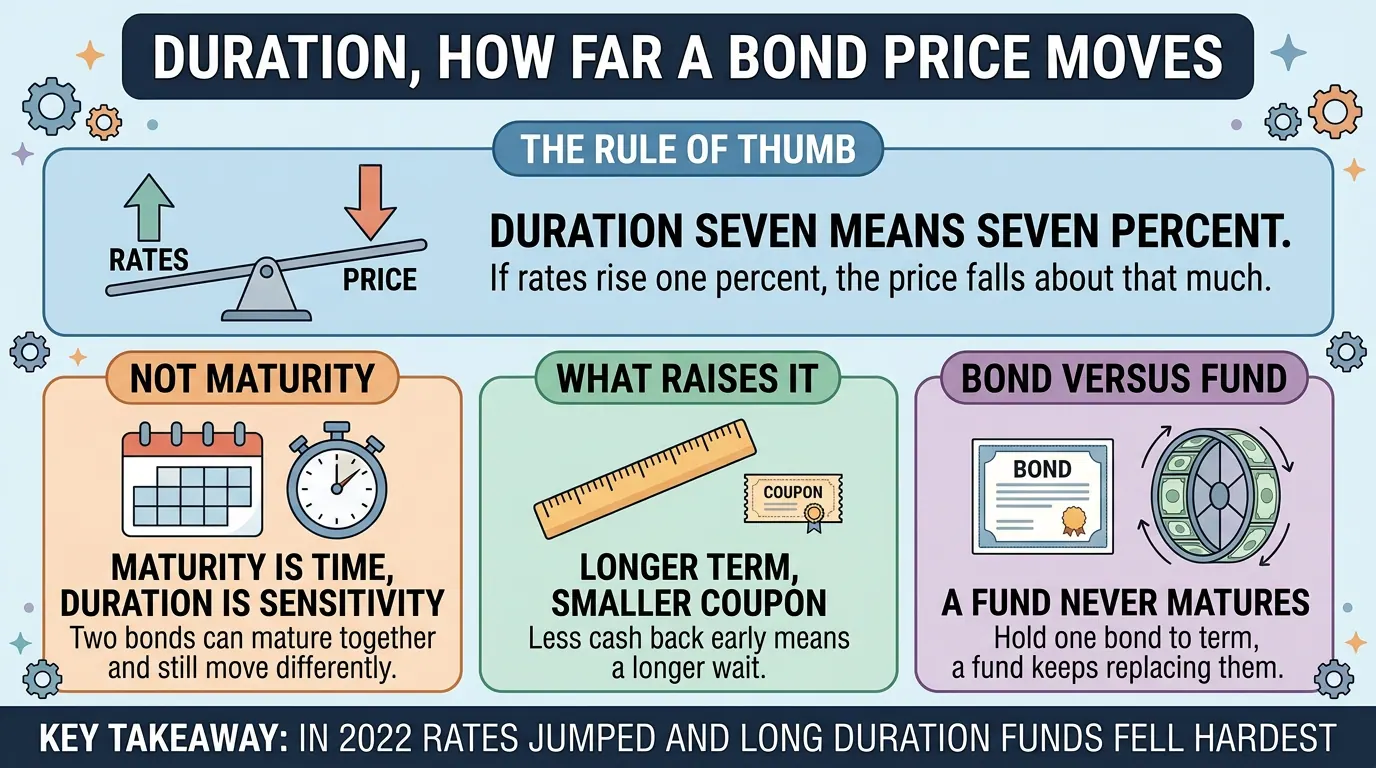
Duration is a measure of sensitivity. It answers a different question: if market interest rates move by one percentage point, how far does this bond's price move? Technically it is the weighted average time until you receive the bond's cash flows, but treat that as the derivation and the sensitivity as the meaning.
Two bonds can mature on the same day with very different durations, because what matters is when all the money comes back, not just when the last piece does. A 30-year bond paying a large coupon returns cash the whole way through. A 30-year bond paying nothing until the end returns everything at once, at the very end.
The Rule of Thumb
For every 1 percentage point that rates rise, a bond's price falls by roughly its duration, expressed as a percent. Rates falling works the same way in reverse.
Duration 2, rates rise 1 point: price falls about 2%.
Duration 7, rates rise 1 point: price falls about 7%.
Duration 17, rates rise 1 point: price falls about 17%.
Scale it for smaller moves. You hold $25,000 in a fund with a duration of 6.5 and yields rise 0.75 of a point. Multiply 6.5 by 0.75 to get 4.875%, so the price effect is roughly a $1,220 decline. Interest earned over the same stretch offsets part of it, which is why price return and total return are different numbers.
This is why "bonds are the safe part of the portfolio" needs a qualifier. A short-duration fund is safe in that sense. A long-duration fund is not, and the number tells you which is which before you buy.
Macaulay and Modified, in Plain Terms
You will see two versions of duration, and they are close cousins.
Macaulay duration, named for the economist Frederick Macaulay who described it in 1938, is the original. It is the weighted average number of years you wait to receive the bond's cash, with each payment weighted by its present value. It is genuinely measured in years. A zero-coupon bond, which pays nothing until maturity, has a Macaulay duration exactly equal to its maturity, because there is one cash flow and you wait the whole time for it.
Modified duration takes that figure and divides it by one plus the yield per period. The conversion turns a time measure into a price-sensitivity measure: percent change in price per percentage point change in yield. It comes out slightly smaller than Macaulay duration, and it is what the rule of thumb above refers to.
Fund pages usually publish average effective duration, a third variant that also accounts for bonds whose cash flows can change, such as callable corporate bonds or mortgage-backed securities where homeowners refinance. For a plain Treasury fund, effective and modified duration are nearly identical.
What Pushes Duration Up
Longer maturity raises duration. More of your money sits further out, and distant cash flows are the ones most affected when the discount rate changes.
A lower coupon raises duration. Coupons return money early, which shortens the average wait. A bond with an 8% coupon hands you cash the whole time; a bond with a 1% coupon hands you almost nothing until the end. Compare two 20-year bonds: the zero-coupon version has a duration of 20, while an 8% coupon version might land near 10. Same maturity, twice the sensitivity.
A lower starting yield also raises duration, because distant payments get discounted less heavily and therefore carry more weight. That is the quiet reason the 2010s were dangerous for bondholders. Low coupons and low yields together pushed duration across the whole bond market to unusually high levels, right before rates rose.
Callable bonds break the pattern. If the issuer can redeem early, duration shortens when rates fall and lengthens when rates rise. You get the bad half of both directions.
Convexity in One Paragraph
Duration draws a straight line through a relationship that is actually curved. Plot a bond's price against its yield and you get a bend, not a slope. For a normal bond the bend works in your favor: a 3-point drop in rates gains you more than a 3-point rise costs you. Convexity is the name for that curvature, and it means duration alone overstates your loss when rates spike and understates your gain when they fall. For a 0.25-point move the correction is too small to bother with. For a 3-point move it is large enough that professionals track convexity separately. Mortgage-backed securities have negative convexity, meaning the curve bends the wrong way and the asymmetry works against the holder.
A Bond You Hold vs. a Fund That Holds Bonds
This distinction decides whether duration risk is temporary or permanent.
An individual bond gets shorter every day. A 10-year Treasury has a duration near 9 at issue and near zero the week before it matures. Hold it to the end and you receive face value regardless of what prices did along the way, assuming the issuer pays. A loss during a rate spike is real on a statement and gone at maturity.
A bond fund does not work that way. A fund with a mandate to hold 20-year-plus Treasuries sells bonds as they age below that threshold and buys fresh long ones. Duration stays roughly constant forever. There is no maturity date and no promise to return a specific amount.
The offset is that the fund's yield resets upward as it buys higher-rate bonds, and given enough time that extra income covers the price loss. The rough guideline is that a holding period near the fund's duration lets the two forces cancel. That is an approximation, not a guarantee, and it assumes you sit through the drawdown.
2022, the Live Demonstration
The Federal Reserve raised its policy rate from near zero to over 4% in a single year, the fastest tightening in decades, and yields across the curve moved up several percentage points.
The Bloomberg US Aggregate Bond Index, the standard benchmark for the investment-grade US bond market, returned -13.0% for 2022. That was its worst calendar year since the index began in 1976, and it lines up with an index duration in the neighborhood of 6 meeting a rate move of roughly 2 points.
Long duration fared far worse. The iShares 20+ Year Treasury Bond ETF (TLT), carrying a duration in the high teens, returned -31.2% for the year. Zero-coupon long Treasury funds fell further still. Every one of those funds held US government debt with essentially no default risk. The entire loss was duration meeting a rate move, exactly as the arithmetic said it would be.
Summary
Duration measures how much a bond's price moves when interest rates change, not how long until it matures. A duration of 7 implies roughly a 7% price move per percentage point of rate change, in either direction. Longer maturities, lower coupons, and lower starting yields all push duration higher, and convexity corrects the estimate for large moves. Individual bonds shed duration as they age toward maturity while bond funds hold theirs indefinitely, which is why long-duration funds fell over 30% in 2022 and a held-to-maturity Treasury simply paid what it promised.