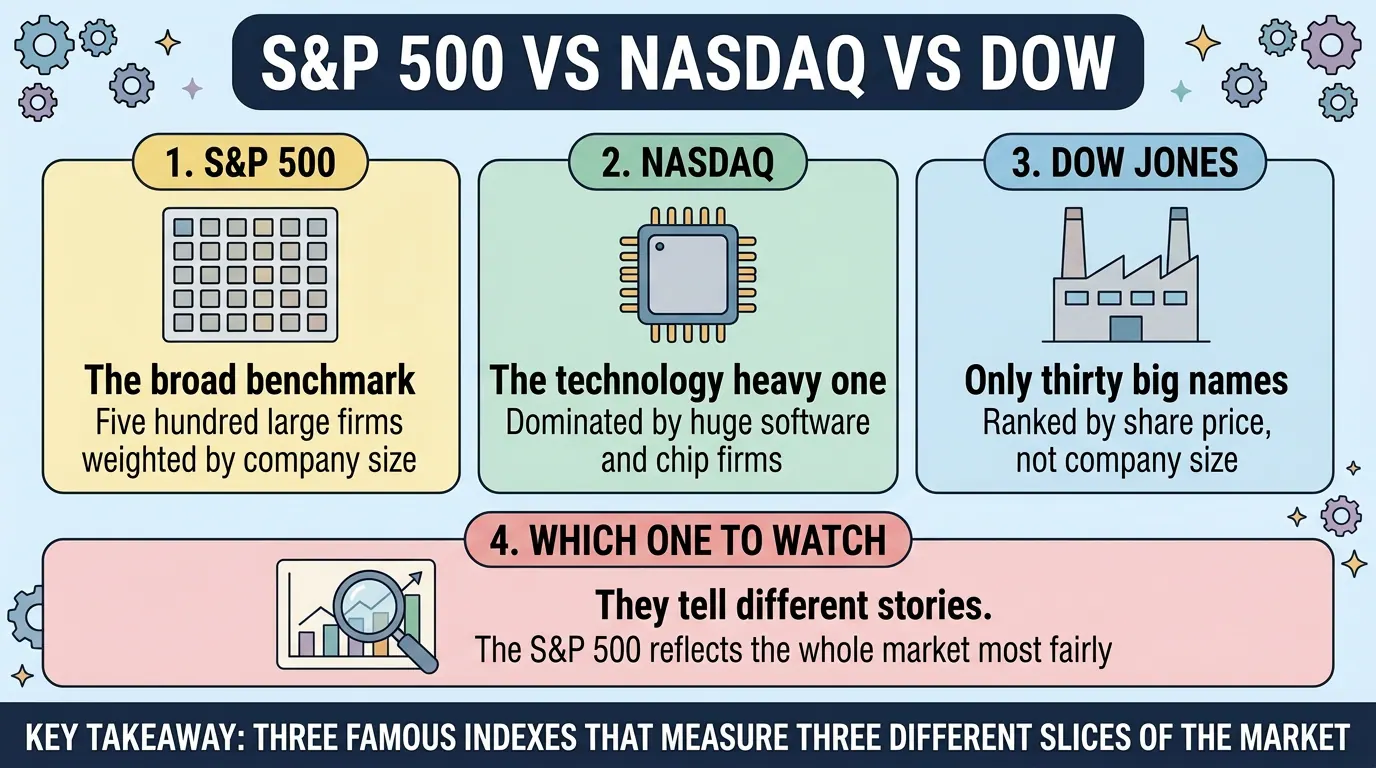
If you have ever heard someone say “The market is up today!”, they are likely talking about the S&P 500, Nasdaq, or Dow Jones - three of the most important indexes used to track the US stock market. This article will go over the basics of each index, how they are similar, and how they differ.
The S&P 500 Index (S&P 500)
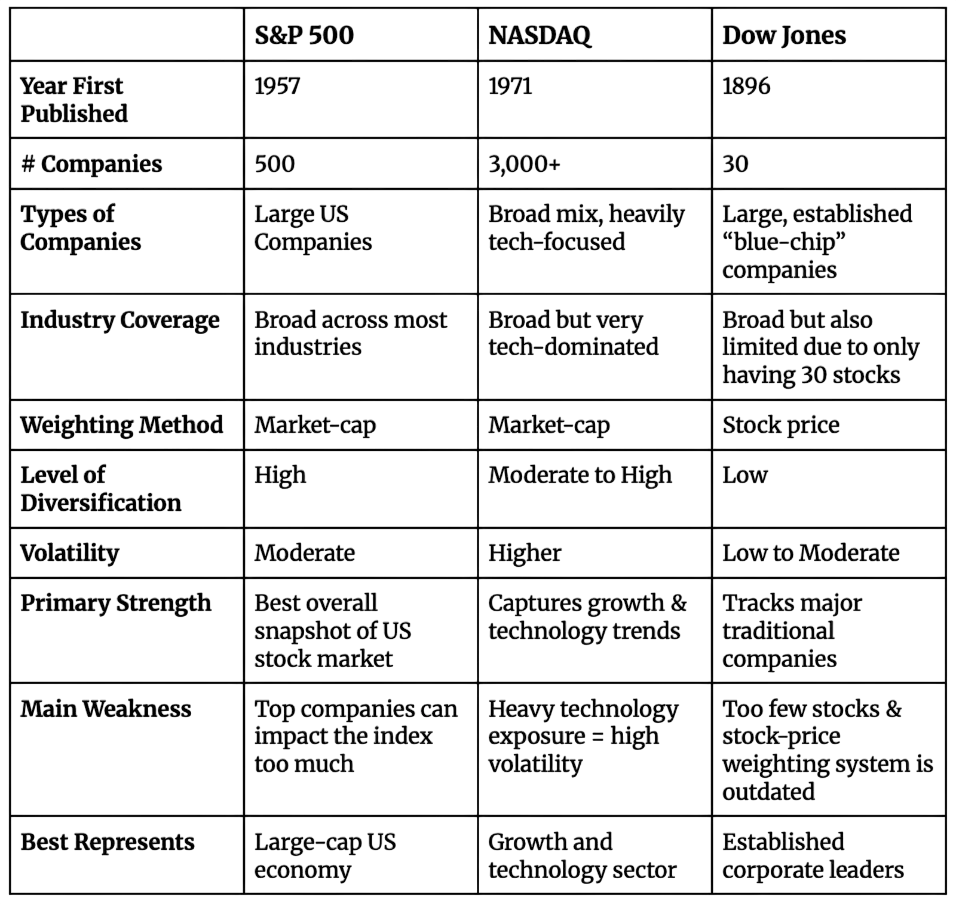
The S&P 500 tracks around 500 large US companies chosen by a committee on market value, liquidity and profitability, not strictly the 500 biggest. It is often considered the best overall measure of the U.S. stock market because it includes companies from nearly every major industry. Together, these companies make up about 80% of the total value of the U.S. stock market.
The S&P 500 is market-cap weighted. This means that companies with higher total value (market capitalization) have a bigger impact on the index. While this makes the index reflect the market more realistically, it also creates concentration risk (when a small group of companies impact an index a lot). As of August 2026, the ten largest companies account for well over a third of the entire index, and Nvidia alone makes up roughly 8% of it. If Nvidia’s stock moves sharply, it can noticeably affect the entire index.
The Nasdaq Composite Index (NASDAQ)
Unlike the S&P 500, the Nasdaq Composite Index contains over 3,000 stocks, containing many fast-growing technology companies. This makes them more risky, and because of this, the NASDAQ is often more volatile (moves up and down more) than other indexes. Similar to the S&P 500, the NASDAQ is also market-cap weighted (larger company = larger share of index). This means that the NASDAQ also faces the same issue as the S&P 500, where a small number of companies can influence the index quite a lot.
One point of confusion is worth clearing up. When people talk about investing in “the Nasdaq,” they almost always mean QQQ, an ETF that tracks the Nasdaq-100 rather than the Composite. The Nasdaq-100 holds only the 100 largest non-financial companies listed on the exchange, so it is a far more concentrated bet than the 3,000-stock Composite described above.
The Dow Jones Industrial Average (Dow Jones)
The Dow Jones is composed of 30 prominent companies listed on the US stock market. It is one of the oldest stock indexes, first published in 1896. The companies in the index are well-established “blue-chip” companies, which are leaders in their industries and tend to be stable, globally recognized brands. Unlike the S&P 500 and NASDAQ, the Dow Jones is share-price weighted. This means that companies with higher share (stock) prices have a larger influence on the index. This is different from market-cap weighted funds because share prices are not necessarily correlated with the company’s total size. To learn more about the difference between market cap and share price, read Market Capitalization: Understanding Company Size in the Stock Market.
Summary
These indexes are a great place to get started with investing, and offer the most reliable long-term return. The S&P is the best overall index, with the Nasdaq being the best index to invest in high-growth technology stocks. The Dow Jones is well-known but used less because of its price-weighting system and small number of stocks.