Roughly half of American renters carry no renters insurance, usually for one of two reasons. They assume the landlord's policy covers them, or they assume they do not own enough to bother insuring.
Both are wrong, and the second one is wrong in a way that is expensive.
The landlord's policy covers the building. It covers the walls, the roof, the plumbing, and the landlord's financial interest in all of it. It covers nothing you own and nothing you might be responsible for. If a pipe bursts in the unit above yours and destroys everything you own, the landlord's insurer repairs the building and you replace your possessions yourself.
What the Policy Actually Does
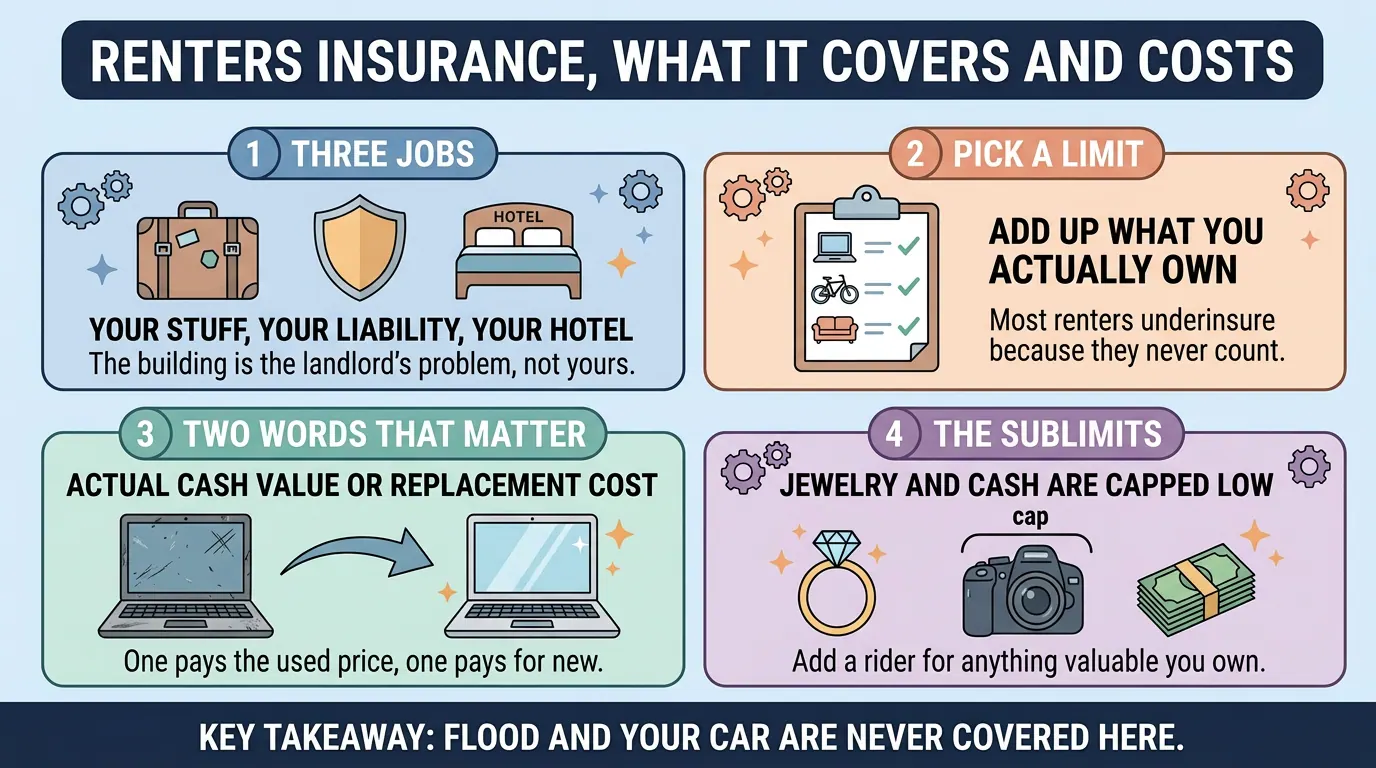
A renters policy has three parts, and the second one is the reason to buy it even if you genuinely own nothing.
Personal property. Replaces your belongings when they are stolen or destroyed by a covered cause. Fire, smoke, theft, vandalism, water damage from plumbing, and windstorm are standard.
Personal liability. Pays when you are legally responsible for injuring someone or damaging their property. Your dog bites a visitor. You leave a bathtub running and flood the two units below you. You knock a laptop off a table at a friend's apartment. Liability coverage handles the claim and, importantly, pays for your legal defense.
Loss of use. Pays for a hotel, meals, and additional living costs when your unit becomes uninhabitable. If a fire displaces you for three months, this is what covers the rent on a temporary place while you are still paying for the damaged one.
Standard liability limits start around $100,000 and can typically be raised to $300,000 or $500,000 for a few dollars a month. That is the cheapest coverage in the policy relative to what it protects.
Add Up What You Own
The "I don't own enough" objection collapses the moment you count.
Walk through a one-bedroom apartment and total the replacement cost:
Laptop and phone: $1,800
TV and gaming console: $900
Mattress and bed frame: $1,200
Couch, table, chairs, desk: $2,000
Clothing, shoes, coats: $2,500
Kitchen equipment, dishes, small appliances: $800
Bike, sports equipment, instruments: $900
That is roughly $10,000, and it is a conservative accounting of an unremarkable apartment. Now consider replacing all of it in one week after a fire, out of a checking account.
Typical cost for a policy covering that: somewhere around $150 to $300 per year.
Two Words That Decide What You Get Paid
This is the most consequential choice on the application and it is buried in a dropdown menu.
Actual cash value pays what your item is worth today, after depreciation. A five-year-old laptop that cost $1,400 might be valued at $300. That is the check you receive.
Replacement cost pays what it costs to buy a comparable new item. Same laptop, roughly $1,200 to $1,400 depending on current models.
Replacement cost typically raises the premium modestly, often by a few dollars a month, and it is close to a settled question. Depreciation on electronics and furniture is brutal, and actual cash value coverage tends to pay out a fraction of what a total loss actually costs you.
Note the mechanics: many replacement cost policies pay the depreciated amount first, then release the remainder after you buy the replacement and submit a receipt. You need some cash to front the purchase.
The Sublimits That Surprise People
Your policy has an overall limit, and then it has separate, much lower caps on specific categories. These are called sublimits, and nobody reads them until they file a claim.
Common examples on a policy with a $30,000 personal property limit:
Jewelry and watches: often capped near $1,500 for theft
Cash: frequently $200
Firearms: often $2,500
Electronics: sometimes capped separately
Collectibles, trading cards, and musical instruments: varies widely and often low
So an engagement ring worth $6,000 is covered up to $1,500. The fix is a scheduled personal property endorsement, sometimes called a rider, which insures a specific listed item for its appraised value. It costs extra and usually requires an appraisal, and for anything genuinely valuable it is the difference between being insured and being nominally insured.
What Is Never Included
Two exclusions are standard in every policy and both matter.
Flood. Not covered, ever, by a standard renters policy. Flood insurance is a separate product, sold through the National Flood Insurance Program or private insurers. Renters can buy contents-only flood coverage. If you live near water or in a low-lying area, this is a real gap.
Earthquake. Also excluded, also available as a separate policy or an endorsement, and relevant in far more of the country than most people assume.
Also excluded: your roommate's belongings, unless they are named on the policy, and damage from your own neglect or intentional acts.
Roommates and Cars
Two practical situations that come up constantly.
Roommates are not automatically covered by your policy. Each person generally needs their own, or you need to be listed together on one, which insurers often resist for unrelated tenants. Assume separate policies.
Your car is not covered by renters insurance, but items stolen from your car often are. Auto insurance covers the vehicle and its permanently installed equipment; the laptop in the back seat falls under your renters policy, subject to your deductible.
Getting It
The process takes about fifteen minutes online. You will be asked for your address, an estimate of your personal property value, your desired liability limit, and your deductible, which is the amount you pay out of pocket before the insurer pays anything. Deductibles are commonly $500 or $1,000, and raising it lowers your premium slightly.
Two things worth doing at signup. Ask about bundling, since carrying renters and auto insurance with the same insurer commonly cuts the auto premium by enough to make the renters policy close to free. And photograph or video every room, including inside closets and drawers, then store it somewhere that is not your apartment. Proving what you owned is the hardest part of any total-loss claim.
Summary
Your landlord's insurance covers the building and nothing you own, so a renters policy exists to replace your belongings, pay for damage or injury you are responsible for, and cover temporary housing if your unit becomes uninhabitable. A typical one-bedroom apartment holds around $10,000 of replaceable property against a premium of roughly $150 to $300 per year. Choose replacement cost rather than actual cash value, because depreciation on electronics and furniture pays out a fraction of what a total loss costs. Check the sublimits on jewelry and other categories, and remember that flood and earthquake damage are excluded from every standard policy and must be bought separately.