Coca-Cola has paid a cash dividend every year since 1920 and raised it every year for more than six decades. Own the shares and money arrives in your account roughly every three months, without you selling a thing.
That is a dividend. A company takes part of its profit and hands it to the people who own it, in cash. It is one of the two ways a stock pays you back, the other being a rising price.
Plenty of huge, successful companies pay nothing, which is rarely a warning sign. Paying says more about a company's stage of life than its quality.
What a Dividend Is
Dividends are quoted per share. Declare 51 cents a share, own 200 shares, and $102 shows up. Four payments a year makes $408.
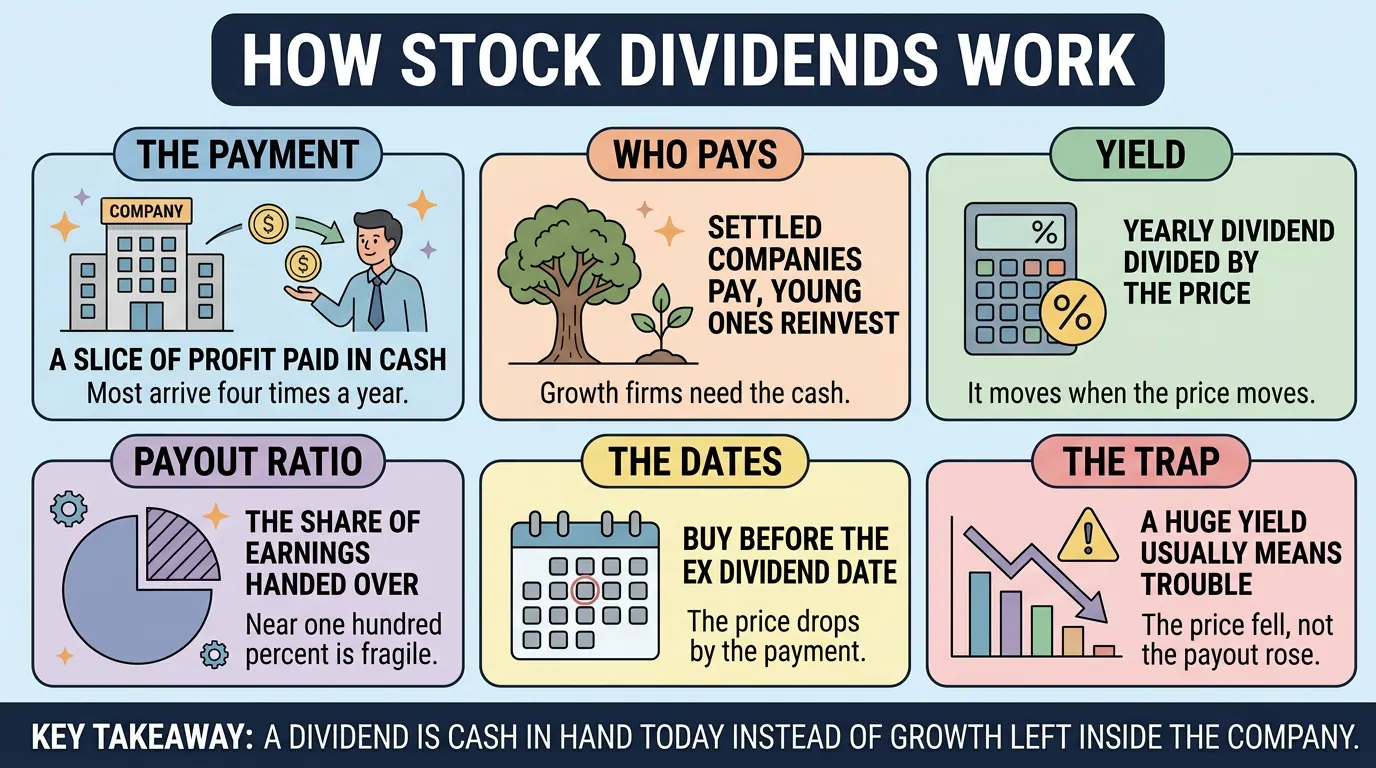
Most US payers pay quarterly. The amount is set by the board of directors, the group shareholders elect to oversee the company. It is a decision, not an obligation: boards can raise, freeze, cut, or cancel it.
Why Some Companies Pay and Others Reinvest
A company with profit must do something with the cash: reinvest it, pay down debt, buy back shares, or pay a dividend.
Fast-growing companies usually reinvest, because a dollar spent on engineers or new stores can become several dollars of future profit. Alphabet, the parent of Google, paid nothing for nearly twenty years after its 2004 listing and declared its first dividend in 2024. Mature companies generate more cash than they can usefully spend on themselves.
Cutting an established dividend reads as an admission of trouble and the stock usually drops hard, so boards set the payment where they can hold it through a bad year.
Dividend Yield
Dividend yield converts the payment into a percentage so stocks can be compared. It is the annual dividend per share divided by the current price, so a $50 stock paying $2 yields 4%.
Notice what sits in the denominator. Price moves every second the market is open while the dividend changes maybe once a year, so yield moves mostly because price moved. If that $50 stock falls to $25 on bad news and the dividend has not changed, the yield is 8%. It doubled because the market decided the company is worth half as much, often anticipating a cut.
The Payout Ratio
The payout ratio is the dividend per share divided by earnings per share (profit divided by share count). Earn $4, pay $2, and the payout ratio is 50%.
High or low depends on the industry. Utilities and consumer staples often run 60% to 80% on steady earnings, while technology companies often run under 20%. A real estate investment trust (REIT), which owns income-producing property, must legally distribute at least 90% of taxable income, so a number that looks alarming elsewhere is routine there. Above 100% means paying out more than was earned, which reserves or borrowing cover briefly and not forever.
The Four Dates
Every dividend runs through four dates, and confusing them is the classic beginner mistake.
Declaration date. The board announces the dividend and the dates that follow. Until then nothing is owed.
Ex-dividend date. The cutoff. Buy on or after it and the dividend goes to the seller. "Ex" means without, as in trading without the right to the payment.
Record date. The day the company checks its books for registered shareholders. Under the T+1 settlement rules the US adopted in May 2024, trades finalize one business day after placement, so the ex-dividend and record dates now coincide.
Payment date. The cash arrives, usually two to six weeks later.
Why the Price Drops on the Ex-Dividend Date
On the morning a stock goes ex-dividend, it typically opens lower by roughly the dividend. A company committed to handing out $1 per share in cash is worth about $1 per share less, so a stock closing at $50 with a $1 dividend coming tends to open near $49.
That closes a loophole beginners think they have found. Buying the day before the ex-date to collect the payment produces nothing. You receive $1 and your shares are worth $1 less, and in a taxable account you finish behind, owing tax on it.
How Dividends Are Taxed
US tax law sorts dividends into two buckets. Qualified dividends get long-term capital gains rates of 0%, 15%, or 20%, depending on taxable income. The payment must come from a US or qualified foreign corporation, and the shareholder must have held the stock more than 60 days during the 121-day window beginning 60 days before the ex-dividend date. That rule exists to stop people from buying in the day before the ex-date to harvest the lower rate.
Ordinary dividends, also called non-qualified, are taxed like wages, topping out at 37%. REIT and bond fund payments usually land here, since what they distribute is really interest. High earners can owe an extra 3.8% net investment income tax either way. None of this applies inside a 401(k) or IRA.
Automatic Reinvestment
A dividend reinvestment plan, or DRIP, spends each dividend on more shares of the same stock automatically. Brokers usually allow fractional shares, so a $102 dividend on a $340 stock buys 0.3 of a share, and more shares produce a bigger dividend next quarter.
In a taxable account, reinvested dividends are still taxed the year they are paid even though no cash was received, and every purchase adds to the cost basis, the running total treated as invested. Ignoring basis means paying tax twice on the same dollars.
Dividend Aristocrats
The S&P 500 Dividend Aristocrats are index members that have raised their dividend every year for at least 25 consecutive years while meeting minimum size and trading-volume rules. As of 2026 there are 69, the most since the list started in 1989.
That filter means raising the payment through the dot-com crash, the 2008 crisis, and the 2020 shutdown. It still describes only the past: AT&T sat on the list for decades until a 2022 dividend cut removed it.
The High-Yield Trap
Sorting a screener by highest yield produces a list that looks generous and is mostly a list of companies in trouble.
Yield rises when price falls, prices fall when investors expect worse earnings, and worse earnings put the dividend at risk. The highest yields in the market are often attached to dividends about to be cut, and when the cut lands the shareholder loses the income and takes another drop in price. A 9% yield is a 9% return only if the payment holds, and the payout ratio, the earnings trend, and the debt load indicate whether it will.
Summary
A dividend is cash paid out of profit at a board's discretion, usually quarterly, and companies that reinvest instead are not worse companies. Yield is the annual dividend over price, so a falling price inflates it, while the payout ratio is the better test of whether a payment survives. Qualified dividends get capital gains rates, ordinary dividends are taxed like wages, and reinvested dividends still get taxed the year they are paid.