Here is a mistake that costs people years of growth and is almost never discovered until far too late.
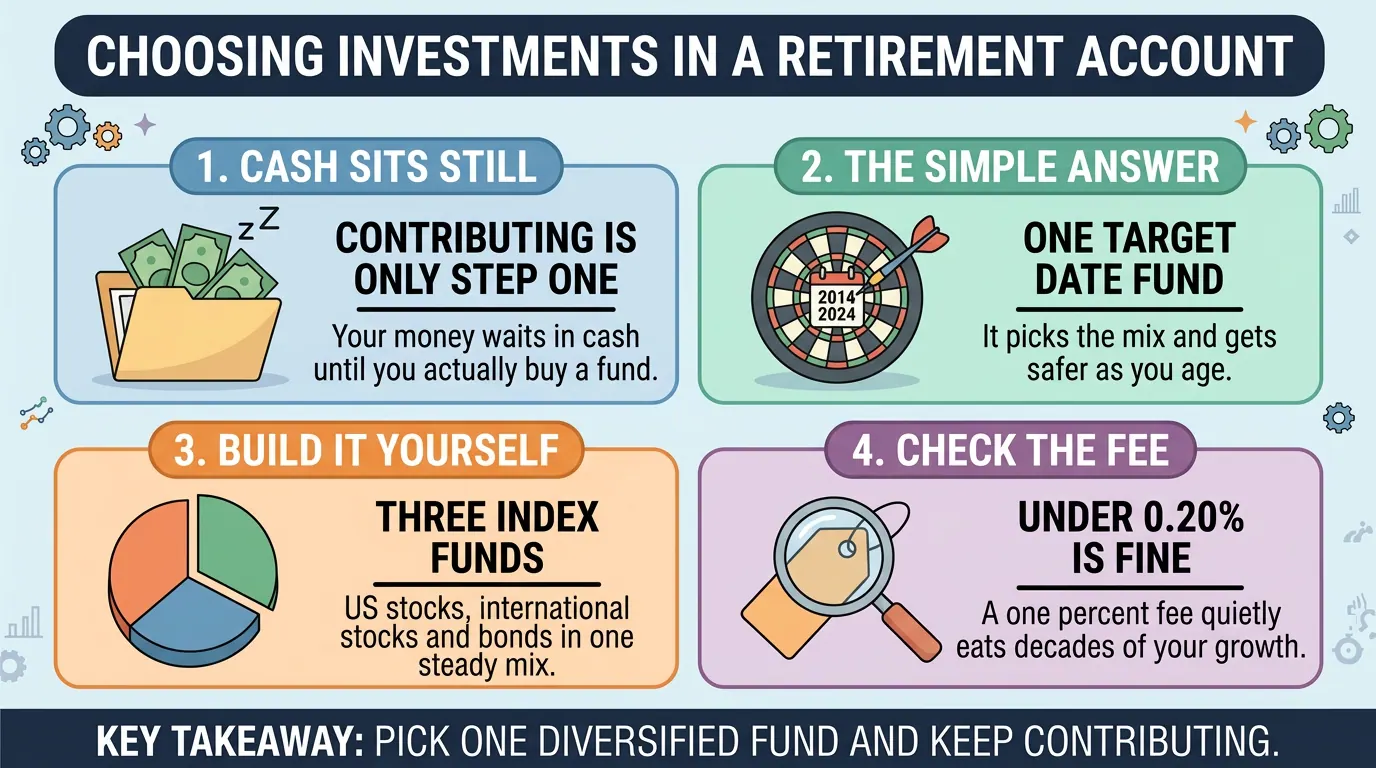
You sign up for your 401(k) at work. You pick a contribution percentage. Money starts leaving your paycheck. You feel responsible. Four years later you log in and discover the entire balance has been sitting in something called a money market fund, earning almost nothing, because signing up for the account and choosing what to buy inside it are two separate steps and nobody told you about the second one.
A retirement account is a container, not an investment. A 401(k) is the workplace version, funded from your paycheck. An IRA is the version you open yourself at a brokerage. Both are empty until you fill them.
This article is about filling them.
What You Are Choosing Between
Open the investment menu in a workplace plan and you will typically see somewhere between ten and thirty options, nearly all of them mutual funds. A mutual fund is a pooled basket holding many different stocks or bonds, which you buy as a single share. Buying one share of a stock fund makes you a part owner of hundreds of companies at once.
The menu usually sorts into four categories:
Stock funds. Ownership in companies. Highest long-run growth and the largest year-to-year swings.
Bond funds. Loans to governments and corporations. Lower growth, much steadier.
Target-date funds. A prepackaged mix of the two that changes over time.
Money market or stable value funds. Cash equivalents. Almost no growth. This is where uninvested money often sits by default.
Two more terms you will encounter. An index fund simply holds everything in a market index, such as all 500 companies in the S&P 500, rather than paying a manager to pick winners. An actively managed fund pays that manager. The index version is cheaper, and the cost difference matters enormously over decades.
The Simplest Correct Answer
For most beginners, the right choice is a single target-date fund, and choosing it takes about two minutes.
A target-date fund is named for the year you expect to retire, such as a "2065 Fund." You pick the one closest to your expected retirement year and buy it. That is the entire process.
What it does internally is handle the one decision that actually matters, which is how much of your money sits in stocks versus bonds. When you are 25, the fund holds mostly stocks, because you have forty years to ride out downturns. As the target year approaches, it gradually shifts toward bonds, because someone retiring in three years cannot afford a 35% drop. That gradual shift is called a glide path.
You do not rebalance it. You do not adjust it as you age. You do not have to know what an asset allocation is. The fund does all of it.
Target-date funds are the default in most modern plans for exactly this reason. They are offered in roughly 95% of large plans, and about 60% of participants hold a single one.
One detail worth checking. Some target-date funds keep de-risking for years after the target date, and some stop adjusting at the target date. The industry calls these "through" and "to" glide paths. It rarely matters much for someone forty years out, but it is a reasonable thing to look at once you are close.
Building It Yourself
If you would rather assemble your own, three funds cover nearly everything a beginner needs:
A total US stock market index fund
A total international stock index fund
A total bond market index fund
A common starting mix for someone in their twenties is heavily weighted toward the two stock funds with a small bond position, shifting toward bonds over the decades. The tradeoff versus a target-date fund is that you now have to rebalance yourself, meaning periodically selling whatever grew and buying whatever lagged to return to your intended percentages. Most people either do this poorly or forget entirely, which is the argument for just buying the target-date fund.
Check the Expense Ratio Before You Buy Anything
Every fund charges an annual fee expressed as a percentage of your balance, called an expense ratio. A 0.05% ratio costs $5 per year on a $10,000 balance. A 1.00% ratio costs $100 for the same balance.
That gap sounds trivial and is not, because the fee compounds against you every year for as long as you hold the fund. Two people with identical contributions and identical market returns can end up tens of thousands of dollars apart based on nothing but which fund they picked from the same menu.
Reasonable numbers to expect:
Index funds: often 0.02% to 0.10%
Target-date funds: the industry asset-weighted average was 0.27% in 2025, down from roughly 0.55% a decade earlier
Actively managed funds: frequently 0.50% to 1.00% or higher
Every fund publishes its expense ratio on a one-page document called a fact sheet, and your plan is required to disclose fees to you. If two funds on your menu track the same index, the cheaper one is the better one. There is no version of this where paying more for the same holdings helps you.
The Mistake to Avoid Twice
Two versions of the same error account for most of the damage beginners do to themselves.
The first is leaving money uninvested, as described above. Log into your account and confirm the balance is actually in a fund, not in a cash holding option. If you have never done this, do it today.
The second is selling during a downturn. Stocks lost roughly 37% in 2008. Someone who moved their balance to cash at the bottom locked in that loss and missed the recovery. Someone who did nothing at all recovered fully and kept compounding. The target-date fund cannot protect you from this, because it requires you to leave it alone. Doing nothing during a crash is an active skill, and it is worth more than any fund selection you will ever make.
Summary
Enrolling in a retirement account does not invest your money, and confirming that your balance is actually in a fund rather than a cash option is the single most important thing to check. For most beginners a single target-date fund named for the year closest to your retirement is the correct answer, because it manages the stock-to-bond mix automatically through a glide path. If you build your own portfolio instead, a total US stock fund, a total international stock fund, and a total bond fund cover nearly everything. Compare expense ratios before choosing anything, since index funds commonly charge under 0.10% while actively managed funds often charge ten times that for the same market exposure.