Car insurance is mandatory in nearly every state, which means most drivers buy it without understanding it. They pick the cheapest option, get a card for the glovebox, and discover what they actually purchased at the worst possible moment.
A car policy is not one product. It is a bundle of separate coverages, each doing a different job. Knowing which is which is the whole skill.
Two words appear throughout. Your premium is what you pay to have the policy, usually monthly or every six months, whether or not you ever file a claim. Your deductible is what you pay out of pocket on a claim before the insurer pays anything, so a $500 deductible on a $3,000 repair means you pay $500 and the insurer pays $2,500.
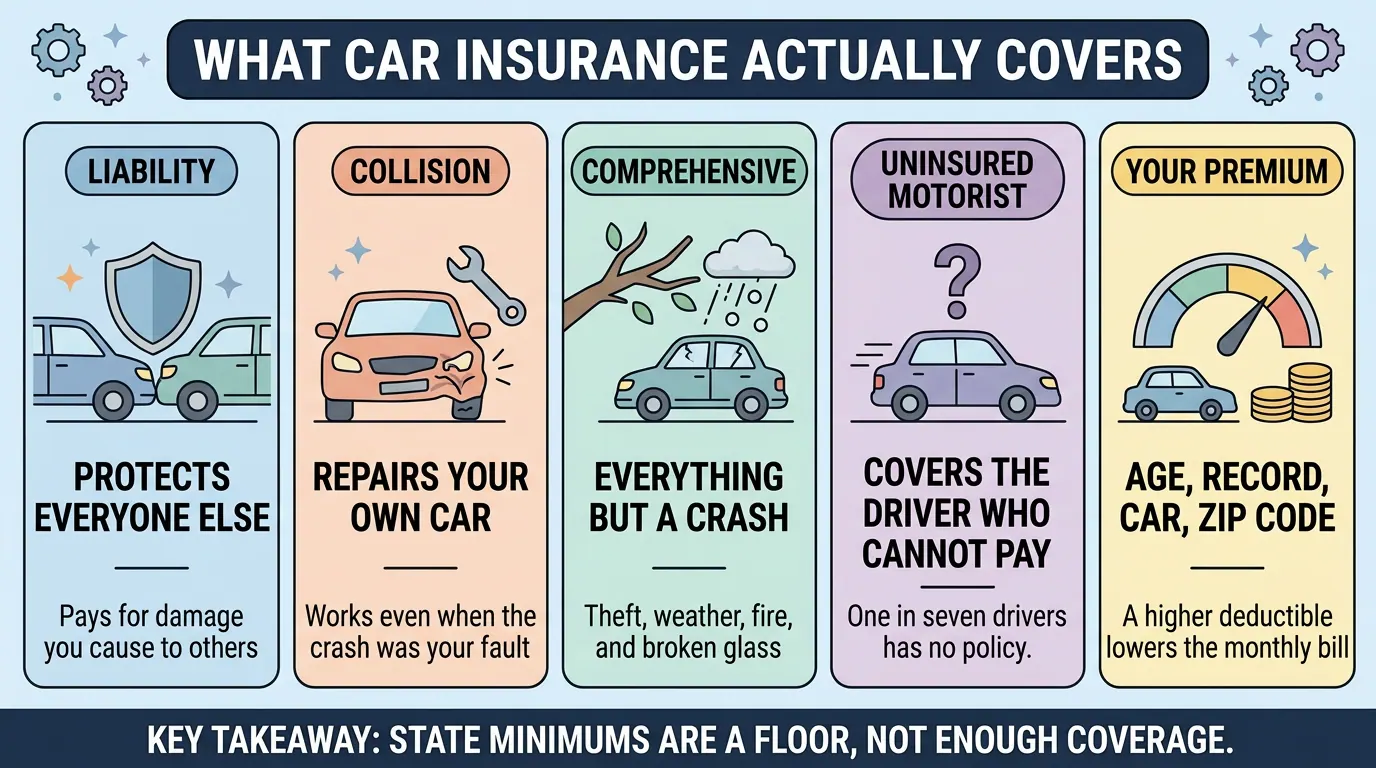
Liability: The Part That Protects Everyone Else
Liability coverage pays for damage and injuries you cause to other people. It pays nothing toward your own car or your own injuries.
This is the coverage your state requires, and the reason it is required is that the alternative is uncompensated victims.
Liability is usually written as three numbers, like 100/300/100. Every driver should be able to read them:
100 = up to $100,000 for bodily injury per person you injure
300 = up to $300,000 for bodily injury per accident, total, across everyone
100 = up to $100,000 for property damage you cause
An accident where you injure two people might use $80,000 for one and $150,000 for the other. The first is under the $100,000 per-person cap. The second exceeds it, so the policy pays $100,000, and you owe the remaining $50,000 personally.
State Minimums Are Not a Recommendation
State minimum requirements are floors set by legislatures, and many were set decades ago and never meaningfully updated.
California's minimum, for example, is 30/60/15. That $15,000 property damage limit is the part to notice, because the average new car now costs well over $40,000. Total someone's SUV with minimum coverage and you are personally responsible for most of it.
This is where car insurance becomes a wealth protection question rather than a compliance question. If you cause a serious injury accident, the injured party can pursue your income and assets for anything your policy does not cover. Raising liability limits from a state minimum to 100/300/100 typically costs a modest amount per month, because severe accidents are rare and the insurer prices them accordingly. It is one of the better values in insurance.
Collision and Comprehensive: The Part That Protects Your Car
Neither of these is required by law. Both are usually required by your lender if you financed the car.
Collision covers damage to your car from a crash, whether you hit another vehicle, a guardrail, or a tree.
Comprehensive covers damage to your car from almost everything that is not a crash: theft, vandalism, hail, fire, falling branches, and animal strikes.
Both come with a deductible, commonly $500 or $1,000, that you pay before the insurer pays.
The important limitation: both pay based on your car's actual cash value, meaning what it is worth today, not what you paid or what a replacement costs. If your car is worth $4,000 and you carry a $1,000 deductible, the most you can collect is $3,000. At some point the coverage stops being worth its premium, and a common rule of thumb is to reconsider once your annual premium for collision and comprehensive approaches roughly 10% of the car's value.
Uninsured Motorist: The Coverage People Skip and Regret
Roughly one in seven drivers in the United States is uninsured, and many more carry only bare minimum limits.
Uninsured motorist coverage pays for your injuries when the at-fault driver has no insurance. Underinsured motorist coverage pays when they have some, but not enough.
Think about what happens without it. A driver with minimum coverage runs a red light and injures you badly. Your medical bills reach $150,000. Their policy caps out at $25,000. They have no assets worth pursuing. Without uninsured or underinsured coverage, the remaining $125,000 is your problem.
This coverage is inexpensive relative to what it does, because it protects you against other people's decisions. It is required in some states and optional in others, and it is the single coverage most worth adding when it is optional.
The Other Pieces
Personal injury protection (PIP), sometimes called no-fault coverage, pays your and your passengers' medical costs and lost wages regardless of fault. Required in no-fault states such as Florida, Michigan, and New Jersey.
Medical payments (MedPay) is a smaller version of the same idea, covering medical bills for you and your passengers without regard to fault.
Gap insurance covers the difference between what you owe on a car loan and what the car is worth if it is totaled. Because new cars lose value faster than loans amortize, a totaled car can be worth less than the remaining loan balance, leaving you paying for a car you no longer have. Relevant mainly if you financed with a small down payment.
What You Will Pay and Why
Nationally, full coverage averages roughly $2,200 to $2,900 per year depending on which survey you read, while minimum liability alone averages somewhere between about $600 and $1,600, with most national surveys landing near $700. Both figures vary enormously.
The main pricing factors:
Age and driving experience. Drivers under 25 pay substantially more, and it drops noticeably at 25.
Location. Rates are set by ZIP code based on local accident, theft, and repair costs. Estimates for Maryland full coverage range from about $1,800 to $4,200 a year depending on the source, with most landing near $3,100. Rural states are far cheaper.
Driving record. An at-fault accident or a speeding ticket typically raises rates for three to five years.
Vehicle. Repair cost and theft rate matter more than sticker price.
Credit-based insurance score. Legal in most states and prohibited in California, Hawaii, Massachusetts, and Michigan.
At-Fault vs. No-Fault States
In an at-fault state, the driver who caused the accident is responsible, and their liability coverage pays the other party.
In a no-fault state, each driver's own PIP coverage pays their own medical bills regardless of who caused it, and the ability to sue is limited to more serious injuries.
This affects which coverages you need and what happens after a crash, so it is worth knowing which system your state uses before you buy.
Summary
A car insurance policy bundles separate coverages: liability pays for harm you cause others, collision and comprehensive pay for damage to your own car, and uninsured or underinsured motorist coverage pays when the at-fault driver cannot. Liability is written as three numbers such as 100/300/100, representing per-person injury, per-accident injury, and property damage limits, and state minimums are frequently far too low to protect your assets. Collision and comprehensive pay only your car's current value minus your deductible, so both become questionable on older vehicles. Uninsured motorist coverage is the most commonly skipped and most worth adding, given that roughly one in seven US drivers carries no insurance at all.