Health insurance is where people discover that having insurance is not the same as having your bills paid. You can be fully insured, walk out of a hospital, and receive a bill for thousands of dollars, and nothing went wrong.
Four terms explain why. They work in sequence, and once you can see the sequence, health plan documents stop being cryptic.
One term sits outside the sequence and should be cleared up first. Your premium is what you pay every month simply to have the plan, whether you use it or not. It is rent on the coverage. Everything below is what you pay on top of the premium when you actually receive care.
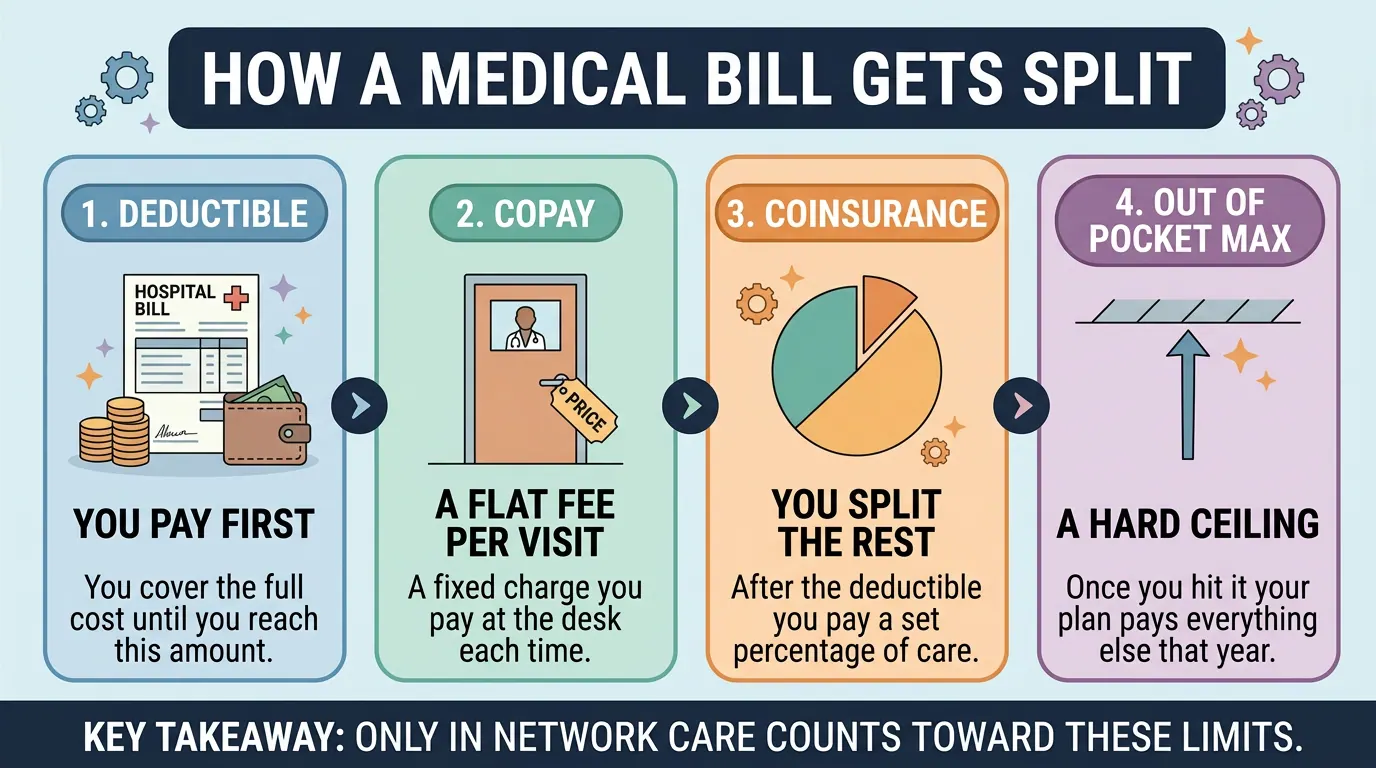
The Four Terms
Deductible. What you pay out of pocket before the plan starts paying for most services. A $2,000 deductible means the first $2,000 of covered care is on you.
Copay. A flat fee for a specific service, such as $30 for a doctor visit or $15 for a prescription. Copays are often charged even before you meet your deductible.
Coinsurance. After your deductible is met, you and the plan split costs by percentage. "20% coinsurance" means you pay 20% and the plan pays 80%.
Out-of-pocket maximum. The absolute annual ceiling on what you pay for covered in-network care. Once you hit it, the plan pays 100% for the rest of the year. Your deductible, copays, and coinsurance all count toward it. Your premiums do not.
That last term is the one most people have never heard of, and it is the most important. The out-of-pocket maximum is the number that determines your worst-case year.
Running One Claim Through the Sequence
Take a plan with a $2,000 deductible, 20% coinsurance, and a $8,000 out-of-pocket maximum. You need surgery that costs $52,000.
Step one: the deductible. You pay the first $2,000. Running total paid by you: $2,000.
Step two: coinsurance. $50,000 of the bill remains. At 20%, your share would be $10,000.
Step three: the ceiling. You have already paid $2,000 toward your $8,000 maximum, so only $6,000 of room remains. You pay $6,000 in coinsurance and then stop, because you have hit the ceiling.
Your total cost: $8,000. The plan covers the remaining $44,000. Every additional covered in-network service for the rest of that plan year costs you nothing.
Without insurance, that surgery costs $52,000. With this plan, it costs $8,000 plus your premiums. That is what you bought.
Why the Ceiling Is the Number That Matters
When comparing plans, people fixate on the premium, then on the deductible. Both matter, but the out-of-pocket maximum defines your actual exposure to disaster.
A plan with a $500 deductible and a $9,000 out-of-pocket maximum can cost you more in a catastrophic year than a plan with a $3,000 deductible and a $5,000 maximum. The second plan looks worse on the headline number and protects you better where it counts.
There is a legal cap on how high that maximum can go. For 2026, ACA-compliant plans cannot exceed $10,600 for an individual or $21,200 for a family. That figure is reset annually, and it rose sharply from $9,200 in 2025, so check the current year rather than assuming.
The Trap: In-Network vs. Out-of-Network
Every number above applies to in-network care, meaning providers who have a contract with your insurer.
Go out-of-network and the arithmetic changes completely. Many plans have a separate, much higher out-of-network deductible and maximum. Some plans, including most HMOs and EPOs, do not cover out-of-network care at all except in emergencies.
This is where surprise bills come from. A patient carefully confirms their hospital is in-network, and then the anesthesiologist working in that hospital turns out not to be. Federal protections now cover many of these situations, particularly emergency care, but the general rule stands: the network is the single most important feature of a health plan, and confirming it is worth the phone call every time.
The Premium Is Separate from All of This
One clarification that trips people up: premiums do not count toward your deductible or your out-of-pocket maximum.
If your plan costs $250 a month and you have a $8,000 out-of-pocket maximum, a catastrophic year costs you $3,000 in premiums plus $8,000 in care, for $11,000 total. The premium is what you pay for having the plan. The out-of-pocket maximum is what you pay for using it.
This is also why comparing plans on premium alone is a mistake. A plan $80 a month cheaper saves you $960 a year and might expose you to $4,000 more in a bad year.
Summary
Health insurance costs work in a sequence: you pay the deductible first, then split costs with the plan through coinsurance, until you reach the out-of-pocket maximum, after which the plan covers everything for the rest of the year. Copays are flat fees for specific services and often apply before the deductible is met. On a plan with a $2,000 deductible, 20% coinsurance, and an $8,000 ceiling, a $52,000 surgery costs you exactly $8,000. The out-of-pocket maximum, capped at $10,600 for individuals in 2026, defines your worst-case year and matters more than the deductible, and all of these figures apply only to in-network care.