A health savings account is marketed as a way to pay medical bills. That is what it says on the box, and it is why most people who have one treat it as a checking account for copays.
It is also, by a technical accident of tax law, the most tax-advantaged account available to an American saver. Used deliberately, it beats both a 401(k) and a Roth IRA.
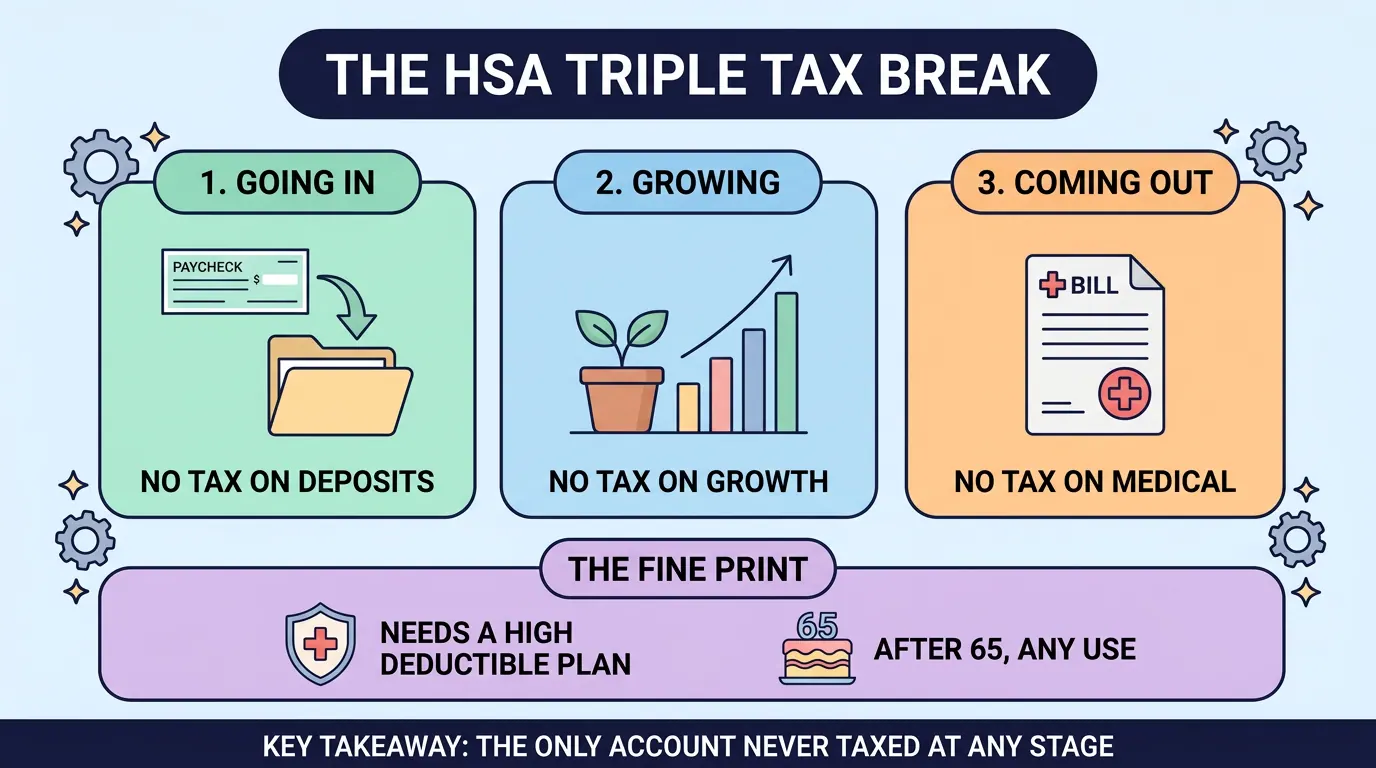
The reason is that it is the only account that is never taxed at any point.
The Three Tax Breaks
Compare how each account is treated at three moments: going in, growing, and coming out.
Traditional 401(k) or IRA. No tax going in, no tax on growth, taxed coming out.
Roth IRA. Taxed going in, no tax on growth, no tax coming out.
HSA. No tax going in, no tax on growth, no tax coming out for qualified medical expenses.
Every other account gives you two of the three. The HSA gives you all of them. Contributions reduce your taxable income now, the balance grows without being taxed, and withdrawals for medical costs are tax free forever.
Contributions made through your employer's payroll also avoid Social Security and Medicare payroll tax, which is a fourth advantage no retirement account offers.
Who Can Have One
The catch is the eligibility requirement. To contribute to an HSA, you must be covered by a high deductible health plan and no other disqualifying coverage.
A deductible is what you pay out of pocket for care before your plan starts paying. For 2026, a plan qualifies as high deductible if it has a deductible of at least $1,700 for individual coverage or $3,400 for family coverage, and an out-of-pocket maximum no higher than $8,500 individual or $17,000 family. That out-of-pocket maximum is the annual ceiling on what you can be charged for covered in-network care.
You cannot contribute if you are enrolled in Medicare, claimed as a dependent on someone else's return, or covered by a general-purpose health flexible spending account.
For 2026 the contribution limits are $4,400 for individual coverage and $8,750 for family coverage, with an additional $1,000 catch-up contribution allowed once you turn 55. Both limits are adjusted annually. Note that the cap is an aggregate one covering everything deposited for the year, including whatever your employer contributes, so an employer putting in $1,000 leaves you $3,400 of room on individual coverage rather than the full $4,400.
An HSA Is Not an FSA
These get confused constantly, and the difference is the single most important thing to understand.
A flexible spending account, or FSA, is use-it-or-lose-it. You elect an amount for the year, and unspent money is generally forfeited, though employers may allow a limited carryover. The 2026 FSA limit is $3,400 with a carryover of up to $680. FSAs also belong to your employer, so leaving your job usually ends the account.
An HSA has no deadline. Money rolls over year after year with no expiration. It belongs to you, not your employer, so it follows you across jobs and into retirement. And it can be invested rather than sitting in cash.
That last point is where most HSA holders leave money on the table. Many providers park the entire balance in a low-interest cash account by default and require you to opt in to investing, sometimes only above a minimum balance. If you have had an HSA for years and never checked, log in and look.
The Strategy That Makes It a Retirement Account
Here is the approach that converts an HSA from a medical checking account into the best savings vehicle you have.
Contribute the maximum. Invest the balance rather than holding cash. Then pay your current medical bills out of pocket from ordinary savings, and leave the HSA alone to compound for decades.
The mechanism that makes this work is that HSA reimbursements have no deadline. There is no rule requiring you to withdraw the money in the same year you incurred the expense. A medical bill you paid in 2026 can be reimbursed from your HSA in 2056, tax free, provided you kept the receipt.
So you keep every medical receipt, whether or not you use it now. Decades later you hold a stack of documented expenses that entitles you to pull that amount out of a much larger, fully compounded balance without paying tax on any of it.
The cost of this strategy is real: it requires having enough cash to absorb medical bills without touching the account. If you cannot do that, using the HSA for its stated purpose is entirely reasonable and still tax advantaged. This is an optimization, not a requirement.
What Happens at 65
The rules loosen substantially once you turn 65, which is what completes the case for treating an HSA as retirement savings.
After 65, withdrawals for non-medical purposes no longer carry the 20% penalty that applies before then. They are simply taxed as ordinary income.
Read that carefully. After 65, an HSA behaves exactly like a traditional IRA for any purpose at all, and better than a traditional IRA for medical expenses, which are tax free. There is no scenario in which it is worse.
It also remains useful for costs Medicare does not cover, and there are many: dental work, vision, hearing aids, and long-term care premiums. Medicare premiums themselves can be paid from an HSA, though Medigap supplement premiums cannot.
One important sequencing note. You cannot contribute to an HSA once enrolled in Medicare, and there is a six-month lookback rule that can create excess contributions if you enroll mid-year. Anyone still contributing near 65 should stop contributing six months before Medicare enrollment.
Where It Fits in the Order
A reasonable priority sequence for someone with access to all of these:
Contribute to your 401(k) up to the full employer match, since a match is free money available nowhere else.
Max the HSA, because it is the only triple-tax-free account.
Fund a Roth IRA or return to the 401(k).
Reasonable people put step two above step one, and if your employer offers no match, the HSA is unambiguously first.
Summary
A health savings account is the only account that avoids tax on contributions, on growth, and on qualified medical withdrawals, which makes it more tax efficient than either a 401(k) or a Roth IRA. Eligibility requires a high deductible health plan, which for 2026 means a deductible of at least $1,700 individual or $3,400 family, and the contribution limits are $4,400 and $8,750 respectively. Unlike a flexible spending account, an HSA never expires, belongs to you rather than your employer, and can be invested. Because reimbursements have no time limit, paying medical bills out of pocket while saving receipts lets the invested balance compound for decades, and after 65 non-medical withdrawals are simply taxed as income with no penalty.