People with excellent credit scores get turned down for mortgages every day. Not for missed payments, not for collections, and not for anything visible on the credit report at all.
The number that stopped them is the debt-to-income ratio, and it lives nowhere near your score. It is calculated fresh by the lender, from your pay stubs and your credit report combined, and at the underwriting table it often carries more weight than the three-digit number everyone worries about.
The Formula
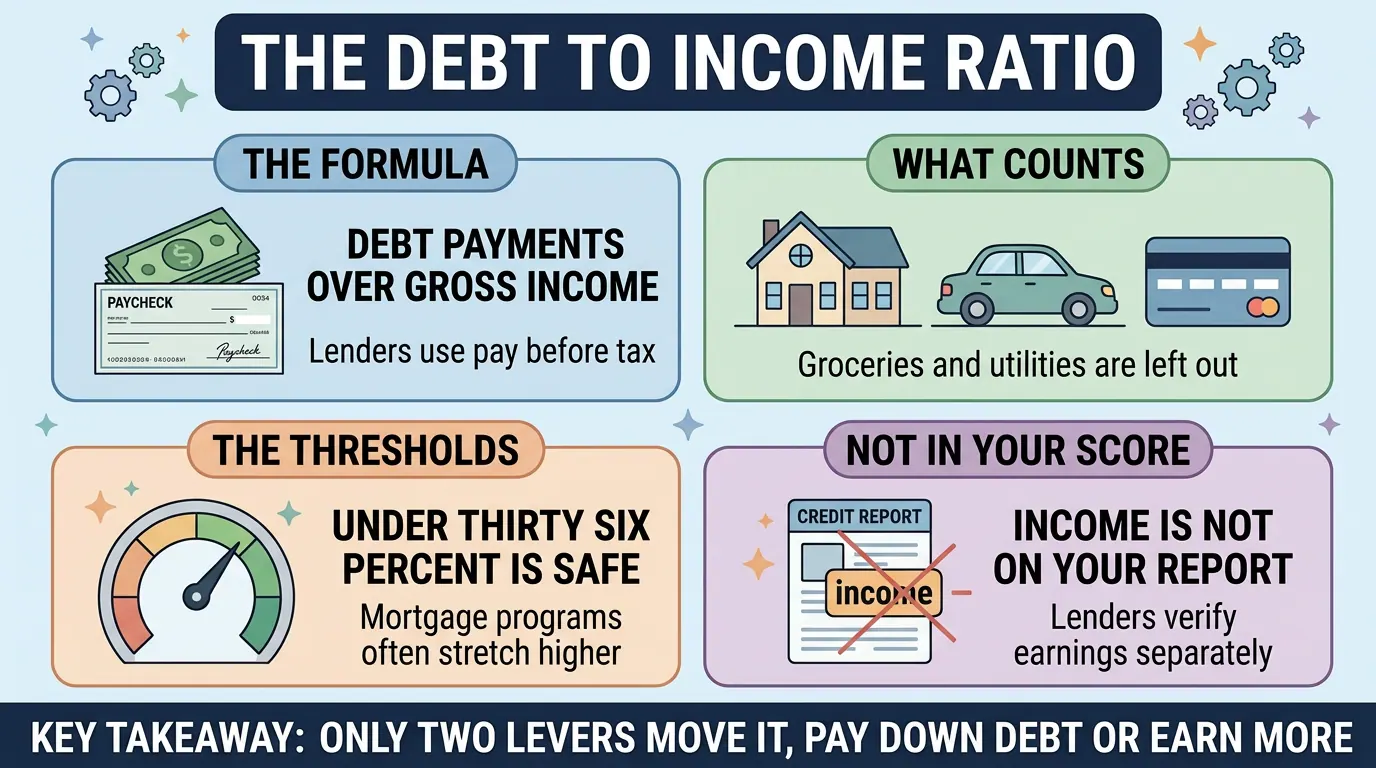
Add up your required monthly debt payments. Divide by your gross monthly income. That is the ratio, usually written as a percentage.
Gross means before taxes and deductions, the top-line figure on your pay stub. Lenders use gross because it is easy to verify and consistent from borrower to borrower, but the choice quietly flatters the result. Someone at 36% of gross income is committing closer to 45% of the money that actually reaches their bank account, because payroll taxes and retirement contributions came out in between. The ratio is a lender's screening tool, not a household budget.
Front-End and Back-End
Mortgage lenders run two versions of the calculation.
The front-end ratio, also called the housing ratio, counts only the proposed housing payment: principal, interest, property taxes, homeowners insurance, mortgage insurance if required, and any homeowners association dues.
The back-end ratio counts that housing payment plus every other monthly debt obligation you carry.
The back-end ratio is the one that usually decides the application. The front-end is a check on whether the house alone is too much regardless of your other debts.
What Counts and What Does Not
Counted are the obligations a court could enforce: minimum credit card payments as reported on your credit report, auto loan and lease payments, student loan payments, personal loans, and court-ordered child support or alimony. Loans you cosigned count too, even if someone else has faithfully paid them for years, because you are legally on the hook if that stops.
Not counted are the things you could theoretically stop buying: utilities, groceries, gasoline, cell phone service, streaming subscriptions, health insurance premiums, and auto insurance premiums. Retirement contributions do not count either. Neither does childcare, in most programs, which is one reason a lender's approval and your actual budget can disagree sharply.
One exception trips people up. Homeowners insurance and property taxes do count, because they are part of the housing payment collected through escrow. Insurance you buy separately does not.
A Worked Example
Take someone earning $72,000 a year, or $6,000 a month gross. Their monthly obligations look like this:
Credit card minimum payments: $75
Auto loan: $400
Student loan: $250
Proposed housing payment including taxes and insurance: $1,600
Front-end ratio: $1,600 divided by $6,000, or about 26.7%. Back-end ratio: $2,325 divided by $6,000, or about 38.8%.
Notice how little the credit cards matter here and how much the car does. The $400 auto payment adds 6.7 percentage points to the ratio on its own, which is often the difference between an approval and a decline.
The Thresholds, and Why They Are Softer Than You Have Heard
The old rule of thumb is 28/36: no more than 28% of gross income on housing, no more than 36% on all debt combined. It is a reasonable conservative target and it is not a legal limit.
You may also have read that 43% is a hard ceiling. It used to be, under the qualified mortgage rules the Consumer Financial Protection Bureau wrote after the 2008 crisis. Qualified mortgage status gives a lender legal protection for having verified your ability to repay. In 2021 the CFPB replaced the flat 43% test with a price-based one, keyed to how far the loan's rate sits above the average rate offered to prime borrowers. A loan can now be a qualified mortgage well above 43%.
In practice, the automated underwriting systems used for most conventional loans can approve back-end ratios up to about 50%. FHA lenders can go higher still, into the mid-50s, when the file shows compensating factors such as significant cash reserves after closing or a high credit score. Higher ratios usually come with a higher rate, since the pricing reflects the added risk.
Why It Is Not in Your Credit Score
Credit scores are built entirely from credit report data, and your income is not on your credit report. The bureaus do not know what you earn. That is why two people with identical reports and identical scores can earn $40,000 and $400,000 and get completely different lending decisions.
This gets confused with credit utilization, which is in the score. Utilization compares your card balances to your card limits. Debt-to-income compares your payments to your paycheck. Different inputs, different purposes, and improving one does not necessarily improve the other. Our article on credit scores covers the utilization side.
The Two Ways to Move It
Only the numerator and the denominator exist, so there are only two levers.
Raise documented gross income. Lenders want stability, which usually means a two-year history for self-employment, bonuses, or commission income. A raise at a salaried job counts right away with an offer letter or pay stubs; a promising side business generally does not count for a while.
Cut required monthly payments. Here is the part that surprises people: the ratio uses the payment, not the balance. Paying a $9,000 auto loan down to $4,000 does nothing at all, because the payment is still $400. Paying that same loan off entirely removes $400 from the numerator and drops the example above from 38.8% to 32.1%. When cash is limited, retiring the smallest remaining balance with a large payment attached does more for a mortgage application than shaving a bit off everything.
Credit cards work slightly differently, since the minimum payment shrinks as the balance falls, so paying a card down does move the number a little each cycle. And extending a loan to a longer term lowers the payment and improves the ratio while raising total interest, which is a real tradeoff rather than a trick.
Summary
Debt-to-income is your required monthly debt payments divided by gross monthly income, calculated once for housing alone and once for everything. It excludes the living expenses that fill most of your actual budget, which is why lender approval and genuine affordability are not the same finding. Thresholds cluster around 36% by convention and stretch to 50% or beyond with strong compensating factors, and because the ratio keys on monthly payments rather than balances, eliminating one loan outright usually moves it further than paying a little on several.