A $300,000 mortgage at a 6.5% rate over thirty years costs about $1,896 a month. That rate is an illustration and sits near where thirty-year averages have run recently, but rates move constantly, so check Freddie Mac's weekly survey for the current number. Run it to the end and you will have handed the lender roughly $683,000.
That is not a scandal. It is what borrowing a large sum for three decades costs, and all of it is printed on a schedule you can read before you sign.
The useful thing about mortgages is how standardized they are. Learn the parts once and every offer you are handed becomes readable.
Principal, Interest, and the Amortization Schedule
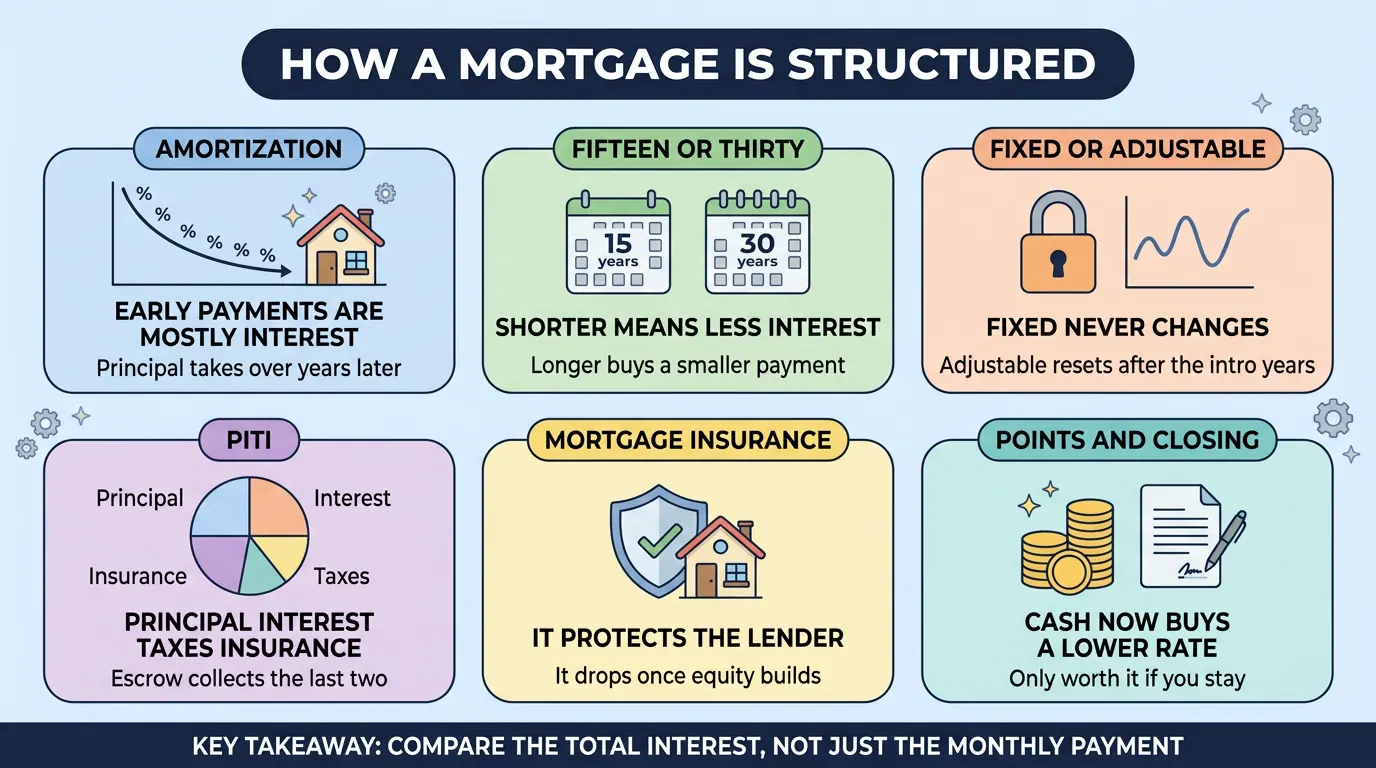
Principal is the amount you borrowed. Interest is the fee for keeping it. Amortization is the schedule that divides every payment between the two so the balance lands on zero exactly at the end of the term.
The payment stays level. The split inside it does not, because interest is charged on the balance still outstanding, and that balance is largest on day one.
On that $300,000 loan at 6.5%, one month of interest comes to $1,625. The payment is $1,896, so only $271 reduces the balance. Roughly 86% of your first payment is interest, and years pass before principal becomes the larger half. That is why extra payments early do so much work: a dollar of principal killed in year two is a dollar that would otherwise accrue interest for 28 more years.
Fifteen Years Versus Thirty
Take the same $300,000 at the same 6.5% and change only the term. Thirty years runs about $1,896 a month and roughly $383,000 in total interest. Fifteen years runs about $2,613 a month and roughly $170,000 in total interest.
An extra $717 a month cuts lifetime interest by more than half, and the real gap is wider still, because lenders price 15-year loans below 30-year loans.
The tradeoff is not purely arithmetic. A 30-year payment is a smaller required obligation, and nothing stops you paying extra in good years. A 15-year payment is due in full whether or not the year went well.
Fixed Versus Adjustable
A fixed-rate mortgage locks the rate for the whole term. An adjustable-rate mortgage (ARM) fixes it for an opening period and then resets on a schedule. A 5/6 ARM holds the rate five years, then adjusts every six months.
Once adjustments begin, your rate is an index plus a margin. The index is a published market rate that moves on its own (many current ARMs use an index derived from SOFR, a benchmark for overnight borrowing between banks). The margin is a fixed number written into your contract, so your rate tracks the market at a constant distance above it.
Caps limit the travel: one on the first adjustment, one on each adjustment after, and one on the total increase over the life of the loan. They are printed as three numbers, such as 2/1/5. Read the last one, because it tells you the worst payment the contract permits.
PITI and the Escrow Account
Lenders quote housing cost as PITI: principal, interest, taxes, and insurance. Property taxes and homeowners insurance are not optional extras, and in high-tax counties they can be a quarter of the monthly bill or more.
Most lenders collect them through an escrow account. You pay one twelfth of the annual bills each month, the servicer holds the money and pays the bills when due, then re-runs the numbers once a year and adjusts you.
Which means a fixed-rate mortgage does not have a fixed payment. The principal and interest portion is fixed for thirty years. The tax and insurance portion moves, and in some markets it has moved a lot.
Mortgage Insurance and When It Ends
Put less than 20% down on a conventional loan and the lender requires private mortgage insurance (PMI). It protects the lender against your default, you pay the premium, and it typically costs from a fraction of a percent to over 1% of the loan amount per year depending on your credit and down payment.
Federal law, the Homeowners Protection Act, sets the exits:
You may request cancellation in writing once the balance reaches 80% of the home's original value, if you are current on payments.
The servicer must end it automatically when the balance is scheduled to hit 78% of original value.
If you somehow reach the midpoint of the loan term still paying it, it ends there.
Original value means the purchase price or the appraised value at closing, not what the house is worth today, though some servicers will consider a new appraisal. FHA loans differ: their mortgage insurance premium generally lasts the life of the loan when the down payment is under 10%, and the way out is refinancing into a conventional loan.
Points and Closing Costs
A discount point costs 1% of the loan amount, paid at closing, and buys a permanently lower rate. On a $300,000 loan a point is $3,000. If it saves $55 a month, you come out ahead after about 55 months, and only if you still hold the loan then. Origination points are a different animal, a fee for making the loan that buys no rate reduction.
Closing costs together commonly run 2% to 5% of the loan. Within three business days of applying you get a Loan Estimate, and at least three business days before closing a Closing Disclosure. Both use a standardized form so competing offers can be laid side by side, which is the whole point of them.
Preapproval Versus Prequalification
Prequalification is an estimate based on numbers you told the lender, unverified. It takes minutes and commits nobody.
Preapproval means the lender pulled your credit report, reviewed income and asset documents, and issued a conditional commitment for a specific amount. Sellers weigh the two very differently.
Neither is final approval. The loan still hinges on the appraisal and a last underwriting review, which is why opening a new credit account during that window can unravel a deal that looked finished.
Refinancing and the Break-Even
Refinancing replaces your mortgage with a new one and brings its own closing costs. The question is how many months of savings it takes to cover them.
A $300,000 balance at 7% costs about $1,996 a month. At 6% it costs about $1,799. That is $197 saved monthly, so with $6,000 in closing costs you break even at about 31 months. Move or refinance again before then and the deal lost money.
The break-even hides one thing. A fresh 30-year term restarts amortization, putting you back at the front where payments are mostly interest. Rate down, payment down, and total interest over your time in the house can still go up.
Summary
A mortgage is principal, interest, and a schedule that front-loads the interest, wrapped in taxes and insurance that move on their own. The term sets both the payment and the lifetime cost, an adjustable rate hands you the interest rate risk within contractual caps, and PMI has a legally defined end date on conventional loans. Points, term, and refinancing all reduce to one calculation: what it costs up front against what it saves per month, and how long you will be there to collect.