The finance office at a car dealership almost always opens with the same question. What monthly payment are you comfortable with? It sounds considerate. It is the most expensive question in the building.
Any payment can be reached. Stretch the loan long enough and a car you cannot afford fits neatly inside a number you can say out loud.
An auto loan is a simple product with one dial that does most of the damage. Understanding that dial is most of the job.
The Car Is the Collateral
An auto loan is secured, which means a specific piece of property backs the debt. That property is the car, and the lender holds a claim on the title until the loan is paid off. A credit card is unsecured: miss enough payments and the issuer sends collectors or sues. Miss enough car payments and the lender can take the car, in most states without a court order.
Here is the part people miss. Repossession does not cancel the debt. The lender sells the car, usually at auction and usually for less than you owe, applies the proceeds, and bills you for the difference plus the towing and sale costs. That leftover is called the deficiency balance, and it is still yours. You lose the car, keep part of the loan, and carry a repossession on your credit report for seven years.
The One Dial: Term Length
The term is the number of months you have to repay. Take the same $30,000 loan at a 7% annual rate and change nothing but the term:
48 months: about $718 a month, roughly $4,480 in total interest.
60 months: about $594 a month, roughly $5,640 in total interest.
72 months: about $511 a month, roughly $6,830 in total interest.
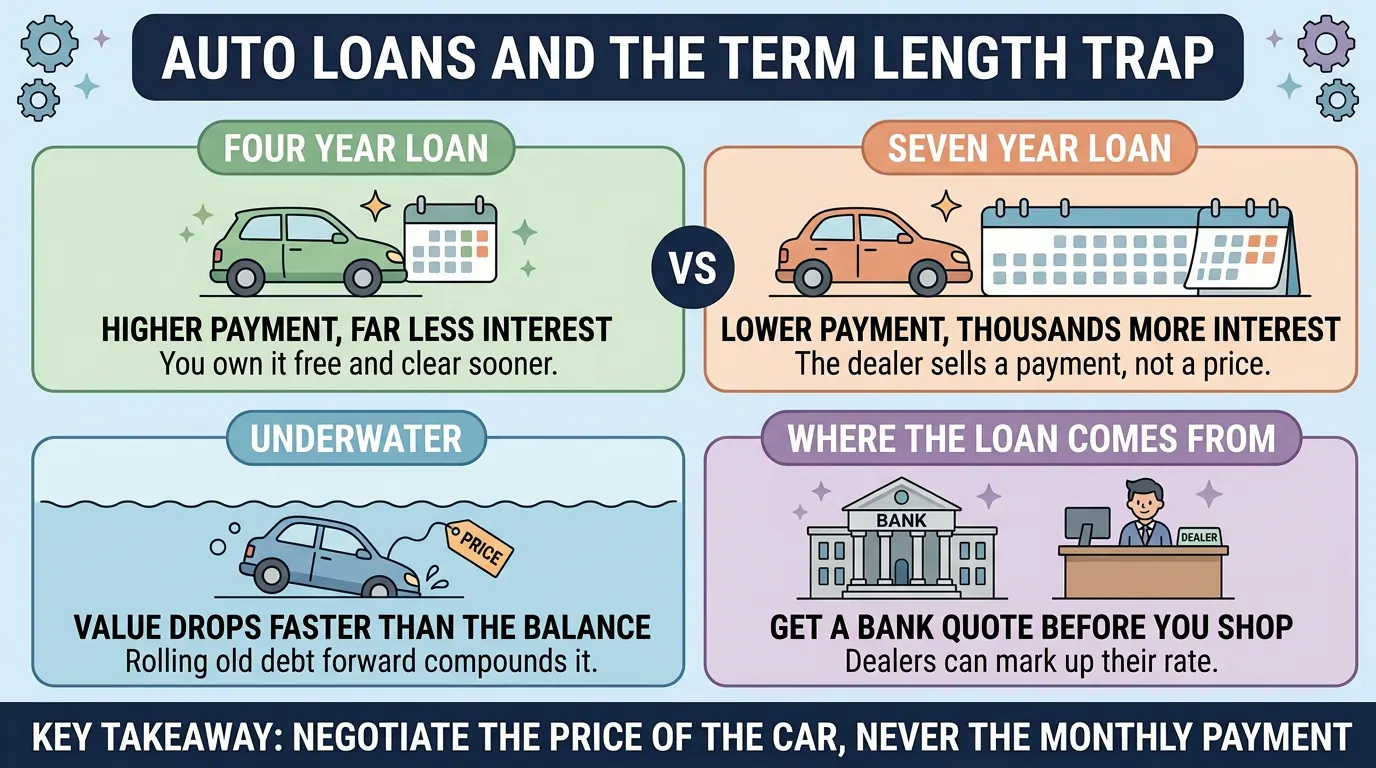
Going from 48 months to 72 drops the payment by $207 and adds about $2,350 in interest. Nothing about the car changed. You borrowed the same amount and paid the lender for two extra years of using its money.
The mechanism is plain. Interest is charged each month on whatever balance is left, so a slower paydown leaves a bigger balance exposed for longer. Our article on how APR compounds walks through the same math on a credit card.
Depreciation and Being Underwater
Depreciation is the value a car loses as it ages. New vehicles commonly shed around 20% in the first year, and the most recent industry data puts the average five-year loss just under 42%, better than the old rule of thumb that a car loses half its value within five years. The pace varies a lot by model and by what the used market is doing.
Your loan balance falls on a schedule the lender set. The car's value falls on a schedule the market sets. When value falls faster than the balance, you are underwater, also called having negative equity, meaning you owe more than the car is worth.
Work it through. A $35,000 car with nothing down, tax and fees rolled in, comes to about $37,000 financed at 7% over 72 months, or roughly $631 a month. After twelve payments you still owe about $31,900, and the car is worth somewhere near $28,000. You are underwater by about $3,900. A bigger down payment shortens that stretch, and so does a shorter term.
Rolling Negative Equity Forward
Two years in, you want a different car and you are $4,000 underwater. The dealer offers to pay off the trade, which sounds like the problem going away. It is not. The $4,000 shortfall gets added to the new loan.
Buy a $30,000 replacement and you finance $34,000. You begin the next loan already underwater, which usually calls for a longer term to keep the payment bearable, which keeps you underwater longer. Do this twice and you are still paying for a car you sold two cars ago.
Where the Money Comes From
Auto loans reach you through two channels. In dealer-arranged financing, the dealership sends your application to several lenders. Each sends back a buy rate, the rate that lender is willing to accept. The dealer is generally allowed to add a markup on top, and that spread is dealership profit that you pay across the life of the loan.
In direct financing, you apply to a bank or credit union before you shop and arrive with a preapproval, a written commitment for a certain amount at a certain rate. A preapproval does two things. It caps what you can spend, and it turns the dealer's financing into a competing bid rather than the only bid. Dealers sometimes beat it, particularly with manufacturer-subsidized rates, which is a fine outcome. The value is in having a number to compare against.
The Four Square
The four square is a worksheet split into four boxes: vehicle price, trade-in value, down payment, and monthly payment. Sales training points the conversation at the payment box, because that is the number customers react to and because it hides a variable the customer is not tracking, the term.
Say yes to a payment and the price, the trade allowance, or the length of the loan can move to make that payment work. The counter is to separate the negotiations. Settle the out-the-door price of the car first. Then handle the trade-in as its own transaction with its own value. Then talk about financing. Each has a separate market and deserves a separate number.
GAP Insurance
If your car is totaled or stolen, your auto insurer pays actual cash value, which is what the vehicle was worth that day. The lender still wants the full loan balance. If the balance is larger, you owe the difference on a car you no longer have.
Guaranteed Asset Protection, sold as GAP, covers that difference. It earns its keep exactly when you are underwater, which usually means a small down payment paired with a long term. Once the car is worth more than the loan, GAP pays nothing, because there is no gap left to fill. It is usually offered in the finance office, is often cheaper from your own auto insurer, and is typically refundable in part if you pay the loan off early.
New Versus Used Rates
Used-car loans carry higher rates than new-car loans, often by several percentage points. The collateral is older, harder to value, more likely to need repair, and worth less at auction if the lender has to take it back. Manufacturers also subsidize rates on new cars through their own finance companies, which is where promotional offers like 0% or 1.9% come from. Those promotions are usually offered instead of a cash rebate rather than alongside it, so the cheaper choice depends on the size of the rebate and how much you are borrowing.
Summary
An auto loan is backed by the car, so defaulting costs you the vehicle and can still leave a deficiency balance behind. Term length is the dial that hides the cost, since stretching the same loan from 48 months to 72 lowers the payment and adds thousands in interest while keeping you underwater far longer. Negotiate the price rather than the payment, bring a preapproval so the dealer's rate faces competition, and treat GAP as protection against negative equity rather than a box every buyer needs to check.