Homeowners insurance is the largest insurance policy most people will ever buy, and it is usually purchased in a hurry, during a closing, from whoever the lender suggested.
Your mortgage lender requires it, which is why it gets treated as paperwork. It is not paperwork. It is the document that determines whether a fire means an inconvenience or a financial catastrophe, and the standard policy has six distinct parts that most owners have never read.
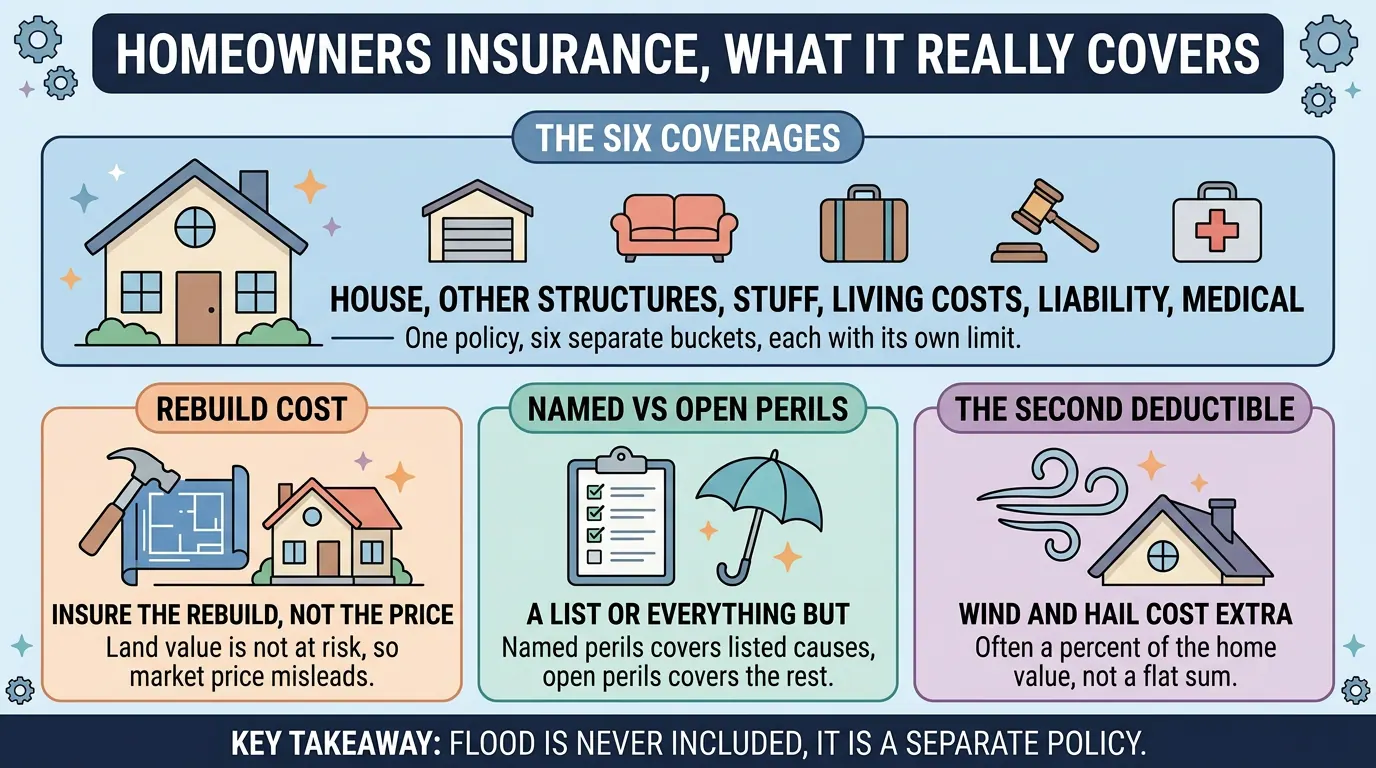
The Six Coverages
Nearly every residential policy in the United States is a form called HO-3. Its coverages are lettered A through F, and they appear in that order on your declarations page.
Coverage A, dwelling. The house itself, including attached structures like a garage.
Coverage B, other structures. Detached buildings: a fence, shed, or separate garage. Usually set automatically at 10% of Coverage A.
Coverage C, personal property. Everything inside. Commonly 50% to 70% of Coverage A.
Coverage D, loss of use. Hotel, meals, and additional living costs while your home is uninhabitable. Often 20% to 30% of Coverage A.
Coverage E, personal liability. Pays when you are legally responsible for injuring someone or damaging their property, including your legal defense. Standard limits start around $100,000 and should usually be raised.
Coverage F, medical payments. Small medical bills for guests injured on your property, regardless of fault. Typically $1,000 to $5,000.
Notice that only Coverage A is a number you choose directly. The rest are usually percentages of it, which means getting Coverage A wrong throws off everything else.
Rebuild Cost, Not Purchase Price
The most common and most expensive mistake in this policy is insuring the house for what you paid.
Your purchase price includes the land. Insurance does not, because land does not burn. What you need to insure is the cost to rebuild the structure from scratch at current labor and materials prices.
Those two numbers can diverge wildly in either direction. A $600,000 house in an expensive metro might sit on $300,000 of land and cost $300,000 to rebuild. A $250,000 house in a rural area might cost $340,000 to rebuild, because construction costs do not track local real estate values.
This matters because of a provision called the coinsurance requirement. Most policies require you to insure the dwelling for at least 80% of its full replacement cost. Fall below that and your claims get reduced proportionally, even on partial losses.
Here is what that looks like. Full rebuild cost is $400,000, so the 80% threshold is $320,000. You insured for $240,000, which is 75% of the required amount. A kitchen fire causes $80,000 in damage. Rather than paying $80,000, the insurer pays roughly 75% of it, about $60,000, and the remaining $20,000 is yours. You were not underinsured for a total loss only. You were underinsured for every loss.
Ask your insurer for a replacement cost estimate rather than guessing, and revisit it after any renovation or after a period of construction cost inflation.
Two Ways the Policy Decides What Is Covered
The dwelling and your possessions are protected under different rules, which is worth knowing.
Open peril, sometimes called comprehensive, covers everything except what the policy specifically excludes. Coverage A on an HO-3 works this way, which is why an HO-3 is the standard.
Named peril covers only the causes explicitly listed. Coverage C, your personal property, usually works this way on an HO-3, with a list including fire, lightning, windstorm, theft, vandalism, and specified water damage.
The practical consequence is that an unusual cause of loss might be covered for your house and not for your furniture. Upgrading contents coverage to open peril is available on some policies and worth asking about.
Replacement Cost on Contents Too
The same choice that matters on renters insurance matters here.
Actual cash value pays what your item is worth today after depreciation. A twelve-year-old sofa is worth almost nothing. Replacement cost pays what a comparable new one costs.
Replacement cost coverage on contents costs modestly more and is close to a settled question, because depreciation on furniture, appliances, and electronics is severe. A total loss settled at actual cash value routinely pays a fraction of what refurnishing actually costs.
Watch the sublimits as well, which are separate lower caps on specific categories. Jewelry is frequently capped near $1,500 for theft, cash near $200, and collectibles vary. Anything genuinely valuable needs a scheduled endorsement listing it specifically, usually with an appraisal.
The Second Deductible Nobody Notices
Your policy has a standard deductible, the amount you pay before the insurer pays anything, commonly $1,000 or $2,500.
In much of the country it also has a second, separate deductible for wind, hurricane, or named storms, and this one is often expressed as a percentage of your dwelling coverage rather than a flat dollar amount.
A 2% named-storm deductible on a $400,000 dwelling is $8,000. Someone who believes they have a $1,000 deductible discovers otherwise the week after a hurricane. These are common along the Atlantic and Gulf coasts and increasingly elsewhere. Read the declarations page for a percentage sign.
Flood Is Not Included
This is the single most important exclusion in American property insurance and it catches people every year.
No standard homeowners policy covers flood damage. Not partially, not incidentally. Flood insurance is a separate policy, available through the National Flood Insurance Program or private insurers.
The distinction the industry draws is where the water came from. A burst pipe inside your house is covered by your homeowners policy. Water that arrived from outside, from rising rivers, storm surge, or heavy rainfall accumulating on the ground, is a flood and is excluded.
A substantial share of flood claims come from properties outside designated high-risk zones, so "I am not in a flood zone" is a statement about pricing rather than about risk. Earthquake is likewise excluded and sold separately.
The Market Has Gotten Harder
One current reality worth planning around. In high-risk states, particularly California for wildfire and Florida and Louisiana for hurricanes, insurers have been raising rates sharply, declining to renew existing policies, and in some cases exiting markets entirely. Some homeowners have been pushed into state-run insurers of last resort, which typically offer narrower coverage at higher prices.
If you are buying in one of these areas, get insurance quotes before you are under contract rather than during the closing. Availability, not just price, has become a real variable in the purchase decision.
Summary
A standard HO-3 homeowners policy has six coverages: dwelling, other structures, personal property, loss of use, personal liability, and medical payments, with most set as percentages of the dwelling amount. Insure the dwelling for its full rebuild cost rather than your purchase price, because most policies require at least 80% of replacement cost and will reduce every claim proportionally if you fall short. Choose replacement cost rather than actual cash value on contents, and check for a separate percentage-based wind or named-storm deductible, which on a $400,000 home can be $8,000 rather than the $1,000 you expected. Flood damage is excluded from every standard policy and must be purchased separately, regardless of whether you live in a designated flood zone.