The average American changes jobs roughly a dozen times over a career, and each time, a decision about the old retirement account gets made. Often it gets made by accident.
Your own contributions are always yours, immediately and completely. Changing jobs cannot put them at risk. What is at risk is the employer's contributions, which may not be fully yours yet, and the money itself, which people cash out at exactly the wrong moment.
You have four options. One of them is significantly worse than the others.
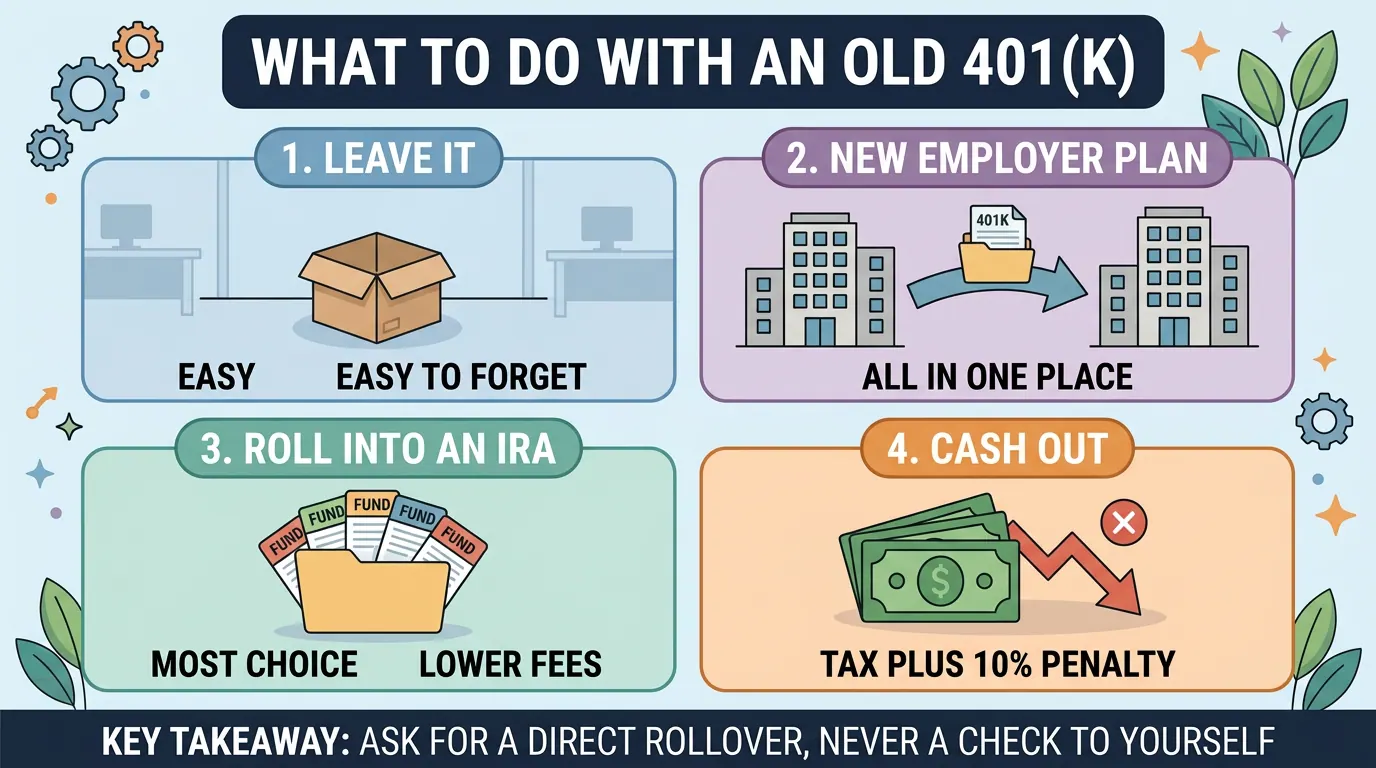
Option 1: Leave It in the Old Plan
Most plans let you keep your money where it is if the balance is above a threshold. Nothing happens, and nothing is lost.
The argument for this is inertia protection. If the old plan has unusually cheap institutional funds, and some large employers do, staying put can be the cheapest option available.
The argument against is that you now have an account you do not think about, at a provider you no longer have a relationship with, receiving statements at an address you may change. Forgotten 401(k) accounts are extremely common and they keep charging fees the entire time they are forgotten.
Option 2: Roll It Into the New Employer's Plan
If your new job offers a plan that accepts rollovers, moving the balance in consolidates everything into one place you actually log into.
The advantage is simplicity. The disadvantage is that you are trading one employer's fund menu for another, and you have no control over either. Compare the expense ratios before you decide. An expense ratio is the annual percentage a fund charges you, so a 0.04% fund costs $4 per year on a $10,000 balance while a 0.90% fund costs $90 for the same balance.
There is one specific reason to prefer this option: if you might ever want to do a strategy called a backdoor Roth contribution, keeping pre-tax money out of IRAs matters. That is an advanced consideration and does not apply to most people early in their careers.
Option 3: Roll It Into an IRA
An IRA is a retirement account you open yourself at a brokerage, independent of any employer. This is what most people should do, for one reason: choice.
A workplace plan offers whatever ten to thirty funds your employer selected. An IRA gives you access to essentially the entire market, including index funds priced near zero. An index fund simply holds everything in a market index rather than paying a manager to pick investments, and it is where most of the cost savings live.
The difference is not cosmetic. Over 35 years, a one percentage point difference in annual fees reduces a retirement balance by roughly 28%, according to the Department of Labor's own worked example. Moving a balance from a 0.90% menu into a 0.04% index fund captures most of that for yourself, permanently.
One exception is worth flagging before you roll everything over. If your 401(k) holds shares of your employer's own stock that have appreciated significantly, a rule called net unrealized appreciation lets you move those shares into a regular taxable brokerage account instead, paying ordinary income tax only on what the shares originally cost and long term capital gains rates on all the growth, which is usually the cheaper outcome.
Option 4: Cash It Out
This is the bad one, and it is the one a startling share of people choose because a check showing up feels like a windfall rather than a loss.
Cash out before 59½ and you owe ordinary income tax on the entire amount plus a 10% early withdrawal penalty. On a $30,000 balance for someone in the 22% federal bracket, meaning the top slice of their income is taxed at 22%, that is roughly $6,600 in federal tax and $3,000 in penalty, before state tax.
The larger loss is invisible. That $30,000, left alone for 30 years at a 7% average annual return, would have grown to roughly $228,000. Cashing out at 30 to buy a car is a $228,000 decision disguised as a $30,000 one.
How to Move Money Without Losing Any
If you roll the money over, the mechanics matter enormously, and this is where people get hurt while trying to do the right thing.
Ask for a direct rollover. The old plan sends the money straight to your new account, either electronically or as a check made out to the receiving institution rather than to you. Nothing is withheld. Nothing is taxed. This is what you want, and the phrase to use on the phone is "direct rollover" or "trustee-to-trustee transfer."
Avoid an indirect rollover. Here the old plan sends the check to you, and you have 60 days to deposit it into the new account. Two traps are waiting.
The first is mandatory withholding. Your old 401(k) is required to withhold 20% for taxes before writing your check. On a $50,000 balance you receive $40,000, but to complete the rollover you must deposit the full $50,000, replacing the withheld $10,000 out of your own pocket. You get that $10,000 back at tax time, but you have to find it now.
The second is the deadline. Miss 60 days, or deposit less than the full amount, and the shortfall counts as a taxable withdrawal with the 10% penalty attached.
There is also a frequency limit worth knowing. You may only do one IRA-to-IRA 60-day rollover per twelve-month period. Direct transfers between IRAs are unlimited, which is another reason to use them.
The Vesting Deadline Nobody Checks
Before you give notice, look up your vesting schedule.
Vesting is the waiting period before your employer's matching contributions actually belong to you. Federal law permits two structures. A cliff schedule gives you nothing until a milestone, then everything, up to a maximum of three years. A graded schedule gives you a growing percentage, with the slowest legal version reaching 20% after two years and full ownership after six.
The practical consequence: someone leaving at two years and eleven months under a three-year cliff forfeits the entire employer match. If you are close to a vesting date, delaying your start date by a few weeks can be worth thousands of dollars. Your summary plan description has the schedule.
Small Balances Get Moved Without You
If your balance is small, your former employer does not need your permission to clear it out.
Balances under $1,000 can be cashed out and mailed to you, which triggers the tax and penalty automatically. Balances between $1,000 and $7,000 can be rolled into an IRA that the plan chooses on your behalf, often into a low-return cash option where it sits indefinitely.
Newer rules have also created automatic portability, where providers move small accounts into a new employer's plan when they find one. That is an improvement, but it is not a substitute for tracking your own accounts.
The takeaway: if you left a job with a modest balance and never dealt with it, go find out what happened to it.
Summary
When you leave a job you can leave the money in the old plan, move it to your new employer's plan, roll it into an IRA, or cash it out, and cashing out is by far the worst because it triggers income tax plus a 10% penalty and forfeits decades of compounding. Rolling into an IRA is usually best because it replaces a fixed employer menu with the entire market and access to index funds priced near zero. Always request a direct rollover, since an indirect rollover forces your old plan to withhold 20% that you must replace from your own money within 60 days. Check your vesting schedule before giving notice, because leaving weeks short of a cliff date can forfeit the entire employer match.