Almost every piece of investing advice comes with a warning attached. Stocks might go up or down. Bonds lose value when interest rates rise. Nobody can promise you a return, and anyone who does is probably running a scam.
There is exactly one exception, and most people who are offered it turn it down without realizing what they did.
It is called an employer match. When you put money into your workplace retirement plan, your employer puts in money alongside it. Not a loan, not a bonus you have to earn, just additional money deposited into your account because you contributed some of your own. For every dollar you could have had matched and did not, you handed back part of your paycheck.
One term first. A 401(k) is the retirement account most employers offer, funded automatically out of your paycheck before the money reaches your bank account. The match is what your employer adds on top.
How a Match Formula Works
Employers do not simply double whatever you contribute. They use a formula, and the most common one in the United States is 50 cents on the dollar, up to 6% of your pay.
Read that in two pieces. The "50 cents on the dollar" is the match rate, meaning how much your employer adds per dollar you contribute. The "up to 6% of your pay" is the match limit, meaning the point at which your employer stops adding anything.
Here is the arithmetic on a $60,000 salary:
You contribute 6% of your pay, which is $3,600 for the year.
Your employer matches half of that, adding $1,800.
Your account received $5,400, but only $3,600 came out of your paycheck.
You just earned an instant 50% return on your own money, before that money was invested in anything at all. No market had to cooperate.
Now here is what happens if you contribute only 3%:
You contribute $1,800.
Your employer matches half, adding $900.
You left $900 of free money sitting on the table, permanently.
Contributing above the limit does not help either. If you contribute 10% of that $60,000 salary, you put in $6,000, but your employer still stops at the 6% threshold and adds the same $1,800. The extra money you contributed is still worth saving, it just is not matched.
The Number You Actually Need to Find
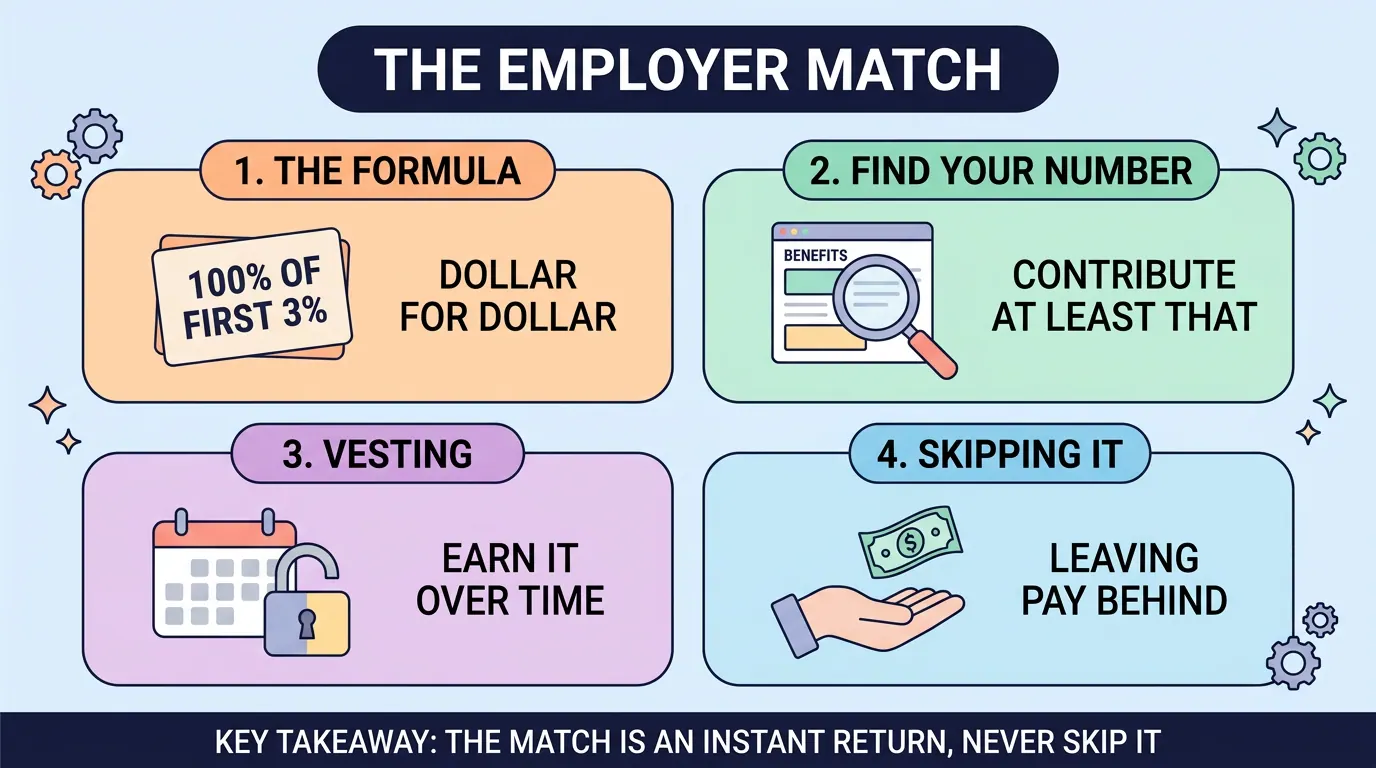
Match formulas vary. Some employers match dollar for dollar up to 3%. Some match 100% of the first 3% and then 50% of the next 2%. A few generous employers match dollar for dollar up to 6%, which doubles your contribution outright.
Across all US plans, the average employer match reached 4.7% of pay in 2025, a record high. When you combine what employees and employers put in together, the average total savings rate hit 12.1% of pay.
The number you need is not the average, though. It is your specific employer's formula, and it lives in a document called the summary plan description. Your human resources department will send it to you if you ask. The one question worth asking on your first day: what is the maximum percentage of my pay that gets matched, and at what rate?
Then contribute at least that percentage. Anything less is a voluntary pay cut.
Vesting: When the Match Becomes Yours
There is a catch, and it is the part beginners miss.
Money you contribute yourself is yours immediately, always, with no conditions. Money your employer contributes may come with a waiting period before you own it. That waiting period is called vesting.
Federal law allows two vesting structures for matching contributions:
Cliff vesting. You own 0% of the match until you hit a milestone, then 100% all at once. The longest a cliff can legally be is three years. Leave at two years and eleven months, and the entire match is clawed back.
Graded vesting. You own a growing percentage each year. The slowest schedule the law permits reaches 20% after two years and increases 20% annually until you own all of it after six years.
Some employers vest the match immediately. Others use the maximum allowed schedule. This matters most when you are deciding whether to change jobs, because leaving a few months early can cost you thousands of dollars that were already sitting in your account.
To find yours, look for "vesting schedule" in the same summary plan description.
The Long-Term Cost of Skipping It
A missed $1,800 match feels small. It is not, because the money would have been invested and growing for decades.
Take that same $60,000 earner who skips the match entirely for 30 years. Assuming a 7% average annual return, the forgone $1,800 per year would have grown to roughly $182,000. That is money the employer offered and the employee declined, one paycheck at a time.
Worth being clear about the assumption: 7% is a reasonable long-run estimate based on historical US stock returns, not a promise. Some years will be negative. The match itself, however, is not an estimate. It is deposited regardless of what the market does.
A Newer Wrinkle Worth Knowing
If student loan payments are the reason you cannot afford to contribute, there is now an option that did not exist a few years ago. Under a 2022 law called SECURE 2.0, employers are permitted to treat your qualified student loan payments as if they were retirement contributions and match them.
Not every employer offers this, because it is optional rather than required. But if you are choosing between paying loans and capturing a match, ask whether your plan has adopted the provision. It may let you do both with the same dollar.
Summary
An employer match is additional money your employer deposits into your retirement account when you contribute your own. The most common formula adds 50 cents per dollar on the first 6% of your pay, which means contributing less than 6% leaves guaranteed money unclaimed. Find your specific formula and vesting schedule in your summary plan description, contribute at least up to the match limit, and check whether your employer matches student loan payments if debt is what is holding you back.