When you compare health plans at a new job, one option usually has a premium so much lower than the others that it looks like a mistake. Then you see the deductible and understand why.
A high deductible health plan trades a smaller monthly bill for a much larger bill in any year you actually need care. Most people reject it on instinct, because a $3,000 deductible sounds frightening and a $95 monthly premium sounds too good to be true.
Both reactions skip the arithmetic, and the arithmetic goes the other way more often than you would expect.
The Terms in Play
Four numbers decide everything, and they work in sequence.
Premium. What you pay every month to have the plan, whether or not you use it.
Deductible. What you pay out of pocket for care before the plan starts paying.
Coinsurance. After the deductible, the percentage split. At 20%, you pay 20% and the plan pays 80%.
Out-of-pocket maximum. The annual ceiling on what you can be charged for covered in-network care. Once you hit it, the plan pays everything for the rest of the year.
That last number is the one to focus on, because it defines your worst case. A high deductible plan is not unlimited risk. It has a hard ceiling like any other plan.
What Legally Counts as One
The label is not marketing. It is a tax definition, and the thresholds change annually.
For 2026, a plan qualifies as a high deductible health plan if it has a deductible of at least $1,700 for individual coverage or $3,400 for family coverage, and an out-of-pocket maximum no higher than $8,500 individual or $17,000 family.
Note the second half. The definition caps how bad the plan can get, not just how high the deductible starts. For context, the legal ceiling on out-of-pocket maximums for all marketplace plans in 2026 is higher still, at $10,600 individual and $21,200 family. A qualifying high deductible plan is required to be better than the legal worst case.
Running the Comparison
Here are two realistic employer options for one person.
Plan A, traditional: $320 per month, $1,000 deductible, 20% coinsurance, $5,000 out-of-pocket maximum.
Plan B, high deductible: $95 per month, $3,400 deductible, 20% coinsurance, $6,000 out-of-pocket maximum.
Plan B costs $2,700 less per year in premiums. That is the head start it carries into every scenario.
A healthy year, $400 of care. Plan A: $3,840 in premiums plus $400 = $4,240. Plan B: $1,140 plus $400 = $1,540. Plan B saves $2,700.
A moderate year, $6,000 of care. Plan A: $3,840 premiums, $1,000 deductible, then 20% of $5,000 = $1,000, total $5,840. Plan B: $1,140 premiums, $3,400 deductible, then 20% of $2,600 = $520, total $5,060. Plan B still wins by $780.
A catastrophic year, $80,000 of care. Both plans hit their ceilings. Plan A: $3,840 plus $5,000 = $8,840. Plan B: $1,140 plus $6,000 = $7,140. Plan B wins by $1,700.
Plan B won all three. That will not always happen, but it happens more often than intuition suggests, because the premium savings apply every single month while the deductible only bites when you use care.
The scenario where the traditional plan wins is the middle band: enough care to blow through the high deductible, not enough to reach either out-of-pocket maximum, with a premium gap too small to compensate. Run your own numbers rather than trusting either instinct.
The Condition That Decides It
The comparison above assumes you can produce the deductible when asked.
A $3,400 deductible you do not have in cash is not a lower-cost plan. It is a plan that sends you to a credit card at 24% interest, or that makes you skip a doctor visit you needed. Both outcomes cost more than the premium you saved.
So the honest rule: a high deductible plan is the better financial choice for people who have the deductible sitting in savings, and the worse choice for people who do not, regardless of what the arithmetic says. Build the emergency fund first, then take the cheaper premium.
The Part That Changes the Math Entirely
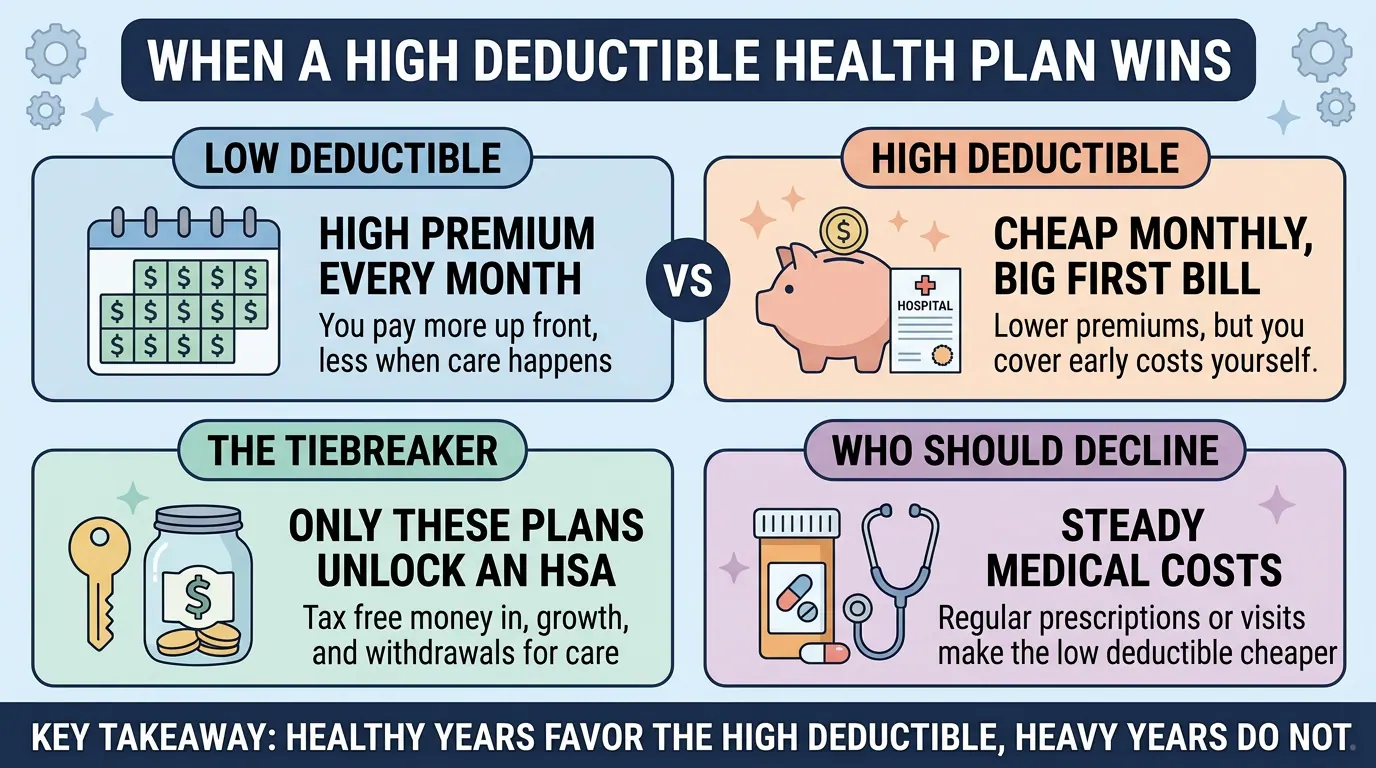
High deductible plans are the only plans that let you open a health savings account, and that account is unusually good.
An HSA avoids tax three times: contributions reduce your taxable income, the balance grows untaxed, and withdrawals for medical expenses are tax free. No other account does all three. For 2026 you can contribute $4,400 with individual coverage or $8,750 with family coverage, plus $1,000 more once you turn 55.
Two features matter for this decision.
The money never expires. Unlike a flexible spending account, which is largely use-it-or-lose-it, an HSA rolls over indefinitely and belongs to you rather than your employer.
Many employers also contribute to it. A $750 employer HSA contribution effectively cuts your deductible by $750, and it should be added to the premium savings when you compare plans.
Redo the earlier comparison with a $750 employer HSA contribution and Plan B's advantage grows to $3,450 in a healthy year. The tax deduction on your own contributions is on top of that.
Who Should Decline One
Three situations argue for the traditional plan even if the arithmetic looks close.
You have a chronic condition or ongoing prescriptions that guarantee you land in the middle band every year. Predictable recurring costs are exactly what a lower deductible is for.
You have no cash reserve. Covered above, and it overrides everything.
You are planning a pregnancy or a known surgery. A year with a scheduled five-figure expense removes the uncertainty the high deductible plan is priced around.
Summary
A high deductible health plan trades a much lower monthly premium for a larger bill in years you use care, and for 2026 it must carry a deductible of at least $1,700 individual or $3,400 family with an out-of-pocket maximum no higher than $8,500 or $17,000. Because the premium savings apply every month while the deductible only bites when you need care, these plans often win in healthy years, moderate years, and catastrophic years alike. They are only the right choice if you can actually produce the deductible in cash, since otherwise the savings arrive as credit card debt or skipped care. They are also the only plans that permit a health savings account, whose triple tax advantage and any employer contribution should be counted as part of the comparison.