Insurance is the only product you buy hoping never to use it. That makes it genuinely strange, and it is worth understanding the underlying machine before looking at any specific policy, because every type of insurance runs on the same three ideas.
Risk Pooling
Imagine a thousand people who each own a house. In any given year, roughly one of those houses will burn down. Nobody knows which one.
For the unlucky owner, the loss is catastrophic. A $300,000 house is gone, and almost nobody can absorb that.
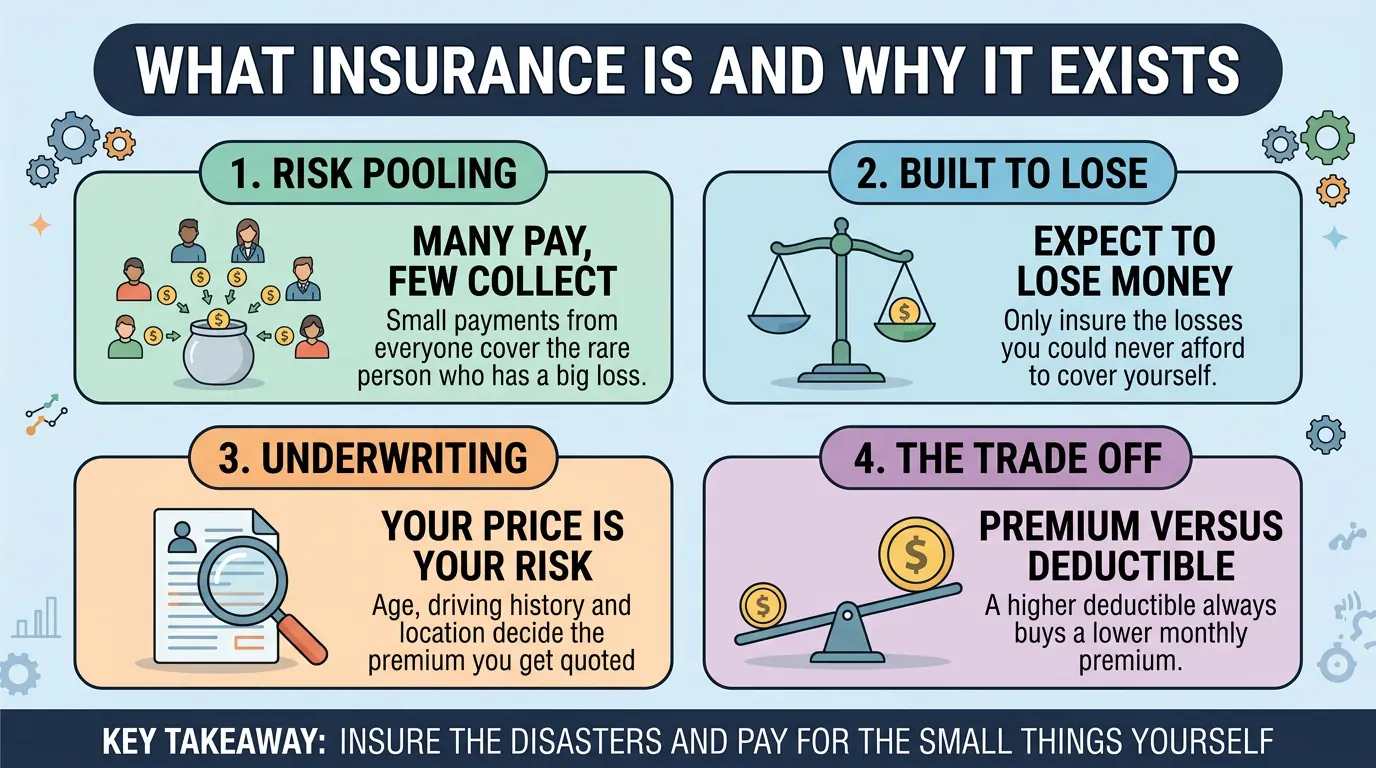
So the thousand owners make an arrangement. Each contributes $500 into a shared pool, which collects $500,000. When one house burns, the pool pays to rebuild it. The 999 owners whose houses did not burn are out $500 each, and they consider it money well spent, because any one of them could have been the unlucky one.
That is insurance. This is risk pooling, and there is nothing more sophisticated hiding behind it. A large group of people each accept a small certain cost to avoid a small chance of a ruinous one.
The insurance company organizes the pool, invests the money while it waits, handles the claims, and keeps the difference as profit.
Insurance Is Designed to Lose You Money
This follows directly from the arithmetic above, and it is the point beginners most often miss.
If the pool collects $500,000 and pays out $300,000 in claims plus operating costs, the participants collectively got back less than they paid in. That is not fraud. It is the necessary structure. The company must collect more than it pays out or it cannot exist.
So on average, across everyone, insurance is a losing financial proposition. You are not buying an expected profit. You are buying protection against an outcome you could not survive financially.
This gives you a clean test for whether a given insurance product is worth buying:
Could you absorb this loss out of pocket without it wrecking you?
Your house burning down: no. Insure it.
Being sued for $400,000 after a car accident: no. Insure it.
A $180 phone screen: yes. Do not insure it.
A $60 pair of headphones: yes. Do not insure it.
Insurance is for catastrophes, not inconveniences. Every extended warranty and phone protection plan you have been offered at a checkout counter fails this test, which is precisely why the cashier is trained to offer it.
Underwriting
The pool only works if the price is right, and setting that price is called underwriting.
Underwriters assess how likely you are to file a claim and charge accordingly. This is why a 19-year-old pays far more for car insurance than a 45-year-old, and why a smoker pays several times more for life insurance than a non-smoker. They are not being punished. They are being priced.
Charging everyone the same rate would collapse the pool, because low-risk people would leave rather than subsidize high-risk people, leaving only high-risk people and premiums nobody could afford.
Underwriting factors vary by insurance type but commonly include age, location, claim history, and the specific thing being insured. Some factors are restricted by law. Credit-based insurance scores, for instance, are prohibited in auto insurance in California, Hawaii, Massachusetts, and Michigan.
The Vocabulary You Cannot Avoid
Six words appear in every policy you will ever read.
Premium. What you pay to have the policy, usually monthly or annually. You pay this whether or not you ever file a claim.
Deductible. What you pay out of pocket before the insurer pays anything. A $1,000 deductible on a $4,000 claim means you pay $1,000 and the insurer pays $3,000.
Claim. Your formal request for the insurer to pay for a covered loss.
Policy limit. The maximum the insurer will pay. A policy with a $100,000 limit stops at $100,000 even if your loss is larger, and you are responsible for the rest.
Rider. An add-on that modifies the policy, usually to cover something the base policy excludes or to raise a limit.
Exclusion. Something the policy specifically does not cover. Standard homeowners policies exclude flood damage, which is why flood insurance is bought separately.
Premium and Deductible Move in Opposite Directions
This tradeoff shows up in every insurance decision you will make.
A higher deductible means you absorb more of any loss yourself, so the insurer's expected payout drops, so your premium falls. A lower deductible means the reverse.
On a car policy the difference might look like this:
$250 deductible: $1,800 per year
$1,000 deductible: $1,400 per year
Raising the deductible by $750 saves $400 per year. If you go three years without a claim, you have saved $1,200, which is more than the extra $750 you would owe on a single claim. That math generally favors the higher deductible, with one condition: you must actually have the deductible in cash. A $2,000 deductible you cannot pay is not savings, it is an uninsured loss waiting to happen.
Which is why an emergency fund and a high deductible go together, and why neither works well without the other.
Summary
Insurance works by pooling many people's small payments to cover the rare large loss that any one of them could not absorb alone. Because insurers must collect more than they pay out, insurance is a losing proposition on average by design, which means the right test for any policy is whether you could survive the loss without it. Underwriting prices your individual likelihood of filing a claim, and every policy is governed by the same core terms: premium, deductible, claim, policy limit, rider, and exclusion. Choosing a higher deductible lowers your premium and is usually the better deal, but only if you keep enough cash on hand to actually pay it.