Percentage budgets like the 50/30/20 rule ask very little of you. Sort your spending into needs, wants, and savings, glance at the ratios once a month, done. For plenty of people that is genuinely enough.
It stops being enough in two situations. The first is when the categories are too coarse to help: your wants bucket comes in at a respectable 30% and you still cannot account for $600 of it. The second is when money is tight enough that precision matters, and "roughly half" is not a good enough answer to whether rent is covered.
Zero-based budgeting and the envelope method are where people go next. Both cost more effort. Both also answer, on any random Thursday, whether you can afford the thing in your hand.
Zero-Based Budgeting: Every Dollar Gets a Job
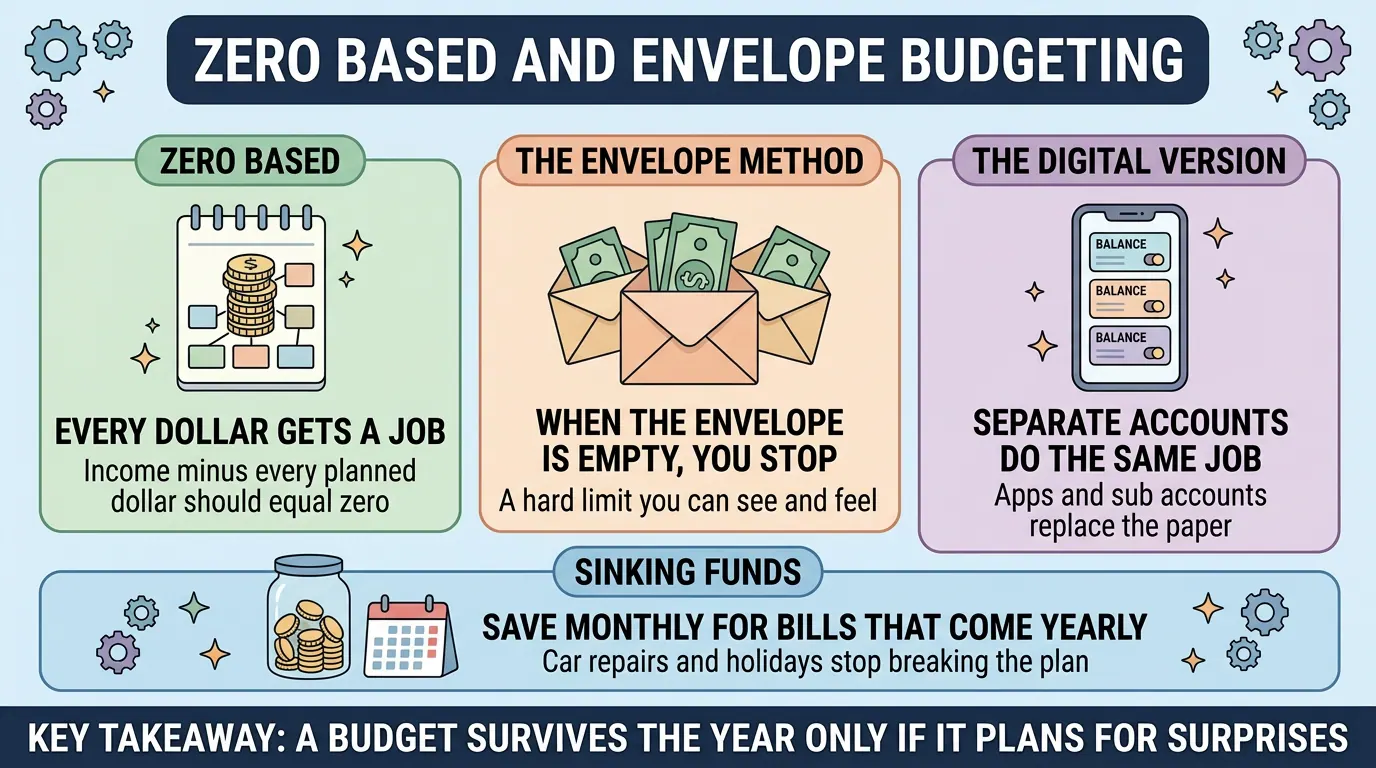
A zero-based budget starts with the money you have and assigns all of it. Write down your income, then work down a list of categories (rent, groceries, gas, phone, the insurance bill due in April, savings, fun money) putting dollars into each until nothing is unassigned. Income minus assignments equals zero, which is where the name comes from.
The number people misread is the zero. It does not mean you spent everything. Saving is a job. Investing is a job. Sitting in the emergency fund is a job. A month that ends with $500 assigned to savings and $0 unassigned is a finished zero-based budget, and a good one.
Here is a month on $3,200 of take-home pay:
Rent $1,200, utilities $150, phone $60
Groceries $400, gas $120, restaurants $200
Car insurance billed in April, $90 set aside this month; Christmas, $50 set aside this month
Emergency fund $400, Roth IRA $300
Everything else, from haircuts to a birthday gift, $230
That adds to exactly $3,200. Compare it to what most people do, which is pay the bills and leave whatever remains in checking as a vague cushion. The cushion gets spent. It always gets spent, because a dollar with no assignment is available to anything that asks.
The Reset and the Overspend
Two mechanics keep the system honest. The first is the monthly reset: every category starts fresh, and you build the plan again from that month's income. The classic version does this in advance based on income you expect. The version that survives contact with reality budgets only money that has already landed, which is why zero-based budgeting handles irregular pay so well.
The second is the overspend rule. Groceries were budgeted at $400 and you spent $460. That $60 has to come from somewhere, and the honest answer is another category, chosen by you, that same week. Move $60 out of restaurants and the budget balances again. What you cannot do is leave the overage sitting as an unexplained gap, because that is how a budget turns into fiction you quietly stop opening.
Covering an overspend by naming where it came from is most of the difference between people for whom budgeting works and people for whom it does not.
Budgeting Last Month's Income
The mature form of this is spending money that is at least a month old. You live through August on the money you earned in July, already sitting in checking and already assigned before August 1 arrives.
Getting there means building up roughly one month of expenses beyond your emergency fund, a slow project measured in seasons. What it buys is the removal of timing from the equation. Whether your paycheck lands on the 3rd or the 17th no longer changes anything, a bill on the 28th does not have to wait, and a client who pays late stops being an emergency. Software calls this aging your money; the idea is much older than any app.
The Envelope Method
The envelope system is the physical ancestor of all of this and works exactly the way it sounds. Cash your paycheck, divide the spending money into labeled envelopes (groceries, gas, eating out, haircuts), and spend from the envelope. When the grocery envelope is empty on the 24th, you eat what is already in the house until the 1st.
The constraint is the point, and it works for psychological reasons rather than mathematical ones. Handing over physical bills registers as a loss in a way that tapping a card does not; behavioral economists call this the pain of paying, and studies comparing cash to cards generally find people spend more when payment feels frictionless. An envelope also reports its own balance without you checking anything.
Fixed bills stay in the bank and get paid normally. Nobody impulsively overspends on rent. Envelopes are for variable spending, which is where discretion lives and where budgets actually break.
The Digital Version
Almost nobody runs a pure cash system now. Two translations work:
Multiple accounts. Open several free checking or savings accounts and name each one: bills, groceries and gas, fun, sinking funds. Automatic transfers on payday split the money. Your envelope is now a balance you can check from your phone.
Category balances in an app. Budgeting software keeps a running balance per category and lets you look before you buy.
A debit card tied to one dedicated spending account gets closest to the original, because the hard stop returns. The card declines when the account is empty, and no willpower is required.
Sinking Funds Are What Make Either System Last a Year
This is the piece beginners skip, and skipping it is why budgets tend to die around month four.
A sinking fund is money set aside monthly for an expense that is irregular but completely predictable. Car registration. The insurance premium that arrives twice a year. Christmas. New tires. The dentist. None of these are emergencies. You know they are coming, you just do not pay them monthly. Divide the annual cost by twelve and budget that amount every month whether or not a bill is due:
Car insurance at $1,200 a year: $100 a month.
Christmas at $600: $50 a month.
Tires every three years at $800: about $22 a month.
Checkups and the dentist at $400 a year: about $33 a month.
That is $205 a month a naive budget never lists, and it is precisely the $205 that later shows up as a "surprise" and wrecks a month. Sinking funds also stop your emergency fund from being drained for things that were never emergencies.
Which System Fits Whom
The 50/30/20 rule, which has its own write-up on this site, fits you if your income comfortably covers your life and you will abandon anything that takes more than a few minutes a month. It is coarse on purpose, and coarse is fine when the budget has slack in it.
Zero-based budgeting fits you if your income is irregular, you have a goal with a deadline, or you keep reaching the end of the month with no idea where the money went. Expect twenty minutes at the start of the month and five minutes once or twice a week after that.
The envelope method fits you if the problem is not planning but stopping. Some people build an immaculate budget and then drop $300 at the mall anyway. They need a constraint they can feel, not a better spreadsheet.
Most people who stick with budgeting end up with a hybrid: zero-based for the plan, envelopes for the two or three categories where they reliably overspend, sinking funds underneath both.
Summary
Zero-based budgeting assigns every dollar of income a job until nothing is unassigned, and zero never means spent, because saving and investing count as jobs. It resets monthly, and when a category runs over you cover it from another category on purpose. The envelope method adds a hard stop, in cash or in a separate account, for the categories where discretion fails. Sinking funds, small monthly amounts for irregular but predictable bills, are what keep either system standing through a full year.