Normal investing has an obvious order. Buy something, wait, sell it for more than you paid. You need the price to go up.
Short selling reverses the order. You sell first at a high price and buy later at a low one, so the trade profits when the stock falls. Selling what you do not own sounds impossible, and borrowing is the trick that makes it work.
It is legal and regulated. It is also the strategy most capable of losing a trader more than they started with, and in January 2021 it produced one of the strangest episodes in modern financial history.
The Mechanics
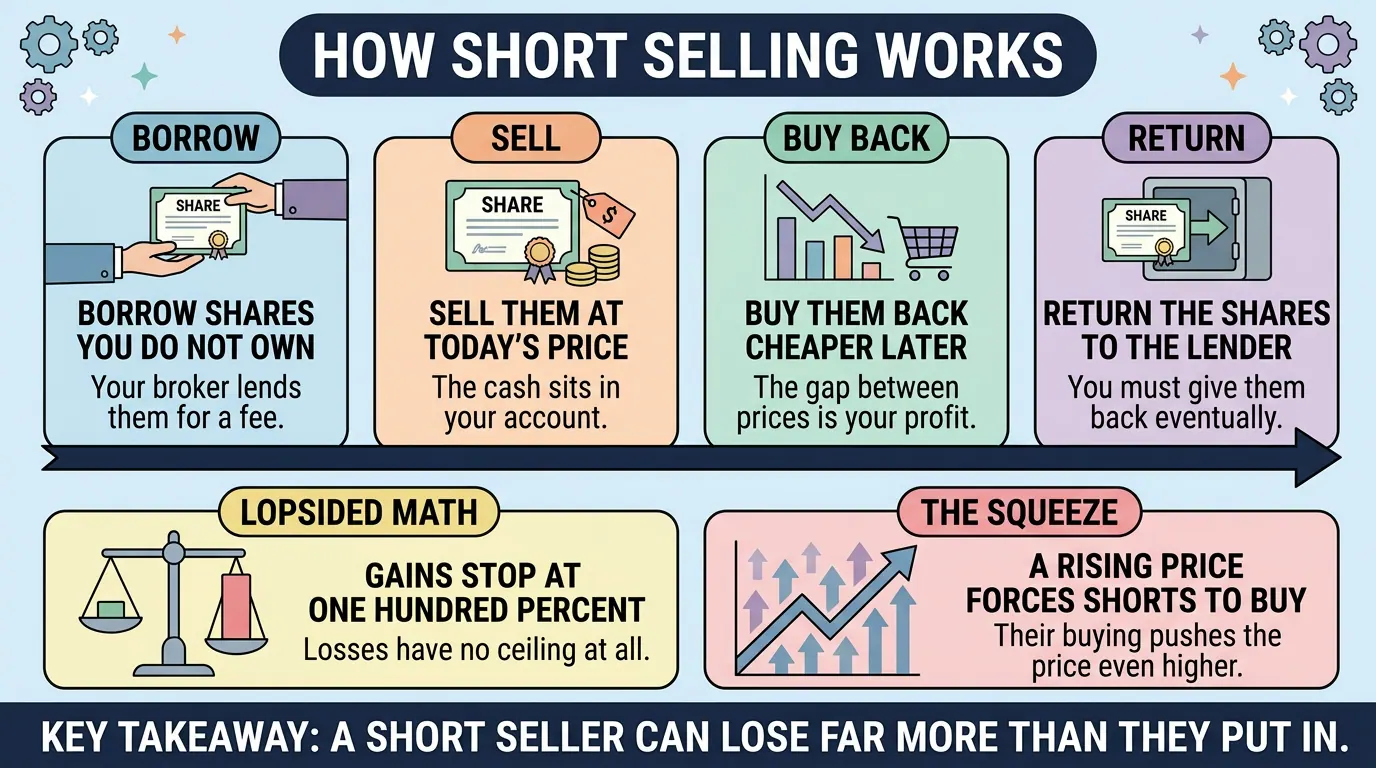
A short sale has four steps.
Borrow. Your broker locates shares owned by someone else and lends them to you. You now owe those shares back.
Sell. The borrowed shares go on the market and the cash lands in your account.
Buy back. Later you buy the same number of shares, which is called covering.
Return. The shares go to the lender, and leftover cash is the profit or the loss.
Run it on a stock at $100. Borrow 100 shares, sell them for $10,000, and if the stock falls to $60 you buy them back for $6,000 and keep $4,000 minus costs. If it rises to $130, buying back costs $13,000 and you are $3,000 in the hole. You owe the shares either way.
Where the Borrowed Shares Come From
The lender is usually another customer of the same brokerage or an institution such as a pension fund sitting on millions of idle shares. Brokers lend out shares held in margin accounts and collect a fee.
That fee is the borrow rate, an annual percentage of the position's value charged the whole time the position stays open. A widely held stock might cost a fraction of a percent a year. A scarce, heavily shorted one can run 20%, 50%, or well over 100% annualized, and at 60% the stock has to fall faster than the meter runs.
If the company pays a dividend while you are short, you owe that dividend to the share's real owner. It leaves the account as a payment in lieu of dividend and gets no favorable tax treatment.
Under a Securities and Exchange Commission rule called Regulation SHO, a broker generally must locate borrowable shares before allowing the sale. Selling shares nobody has arranged to borrow is naked short selling, and it is restricted.
The Margin Account
Shorting cannot be done in a cash brokerage account. It requires a margin account, which permits borrowing from the broker and pledges the assets inside as collateral.
Federal Reserve rules require initial equity of at least 50% of the position's value, so a $10,000 short needs about $5,000 behind it. FINRA maintenance rules then require ongoing equity of at least 30% of current market value for most stocks above $5.
That phrase, current market value, is the dangerous part. The position is repriced daily, so as the stock climbs the collateral requirement grows at the same moment account equity is shrinking.
Why the Math Is Lopsided
Buy a stock at $100 and the worst case is that it goes to zero and you lose $100 a share. Unpleasant, but bounded. The best case has no limit, since a stock can rise 500% or 5,000%.
Short at $100 and both ends flip. The best case is bankruptcy and a price of zero, returning the full $100 a share and not one cent more, so the gain caps at 100%. Prices have no ceiling, so the loss does not either. At $400 the short is down $300 a share, three times what it took in.
A second asymmetry compounds the first. A stock you own that falls shrinks as a share of your portfolio, cutting your exposure. A stock you are short that rises grows. A losing short gets heavier the longer it loses.
Margin Calls and Forced Buy-Ins
A margin call comes when account equity drops under the maintenance requirement. The broker demands cash immediately, and if it does not arrive the broker closes the position at whatever price the market offers.
A forced buy-in comes from the other direction. The lender can recall the shares, usually because they decided to sell, and the broker must find replacements or buy on the open market to close the short. If the stock is hard to borrow, replacements may not exist. Both mechanisms produce buying in a rising stock.
The Short Squeeze
Every short position is a future purchase order, because exiting requires buying. That creates a feedback loop with no natural stopping point.
A heavily shorted stock rises. The rise triggers margin calls, covering means buying, buying pushes the price higher, and that triggers margin calls on the shorts still holding on. None of that buying reflects anyone thinking the company is worth more. It is forced demand from people trying to stop the bleeding, and it can carry a price far past anything the business justifies.
GameStop, January 2021
GameStop was a struggling mall video game retailer, and short sellers had piled in on the reasonable view that physical stores were losing to downloads. By late January 2021, reported short interest exceeded 140% of the freely traded shares.
More than 100% shorted sounds impossible, so unpack it. A borrowed share, once sold, sits in a new owner's account and can be lent out again to a different short seller. One original share supports two short positions.
Retail traders on the Reddit forum r/wallstreetbets spotted the setup and started buying. The stock went from roughly $17 at the start of January to an intraday high of $483 on January 28. Melvin Capital, a hedge fund heavily short the stock, lost about 53% that month and shut down in 2022. Robinhood and other brokers restricted buying at the height of it, which triggered lawsuits and Congressional hearings.
It gets told as small investors beating Wall Street, and it was partly that. The stock also collapsed within weeks, and many people who bought near the top lost heavily.
Short Interest and Days to Cover
Short interest is the number of shares sold short and not yet bought back, collected from brokers twice a month. It is usually measured against the float, meaning shares actually available to trade rather than locked up by insiders. There is no official cutoff, but traders generally treat short interest above 20% of float as heavily shorted.
Days to cover, or the short interest ratio, divides short interest by average daily volume, estimating how many days of normal trading the shorts would need to all get out. A ratio of 8 means a narrow exit, and a narrow exit is what turns a rising price into a squeeze.
What Short Sellers Are For
Short selling has a poor reputation, and regulators have banned it outright during several crises. It also does real work.
Without shorts, only people who already own a stock can express a negative view, by selling, while everyone who thinks it is overpriced but owns none stays silent. Short sellers give that view a route into the price, and research generally finds markets with active short selling absorb bad news faster.
Shorts also have a powerful financial incentive to dig into companies that are lying. Jim Chanos, of the fund Kynikos Associates, built a short position in Enron in 2000 after deciding its accounting made no sense, more than a year before the company collapsed.
Summary
Short selling means borrowing shares, selling them, and buying them back later, so the trade profits when the price falls. It needs a margin account, carries a borrow fee that runs continuously, and obliges the seller to cover any dividends. The gain caps at 100% because a stock can only fall to zero, while the loss has no ceiling and grows heavier as it goes wrong. Margin calls, forced buy-ins, and squeezes can all close a position at the worst possible price, and being right about a company is no protection against being wrong about the timing.