A savings account makes two promises at once. It pays you something, and it hands the money back the moment you ask. Those promises pull against each other, because a bank that must be ready to pay you on any random Tuesday cannot lend your deposit out for five years, and short, safe lending does not earn much.
Certificates of deposit and money market accounts renegotiate that deal in opposite directions. A CD trades away access for a locked rate. A money market account keeps the access and lets the rate float. A third product, the money market fund, sounds like the second one and is not a bank account at all.
All three hold cash, so choosing among them is not about risk tolerance. It is about a question most people skip: what day do you actually need this money?
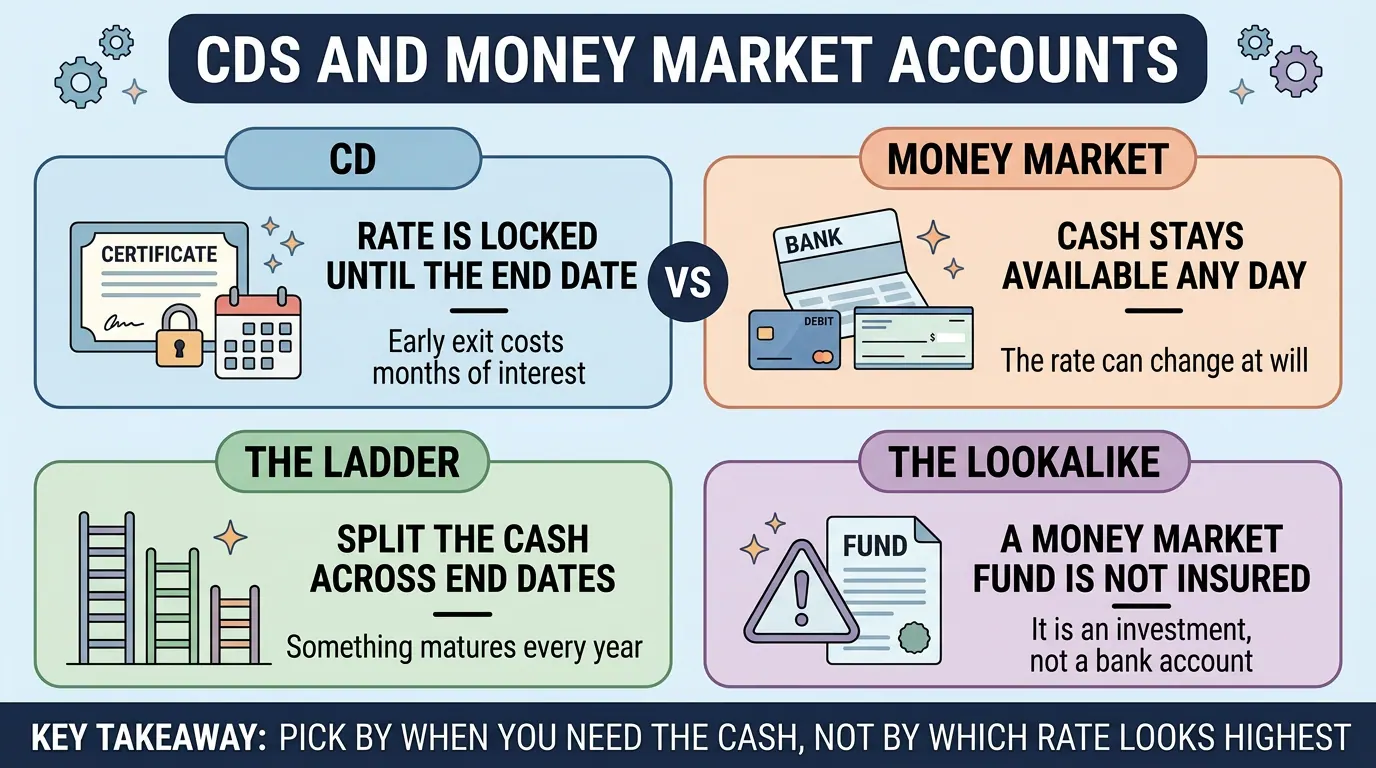
What a CD Is, and What Breaking One Costs
A certificate of deposit (CD) is a deposit you agree to leave at a bank for a fixed period, called the term. Terms run from three months to five years. In exchange, the bank fixes your interest rate for the whole term. It cannot cut the rate on you later, and it will not raise it either.
The money is federally insured on the usual terms, up to $250,000 per depositor, per insured institution, per ownership category, through the FDIC at banks and the National Credit Union Administration (NCUA) at credit unions.
Leave early and you pay an early withdrawal penalty, which banks quote in months of interest rather than in dollars. A common schedule charges three months of interest on terms of a year or less, six months on two- and three-year terms, and a year or more on five-year CDs.
Put $10,000 in a five-year CD paying 4%, then close it after twelve months:
You earned roughly $400 in interest.
A six-month penalty takes back roughly $200.
You leave with about $10,200, an effective return near 2%.
Break it after two months instead and the arithmetic turns ugly. You have earned about $67, the penalty is still six months of interest, and the bank takes the difference out of your principal. Most disclosures say exactly that: the penalty may reduce principal.
The Fixed Rate Protects You and Traps You
If rates fall after you open a five-year CD at 4.5%, you keep collecting 4.5% while high-yield savings accounts slide to 3%. That is the reason long CDs exist. If rates rise instead, you are the one stuck at 4.5% while new savers are offered 5.25%, and getting out costs you the penalty.
A high-yield savings account, covered elsewhere on this site, pays a variable rate the bank can change any day. Variable means you gain when rates rise and lose when they fall. Fixed reverses who is exposed. Neither is safer; they fail in opposite weather.
The CD Ladder
A ladder saves you from guessing which way rates go. Instead of one $10,000 CD, buy five $2,000 CDs with terms of one, two, three, four, and five years. Every twelve months a rung matures, and you either spend it or roll it into a new five-year CD. After four years every rung is a five-year CD, usually the best rate on the menu, and something still comes due each year.
Bank CDs, Brokered CDs, and No-Penalty CDs
A bank CD is opened directly with the bank and usually renews automatically. Watch the grace period after maturity, often about ten days, or you can end up locked into another full term at whatever rate the bank feels like paying.
A brokered CD is issued by a bank but sold through a brokerage account. The FDIC insurance still comes from the issuing bank, and holding CDs from several issuers in one account is a convenient way to stay under the per-bank limit. Three differences matter:
There is no early withdrawal penalty, because there is no early withdrawal. To get out you sell the CD to another investor on the secondary market. If rates have risen since you bought, that price is below what you paid.
Many brokered CDs are callable, meaning the issuing bank can end them early. Banks call when rates have fallen, exactly when you wanted to keep your old rate.
Interest is usually paid out to your brokerage account rather than compounding inside the CD.
A no-penalty CD (also called a liquid CD) lets you withdraw after a short holding period, often six or seven days, and keep the interest earned. The catch is priced in. The rate is lower than a standard CD of the same length, and the withdrawal is usually all or nothing.
Money Market Accounts
A money market account (MMA) is a bank deposit account that behaves like savings with checking privileges attached, carrying the same FDIC or NCUA insurance. Many come with a debit card, a small book of checks, or both, and that access is what separates an MMA from a plain high-yield savings account.
The rate is variable and often tiered, so the advertised number may apply only above a balance threshold. Banks also cap how many checks or transfers you get per statement cycle. Regulation D's federal six-per-month limit was suspended in April 2020, but many banks kept their own version, so your limit is whatever the account agreement says.
A Money Market Fund Is Not a Money Market Account
A money market fund is a mutual fund. It pools investors' money and buys very short-term debt: Treasury bills, government agency paper, commercial paper, bank CDs. You hold it in a brokerage account.
There is no FDIC insurance on it. Brokerage accounts carry Securities Investor Protection Corporation (SIPC) coverage up to $500,000 per customer, but SIPC does a different job. It steps in when a brokerage firm fails and customer assets go missing. It does not protect you from the fund losing value.
That risk is small and not zero. These funds are managed to hold their share price at exactly $1.00 and nearly always do. In September 2008 the Reserve Primary Fund broke the buck after Lehman Brothers defaulted on debt it held, and its shares fell to 97 cents. Rules were tightened afterward, and some funds can now charge a liquidity fee when too many investors head for the exit at once.
In exchange for that sliver of risk, these funds have tended to yield more than bank money market accounts, and their yields track short-term rates almost immediately.
Choose by Date, Not by Rate
Sort your cash by when you need it.
No date at all. Emergency savings belongs in a high-yield savings account or a money market account, where access is the first question and yield is the second.
A known date, one to five years out. Tuition next August, a down payment in three years. A CD maturing near that date locks your rate, and a ladder does the same for a series of dates.
Cash already sitting in a brokerage account. A money market fund is the usual holding pen for money waiting to be invested.
Sorting by yield instead is the common mistake. A CD paying half a point more than savings is a bad trade if you break it in month four, because the penalty erases far more than that half point ever earned.
Summary
A CD locks your money for a fixed term at a fixed rate and charges a penalty, quoted in months of interest, if you leave early. That rate shields you when rates fall and cages you when they rise, which is why ladders, brokered CDs, and no-penalty CDs exist. A money market account is a bank deposit with check or debit access and a floating rate. A money market fund shares the name but is a mutual fund, with no FDIC insurance and usually a higher yield. Match the product to the date you need the cash.