Two beliefs about Social Security are widely held and both are wrong. The first is that it will cover your retirement. The second is that it will not exist by the time you get there.
The truth is duller and more useful than either. Social Security is a meaningful foundation that replaces a fraction of your income, it is facing a real funding shortfall on a known timeline, and the shortfall does not mean zero.
What It Actually Is
Social Security is a mandatory retirement program funded by payroll tax. You have been paying into it since your first job, whether you noticed or not.
The tax is 6.2% of your wages for Social Security, matched by another 6.2% from your employer. Self-employed people pay both halves. The tax applies only up to an annual wage ceiling, which is $184,500 for 2026. Earnings above that are not taxed for Social Security and do not increase your future benefit.
The money you pay in is not saved in an account with your name on it. It funds benefits for current retirees, and future workers fund yours. This design is the source of both its durability and its demographic problem.
Earning a Benefit
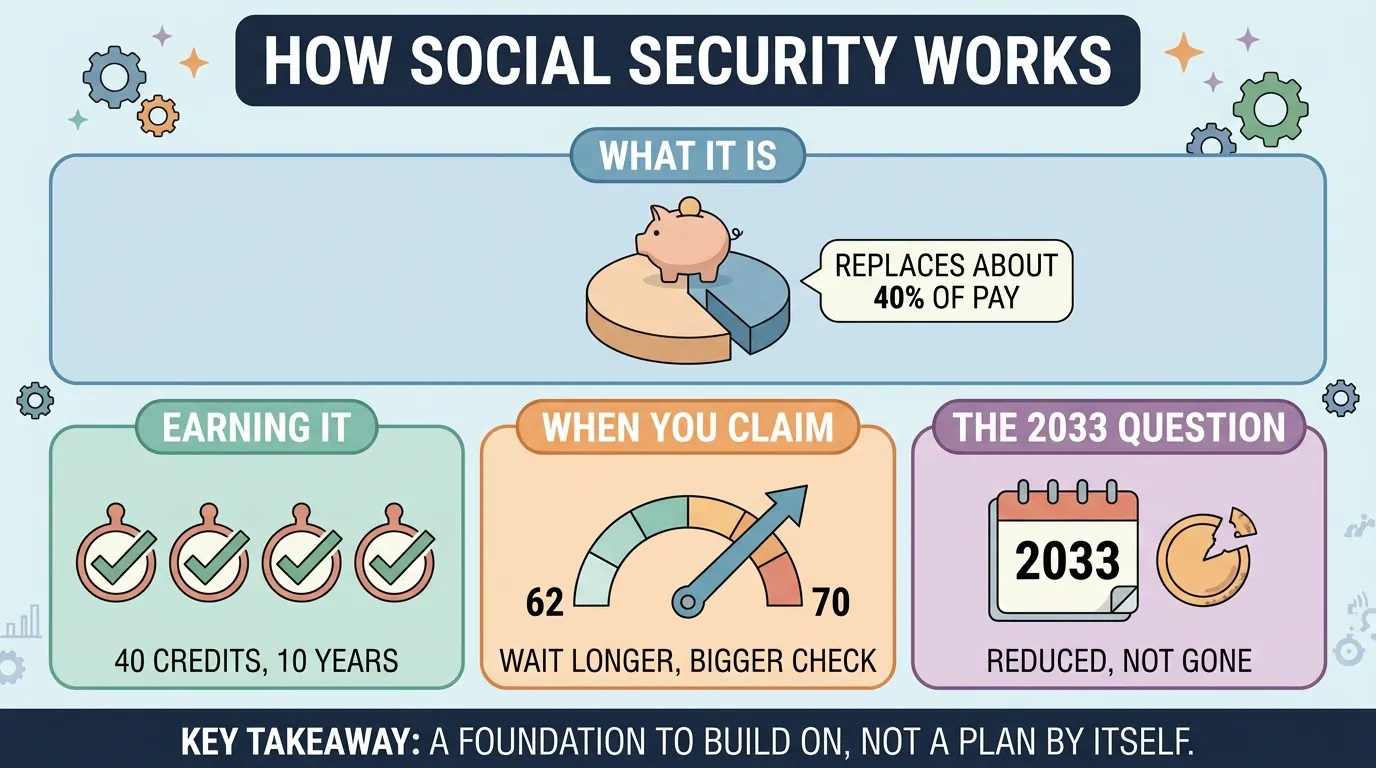
You need 40 credits to qualify, which works out to roughly ten years of work. Credits accumulate based on earnings, and most people working full time earn the maximum four per year.
The benefit calculation uses your highest 35 years of earnings, adjusted for wage growth over time. Two consequences follow directly:
Years with no earnings count as zeros. Someone who worked 30 years has five zeros averaged into their calculation, which pulls the benefit down noticeably.
The formula is progressive, meaning it replaces a larger share of income for lower earners than for higher earners. It uses a series of thresholds where the replacement rate steps down, so the first portion of your average earnings is replaced at 90%, the next at 32%, and the remainder at 15%. This is why Social Security matters enormously to low-income retirees and represents a small slice of a high earner's plan.
For scale, the average retired worker benefit in 2026 is about $2,071 per month, after a 2.8% cost-of-living increase raised it from roughly $2,015.
The Decision That Costs the Most Money
You can claim anywhere between 62 and 70, and the timing changes your monthly check permanently.
Your full retirement age is 67 if you were born in 1960 or later. Claim at that age and you receive your calculated benefit in full.
Claim at 62, the earliest possible, and the benefit is permanently reduced by about 30%.
Claim at 67 and you get 100%.
Claim at 70 and you get roughly 124%, because delaying past full retirement age adds about 8% per year.
The spread between the earliest and latest choice is enormous. Someone whose full benefit is $2,000 per month would receive about $1,400 at 62 and about $2,480 at 70. Same work history, a 77% difference in monthly income for life.
Which is correct depends on how long you live and whether you need the money. Claiming early means more years of smaller checks; claiming late means fewer years of larger ones. The crossover point where waiting pays off more in total tends to fall somewhere in the late seventies to early eighties, which is why people in poor health often claim early and people with longevity in the family often wait.
One additional rule if you claim early and keep working. Before full retirement age, an earnings test withholds $1 of benefits for every $2 you earn above an annual limit. The withheld amount is credited back later in the form of a higher benefit, so it is a deferral rather than a permanent loss, but it surprises people who claim at 62 and then take a part-time job.
Your record can pay more than one person. A spouse who earned little or nothing can claim a spousal benefit worth up to 50% of the worker's full retirement age benefit, and that payment does not reduce what the worker receives. Survivor benefits go further: a widow or widower can step up to 100% of what the deceased spouse was receiving or entitled to receive, which is why the higher earner's claiming decision affects two lifetimes rather than one. Divorced spouses can qualify too if the marriage lasted at least ten years.
Benefits can also be federally taxable, which catches many retirees off guard. The IRS uses a measure called provisional income, roughly your adjusted gross income plus any tax-exempt interest plus half of your Social Security. Above the first set of thresholds, up to 50% of your benefits become taxable; above the higher set, up to 85% do. Those thresholds are not indexed for inflation, so more retirees cross them every year.
The 2032 Question, Answered Honestly
Here is the part usually reported badly.
Social Security's trustees project that the retirement trust fund's reserves will be depleted in the fourth quarter of 2032. That is the number behind every headline claiming the program is going bankrupt.
What actually happens at depletion: payroll taxes keep coming in, because workers keep working. Those incoming taxes are projected to cover about 78% of scheduled benefits. So the realistic scenario is not zero. It is roughly a 22% cut, absent any Congressional action.
Two things belong alongside that number.
Congress has faced this before and acted. The 1983 amendments addressed a similar shortfall by gradually raising the full retirement age and taxing a portion of benefits. Available levers this time include raising or eliminating the wage ceiling, adjusting the tax rate, changing the benefit formula, and raising the retirement age again. Every one of them is politically painful, which is why nothing has happened yet.
And the projection is a projection. It shifts year to year with economic and demographic data.
The reasonable planning posture for someone in their twenties is neither to ignore Social Security nor to assume it disappears. Plan as though you will receive something meaningfully less than what current formulas promise, and treat your own savings as the part you control.
What This Means for Your Plan
Social Security is designed to replace roughly 40% of pre-retirement income for a median earner, and less for a high earner. It was never built to be the whole thing, and the trust fund situation makes conservative assumptions sensible.
Three practical steps:
Create an account at ssa.gov and look at your earnings record. Errors happen, and a missing year of wages permanently lowers your benefit. Fixing it is far easier now than in forty years.
Note that the statement's benefit estimates assume current law, so they represent the un-cut version.
Treat your 401(k) and IRA as the load-bearing part of the plan. If Social Security ends up better than expected, that is a pleasant surprise rather than a requirement.
Summary
Social Security is a payroll-tax-funded program requiring about ten years of work to qualify, with benefits based on your highest 35 years of earnings and a progressive formula that replaces more income for lower earners. Claiming age matters enormously: 62 cuts your benefit permanently by about 30%, while waiting until 70 raises it to roughly 124% of the full amount, a spread of about 77% between the two extremes. The average retired worker receives about $2,071 per month in 2026 after a 2.8% cost-of-living increase. Trust fund reserves are projected to deplete in late 2032, after which incoming payroll taxes would still cover about 78% of scheduled benefits, so the realistic risk is a substantial cut rather than nothing at all.