By December 2008 the Fed had done everything its main tool allowed. The federal funds rate sat at zero to 0.25 percent, and the economy was still contracting. There was nothing left to cut.
What it did next was buy bonds, on a scale nobody in the United States had tried. That program, quantitative easing, is now a standard part of the toolkit, and unwinding it is a routine part of the cycle. It is also the piece of Fed policy people are most confident and most wrong about.
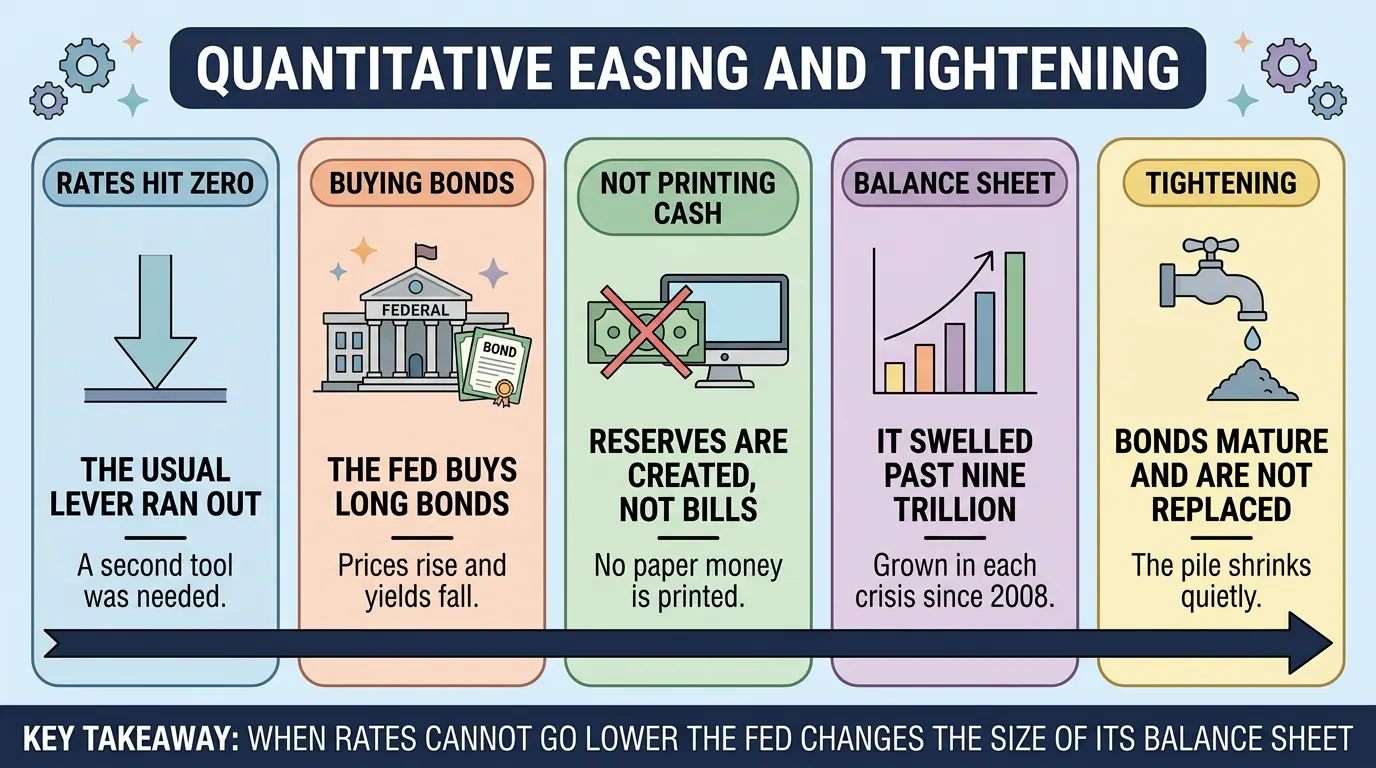
Why a Second Tool Was Needed
Nominal interest rates have a floor near zero. Push much below it and depositors can hold physical currency instead, which pays zero and never less. Europe and Japan went slightly negative for a stretch and found the ground gets soft quickly.
So the Fed changed which price it was aiming at. Instead of the overnight rate, which was pinned, it went after longer-term rates: the 10-year Treasury yield, the 30-year mortgage rate, the corporate bond yield. Those are the rates that decide whether a company builds a plant or a family buys a house. Buying long-dated bonds in size was the way to reach them.
What Buying Bonds Actually Does
The Fed buys Treasury securities and agency mortgage-backed securities from primary dealers in the open market. It pays by crediting reserves to the seller's bank, reserves being deposits banks hold at the Fed itself. The bonds land on the Fed's asset side and the new reserves on its liability side, and the balance sheet grows by the amount bought.
Two channels are usually offered for why this pushes long rates down.
Portfolio balance. By pulling a large quantity of long-duration bonds out of private hands, the Fed shrinks the amount of interest rate risk the market has to hold. Investors who wanted that duration bid for what remains or move into other assets, which drives yields down and other asset prices up. The piece of yield being compressed is the term premium, the extra return investors demand for locking money up longer.
Signaling. Committing to buy long bonds for an extended stretch is a costly, visible way of saying short rates will stay low for a long time, which carries more weight than simply saying it.
What Printing Money Does and Does Not Mean
This is the part that gets mangled. QE creates bank reserves. Reserves are not currency in circulation and cannot be spent by anyone outside the banking system. They sit in accounts at the Fed, where banks use them to settle payments with each other. No household's checking account grows because the Fed bought a bond.
In accounting terms, QE swaps one government liability for another. The public was holding a Treasury bond paying interest. Now it holds a bank deposit backed by reserves that also pay interest. The government's consolidated debt did not change. Its maturity got shorter.
The record supports the distinction. Between 2008 and 2015 the Fed's balance sheet grew roughly fivefold while inflation ran at or below 2 percent for most of the period. The hyperinflation forecasts that followed the 2010 and 2012 rounds did not arrive, because banks largely held the reserves rather than lending them into an economy still working off debt.
2020 to 2022 went differently, and the reason is worth stating precisely. QE was running, but so were direct fiscal transfers, money deposited into household bank accounts by the Treasury under legislation Congress passed. That is a different mechanism, and households spent it. Blaming the resulting inflation on QE alone collapses the two together. QE changes what assets the public holds. Fiscal transfers change how much the public has.
The Balance Sheet, 2008 to Now
Before the 2008 crisis the Fed's balance sheet was under $900 billion, mostly short-term Treasuries held for ordinary operations. Three rounds of purchases between 2008 and 2014 took it to roughly $4.5 trillion. It shrank modestly from 2017 through 2019. Then the pandemic response added about $4.6 trillion in Treasuries and mortgage-backed securities between March 2020 and early 2022, peaking near $8.97 trillion in April 2022.
One consequence gets little attention. The Fed bought long-dated, low-yielding bonds and funds them by paying interest on reserves at whatever the current short-term rate happens to be. When short rates rose above the yield on the portfolio in 2022, the Fed began operating at a loss. Its remittances to the Treasury, normally tens of billions of dollars a year, fell to roughly zero, and the shortfall is carried as a deferred asset to be paid down out of future profits. This does not impair the Fed's ability to set policy, but it is a real fiscal cost of the strategy.
Quantitative Tightening and Runoff
Reversing QE by dumping bonds into the market would be disruptive, so the Fed mostly does not. It uses runoff instead. When a bond in the portfolio matures, the Treasury repays the principal and the Fed simply declines to reinvest it. The balance sheet shrinks passively, capped at a monthly maximum announced in advance.
The limit on how far this can go is the level of bank reserves. Since 2019 the Fed has run an ample reserves system, steering the fed funds rate by setting administered rates (what it pays banks on their reserves, and its overnight reverse repo rate) rather than by making reserves scarce. That only works while reserves stay abundant.
September 2019 is the cautionary tale. Reserves had drained further than anyone realized was safe, and overnight repo rates spiked to several times the fed funds target in a single morning. The Fed had to inject liquidity immediately. The lesson was that the level of ample is not observable in advance. You find the floor by hitting it.
The most recent tightening ran from mid-2022 to December 1, 2025, ending with the balance sheet around $6.57 trillion, roughly half of the pandemic-era growth reversed. The Fed stopped well before reserves got tight, and it now buys Treasuries at a pace meant to track trend growth in demand for reserves. That is balance sheet maintenance rather than stimulus, a distinction that regularly disappears in headlines about the Fed buying bonds again.
The Taper Tantrum
In May 2013, Chair Ben Bernanke told a congressional committee that the Fed might begin reducing the pace of its bond purchases. Not raising rates. Not selling anything. Buying less than before.
The 10-year Treasury yield rose about a percentage point over the following months. Mortgage rates jumped with it, and emerging market currencies and bonds sold off hard as capital pulled back toward the United States.
The episode taught the Fed that markets price the expected path of the balance sheet rather than its current size, and that a change in the pace of purchases gets read as a change in the entire policy stance. Every taper since has been telegraphed months ahead in careful, repeated language. The 2021 taper was announced, then executed, with far less market reaction.
How Much Did It Actually Do?
This is still open. Event studies, which measure yield moves in the narrow window around QE announcements, generally find meaningful effects on long-term rates. Critics, including a 2018 paper by Greenlaw, Hamilton, Harris, and West, argue those windows capture announcement effects that partly reverse afterward, and that estimates drawn from longer time series are smaller and less stable.
There is broader agreement on one point. The first round, launched in the middle of a panic in late 2008, worked mainly by restoring function to markets that had stopped trading. Later rounds, run in calmer conditions, are the ones whose effects are hardest to pin down.
Bernanke's own line, from a 2014 event at the Brookings Institution, is the honest summary: the problem with QE is that it works in practice but not in theory. The evidence that long rates fell around the announcements is decent. The theoretical case for why swapping one safe government asset for another should move much of anything is weaker than the size of the program suggests.
Summary
Quantitative easing is the Fed buying long-dated bonds to push down long-term interest rates once its overnight rate has no room left to fall. It creates bank reserves rather than spendable cash, which is why the 2008 to 2015 expansion produced no inflation surge while the pandemic period, with large direct fiscal transfers running alongside it, did. Tightening happens passively through runoff and stops well before reserves become scarce, because 2019 showed what scarcity looks like. Whether the later rounds moved rates as much as advertised remains genuinely contested.