A tariff sounds like something a foreign country pays. The word gets used that way constantly. Follow the actual paperwork, though, and the check is written by a company in the United States, usually before the goods have left the port.
That does not settle who ends up bearing the cost, which is a separate and much harder question. But it is the right place to start, because most confusion about tariffs traces back to skipping this step.
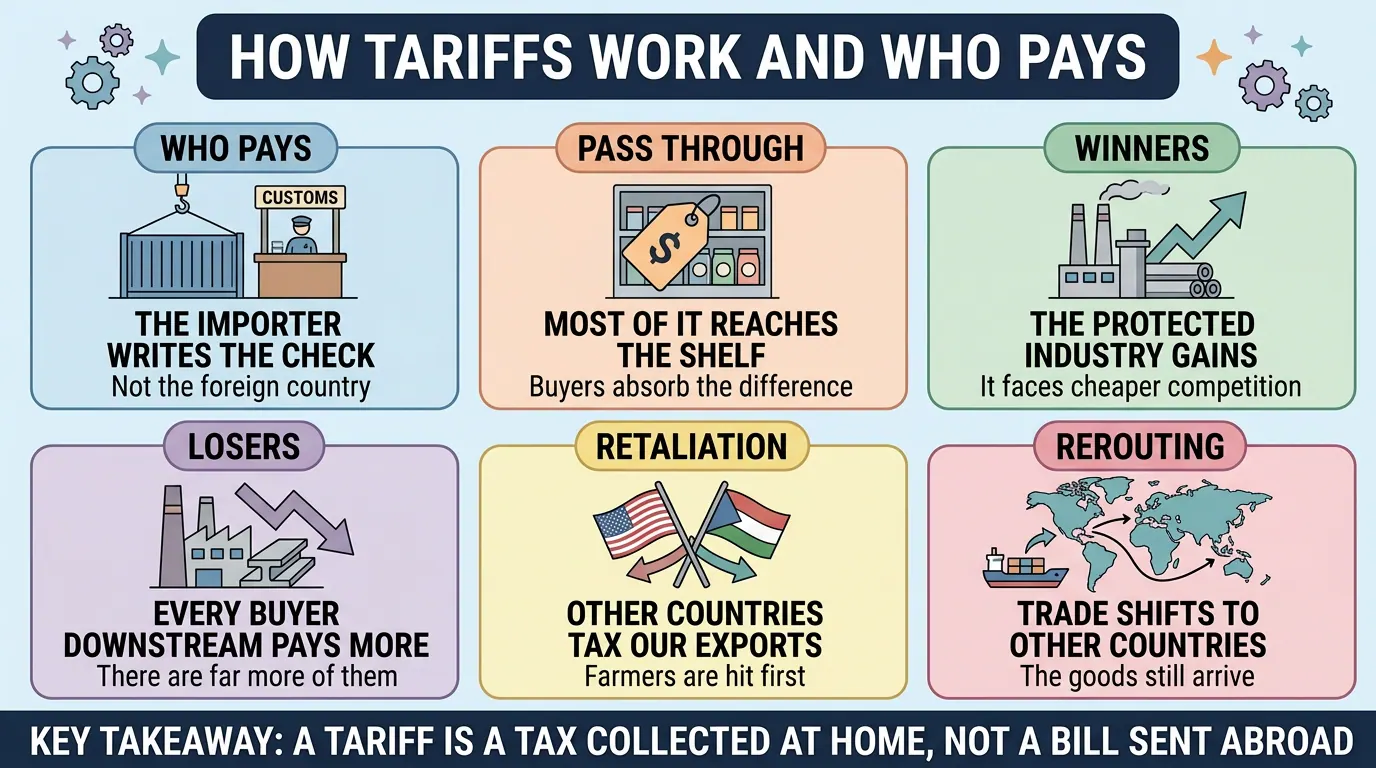
Where the Money Changes Hands
A tariff is a tax on imported goods. US Customs and Border Protection collects it when a shipment clears customs, and it is paid by the importer of record, a business registered in the United States. Most tariffs are ad valorem, meaning a percentage of the declared value of the shipment. Some are specific, meaning a fixed dollar amount per unit, per ton of steel or per liter of juice.
The rate depends on what the product is and where it came from. Every traded good has a code in the Harmonized Tariff Schedule, a document running to thousands of lines, and that code plus the country of origin sets the rate. This is why an argument over whether a garment counts as a jacket or a windbreaker can be worth millions of dollars to a company.
The Pass-Through Question
Once the importer has paid, the cost has three places it can go, and it usually splits among them.
The foreign exporter cuts its price to keep the sale. This happens when the seller has few alternative markets and badly needs American buyers.
The importer, wholesaler, or retailer absorbs it in margin. Common early on, while firms defend market share and sell down inventory bought before the tariff took effect.
The buyer pays it in a higher shelf price, which is where it lands once the first two run out of room.
Which way the split goes depends on how easily the buyer can switch to something else and how badly the seller needs the market. A tariff on a product with an easy domestic substitute pushes more of the cost onto the exporter, who loses the sale outright by holding price. A tariff on something with no close substitute lands mostly on the buyer.
Studies of the 2018 and 2019 US tariffs and of the 2025 round point the same direction. The Peterson Institute for International Economics, summarizing that research in 2026, reported that American buyers (consumers and US firms together) bore roughly 90 percent of the burden in 2025, with foreign exporters cutting prices only modestly. Timing matters too. A New York Fed follow-up published in July 2026 found the pass-through was still far from finished: nearly half the firms that had paid tariffs said they planned further price increases, some of them six months or more out, because fixed-price contracts and staged pricing delay when a cost increase reaches the shelf.
Hold the exact figures loosely. Pass-through estimates vary widely depending on which prices are measured and over what window. The honest summary is that most of the cost stays on the domestic side, while the precise fraction and the speed remain disputed.
The Protected Industry and Everyone Downstream
A tariff on steel raises the price American steel mills can charge. That is the intent, and it works.
Steel is also an input. Automakers, appliance manufacturers, construction firms, and toolmakers all buy it, and their costs rise whether they buy the imported steel or the domestic steel that just got more expensive alongside it. Employment in industries that consume steel is many times larger than employment in industries that produce it.
That asymmetry shows up in nearly every tariff debate. Benefits concentrate in a small number of firms and towns that can identify themselves and organize. Costs spread thinly across a much larger set of businesses and households, most of whom never trace a higher price back to the policy. The concentrated side is almost always louder, whether or not it is larger in dollars.
Retaliation
Trading partners respond, and not randomly. Retaliatory tariffs tend to target exports that are geographically concentrated and politically visible. Agriculture is the standard choice, because farm output is easy to identify, easy to buy somewhere else, and produced in places where the pain registers fast.
After the 2018 tariffs, China shifted a large share of its soybean purchases to Brazil. Some of that trade returned later, but the Brazilian production and port capacity built during those years did not disappear. Broken trade relationships can be slow to rebuild, a cost that keeps showing up years after the tariff itself is gone.
A Trade Deficit Is Not a Scorecard
A trade deficit means a country bought more goods and services from abroad than it sold. It gets described as a loss, as though the money left and nothing came back. That ignores the other half of the ledger.
Dollars sent abroad do not vanish. They return, either buying American exports or buying American assets: Treasury bonds, stocks, real estate, whole factories. In the national accounts this is an identity rather than a theory. A deficit on the current account is matched by a surplus on the capital account of the same size. The United States runs a persistent goods deficit partly because the rest of the world wants dollar assets, and getting them requires getting dollars first.
Underneath that, a country's trade balance reflects the gap between what it saves and what it invests. Invest more than you save at home and you import the difference in capital, with a trade deficit as the mirror image. Tariffs do not change national saving directly, which is why they tend to change who a country trades with more than how much it imports overall.
Supply Chains Reroute
When tariffs hit one country's goods, production and shipping shift toward countries facing lower rates. Vietnam and Mexico picked up substantial share after the 2018 tariffs on Chinese goods.
Some of that is genuine relocation of factories. Some is transshipment, where goods pass through a third country with minimal work done there in order to change the stated origin. Telling the two apart is what rules of origin exist for, and enforcing them requires customs officials to determine how much of a product's value was added where. A broad tariff program eventually drags customs enforcement into factory-level accounting, which is slow and imperfect.
Narrow Tariffs and Broad Ones Behave Differently
A tariff on one product from one country leaves an escape valve open. Buyers switch suppliers, and the effect on the wider price level stays small even when the effect on that one market is large.
A tariff applied across most imports from most countries closes the valves. With no cheaper origin to switch to, more of the cost has to land on domestic buyers, and the policy starts behaving like a broad consumption tax weighted toward goods rather than services. Broad tariffs also raise far more revenue and provoke wider retaliation, since more partners have reason to respond.
Which Law the Tariff Comes From
Tariffs are imposed under specific statutes, and the choice of statute turns out to matter. Much of the 2025 program relied on the International Emergency Economic Powers Act. On February 20, 2026, in Learning Resources, Inc. v. Trump, the Supreme Court held by a 6 to 3 vote that this law does not authorize the President to impose tariffs, and the tariffs issued under it were terminated within days.
Tariffs resting on other authorities were not part of that case and stayed, including Section 232 national security tariffs on steel, aluminum, and autos, and Section 301 tariffs tied to unfair trade practices. The average effective tariff rate on US imports fell from about 16 percent before the ruling to around 9 percent immediately after, then climbed back toward 12 percent through the spring of 2026 as new Section 122 tariffs replaced part of what the Court struck down, according to the Yale Budget Lab. Both figures are high by the standards of the past 70 years, and both will move again as policy and litigation continue.
Summary
A tariff is a tax paid at the border by an American importer, not by a foreign government. The cost then divides between the foreign seller, the importer's margin, and the final buyer, and recent research finds most of it stays on the domestic side. Industries that make the taxed product gain, industries that use it as an input lose, and the losing group is usually larger and quieter. Trading partners retaliate against concentrated exports, supply chains reroute toward untaxed origins, and a trade deficit on its own describes a country's saving and investment balance rather than whether it is winning.