Suppose you find a used car you like for $9,000, but you will not have the money for two months. The seller offers a deal: pay $200 now and he holds the car at that price until the end of August. Show up and you pay $9,000. Walk away and he keeps the $200.
You have just bought a call option. Almost everything else about options is detail.
The derivatives section already places options among the four main derivative contracts. This piece stays on the two building blocks and works through the arithmetic with real numbers.
The Right, Not the Obligation
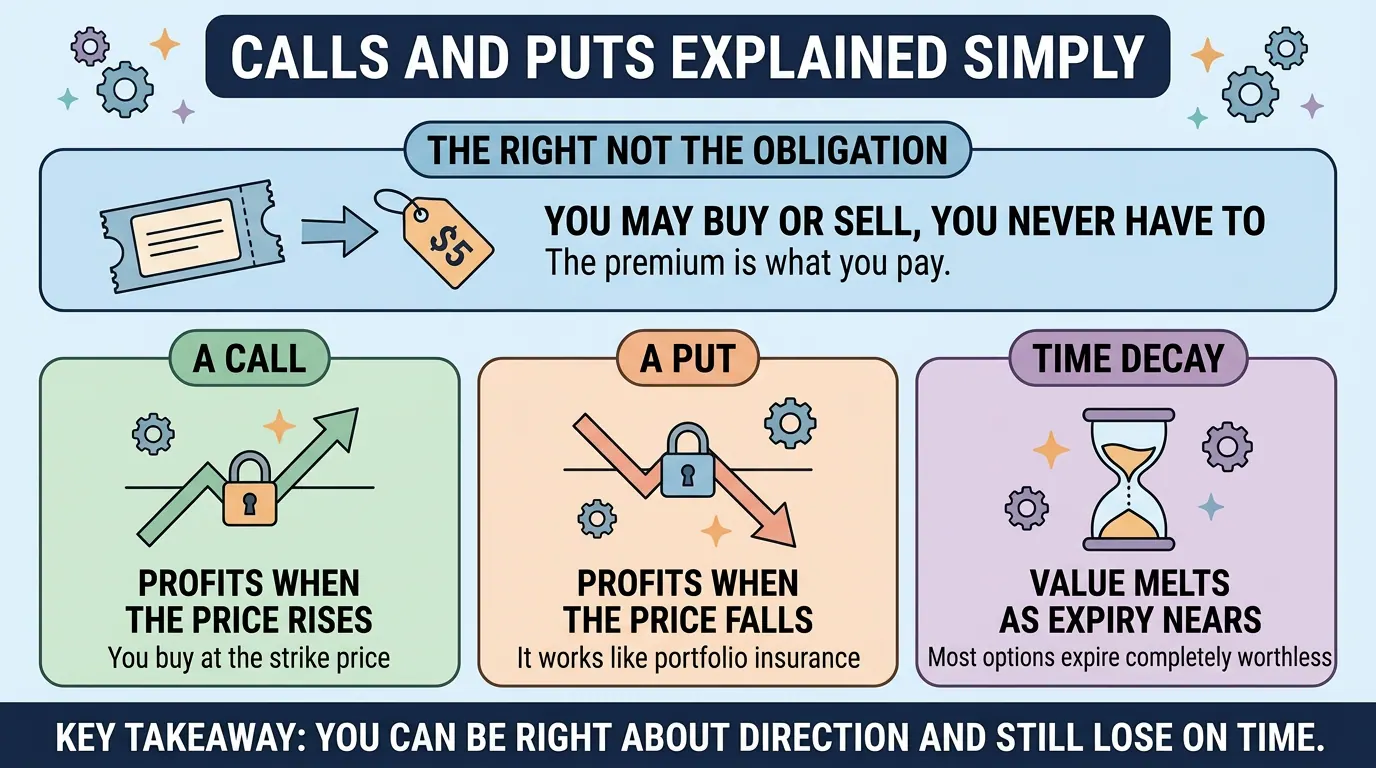
A call option gives the buyer the right to buy a stock at a fixed price by a fixed date. A put gives the right to sell at a fixed price by a fixed date. Either way the buyer chooses whether to use it, and walking away costs only what was paid for the contract.
Four numbers define every option:
The underlying. The stock or index the contract is written on.
The strike price. The price you may buy or sell at.
The expiration date. The day the right disappears.
The premium. What the buyer pays the seller, quoted per share.
One point trips up almost every beginner. A standard US equity option covers 100 shares. A quoted premium of $2.00 means the contract costs $200, and a quote of $0.45 means $45. Prices are per share, bills are per contract.
In the Money, Out of the Money
An option is in the money when using it right now would be worth something. A $50 call is in the money if the stock trades above $50. A $50 put is in the money if the stock trades below $50. Out of the money is the reverse, and at the money means the stock is sitting near the strike. An option that is out of the money at expiration is worthless, because nobody exercises the right to buy at $50 when the stock is $44.
Intrinsic Value and Time Value
The premium splits into two pieces. Intrinsic value is what the option would be worth if it expired this second, so it is the amount by which it is in the money, and never less than zero. Time value is everything else you are paying, the price of the chance that things improve before expiration.
Say a stock trades at $53 and a $50 call costs $4.50. Intrinsic value is $3.00. The other $1.50 is time value.
Time value shrinks as expiration approaches, and it shrinks faster in the final weeks. That is time decay, and it defines what it is like to be an option buyer. The stock can move in your favor and your option can still lose money, because decay took more than the move gave back. At expiration only intrinsic value remains.
A Call, Worked Through
Stock XYZ trades at $50. You buy one call with a $55 strike expiring in three months, for a premium of $2.00 per share.
Cost: $2.00 times 100 shares, so $200. That is the most you can lose.
Breakeven at expiration: strike plus premium, so $55 plus $2.00 equals $57.
If XYZ ends at $62, the option is worth $7.00 per share, or $700. Subtract the $200 you paid and you made $500.
If XYZ ends at $56, the option is worth $100. You still lost $100, even though the stock rose 12 percent.
If XYZ ends at $54, the option expires worthless and you lose the full $200.
Look at the fourth line again. The stock rose and you still lost money. Options do not pay for being right about direction alone. They pay for direction, size, and timing at once.
A Put, Worked Through
Same stock at $50. You buy one put with a $45 strike expiring in three months, for $1.50 per share.
Cost: $150, and again that is the maximum loss.
Breakeven at expiration: strike minus premium, so $45 minus $1.50 equals $43.50.
If XYZ ends at $38, the put is worth $700, for a profit of $550.
If XYZ ends at $44, the put is worth $100 and you have lost $50.
At or above $45, you lose the full $150.
Buying Versus Writing
Every option has two sides. The buyer holds the right. The seller, called the writer, collects the premium and takes on the obligation to deliver if the buyer exercises. The two sides are not mirror images.
A call buyer's loss is capped at the premium and the gain is open-ended, since a stock has no ceiling. A put buyer's loss is capped at the premium too, but the gain is capped as well, at the strike minus the premium, because a stock cannot fall below zero. A writer's gain is capped at the premium, and the loss is where the danger lives.
Writing a call without owning the stock (a naked call) means agreeing to deliver shares at the strike no matter how high the price goes. There is no ceiling on a stock price, so there is no ceiling on the loss. An overnight takeover announcement can cost many times the premium collected.
Writing a put means agreeing to buy the stock at the strike no matter how far it falls. The loss stops only at zero, which for a $45 put means risking $4,500 per contract to collect $150.
Writers also post collateral, called margin, with the broker, and can be forced to close at a loss if it falls short. Selling options can cost far more than the premium taken in.
The Two Conservative Uses
A covered call means writing a call against 100 shares you already own. If the stock rises past the strike, your shares are sold at that price, so you traded your upside above the strike for the premium today. The risk is not a blowup, it is regret.
A protective put means buying a put on stock you own, which sets a floor under what you can get for it. It works like insurance and prices like insurance. Buy it year after year and the premiums add up, whether or not you ever collect.
What Actually Happens at Expiration
You will hear that 80 or 90 percent of options expire worthless. That figure is wrong, and it is repeated most often by people selling something. Exchange data puts the split closer to half or more closed out before expiration, around 10 percent exercised, and roughly 30 to 40 percent expiring worthless.
The real point survives. Most options held all the way to expiration do finish out of the money, because the buyer needed a specific move by a specific date and did not get it. Time works against the buyer and for the writer, which is why the writer's rare losses can be so much bigger than the buyer's.
Summary
A call is the right to buy at the strike and a put is the right to sell at it, with one contract covering 100 shares. Breakeven is the strike plus the premium for a call and the strike minus the premium for a put. Buyers risk only the premium, while writers collect a fixed premium and take on losses that can run far past it.