Agreeing today to trade something months from now sounds simple until you ask the obvious question: what happens if the other side changes their mind?
A private handshake deal for corn delivery in December is worth exactly as much as the counterparty's willingness to honor it. Futures markets exist because unglamorous plumbing was built to remove that question, so two strangers can make a binding deal and both be confident it settles.
The derivatives section already introduces futures as a firm obligation rather than a choice. This piece is about the plumbing.
Standardization Is the Starting Point
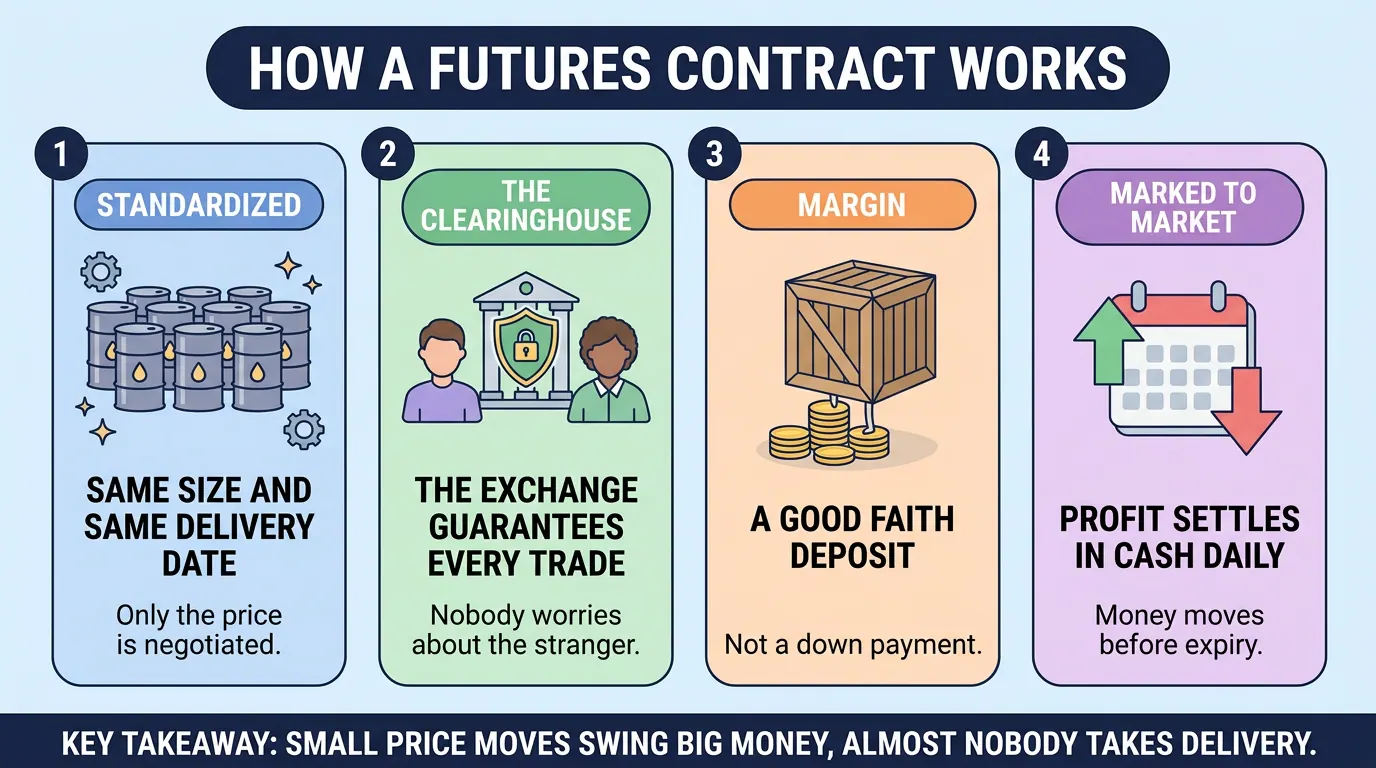
A futures contract is not negotiated. The exchange writes it, and every contract on that product is identical except for price and delivery month. The exchange fixes the quantity, the quality grade, the delivery locations, the last trading day, and the smallest allowed price move.
Standard sizes give you a feel for the scale involved:
Crude oil: 1,000 barrels per contract. At $70 a barrel, one contract controls $70,000 of oil.
Corn: 5,000 bushels per contract.
Gold: 100 troy ounces per contract.
Standardization is what makes the contract tradeable. Because every December corn contract is the same, you can exit by taking the opposite position rather than by finding the person you originally dealt with.
The Clearinghouse Stands in the Middle
Here is the part that makes the whole thing work. Once a trade is agreed, the exchange's clearinghouse steps between the two parties and splits the deal in half. It becomes the buyer to the seller and the seller to the buyer.
You are no longer relying on a stranger but on the clearinghouse, which is capitalized specifically to absorb member defaults. That substitution is why nobody checks anyone else's credit before trading, and why the clearinghouse insists on the collateral rules that follow.
Margin Is a Performance Bond, Not a Down Payment
This is the concept people import incorrectly from stock trading, and getting it wrong is expensive.
When you buy stock on margin, you borrow money and own part of the shares. When you post futures margin, you have not bought anything and you have not borrowed anything. You have posted a good-faith deposit guaranteeing that you can cover a day's losses. The industry term is performance bond, which is a better name.
Two levels apply. Initial margin is what you must have to open the position. Maintenance margin is a lower figure your account must stay above once the position is on. Exchanges set both to cover a plausible one-day move and raise them without warning when a market gets wild. Futures margin often runs between 3 and 12 percent of the contract's face value, far below the 50 percent required to buy stock on margin.
Marked to Market Every Single Day
Futures do not let paper losses accumulate. At the end of each trading day the clearinghouse settles every position against the official closing price and moves real cash between accounts. Gains are credited, losses debited, that evening.
Work it through with oil. You buy one crude contract at $70, controlling 1,000 barrels, and post $5,000 of initial margin.
Oil closes at $71.50. Your account is credited $1,500 that evening.
The next day oil closes at $68.00. Your account is debited $3,500.
Your balance is now $3,000 against a $5,000 initial requirement.
If that balance drops below the maintenance level, you get a margin call: a demand to wire money, usually the same day. Miss it and the broker closes your position at the market, whatever the price is at that moment.
Daily settlement protects the clearinghouse by never letting a debt grow large. It does nothing comparable for you. It converts a bad week into a cash demand, on the exchange's schedule rather than yours.
Delivery, and Why Almost Nobody Takes It
Some contracts settle physically, meaning the seller delivers barrels or bushels to a licensed facility and the buyer pays for them. Others settle in cash, where the exchange pays or collects the difference between your entry price and the final settlement price. Stock index futures work this way, since nobody can deliver an index.
Even in physically settled markets, the overwhelming majority of contracts never reach delivery. Traders close out beforehand by taking the opposite position, which cancels the obligation. Exchanges publish a first notice day, and brokers serving individual traders typically force clients out before it. For a reminder of what delivery can involve, look at April 2020, when the expiring WTI contract settled below zero and some holders paid to hand off oil they had no way to store.
Rolling, Contango, and Backwardation
Because every contract expires, staying in a market long-term means rolling: closing the expiring contract and opening a later one. The two trade at different prices, and that difference is a real cost or benefit.
Contango is when later-dated contracts cost more than nearer ones, which is common in markets with storage costs. Rolling in contango means repeatedly selling low and buying high, a persistent drag. Backwardation is the opposite, later contracts cheaper than near ones, which often signals tight current supply, and rolling then adds to returns.
This explains a puzzle people hit with commodity funds. A fund holding futures rather than the physical commodity can lag the spot price badly over years of contango. The fund is not broken. It is paying to roll.
Hedgers and Speculators
Two groups meet here. A hedger already owns the risk and wants rid of it: a wheat farmer with a crop in the ground, an airline that will burn jet fuel next winter. Locking in a price gives up a favorable move in exchange for a number they can plan around. A speculator takes on risk deliberately, hoping to profit from price changes, and provides the liquidity that lets the farmer transfer risk without having to find an airline wanting the exact opposite position on the same day.
The Warning That Matters Most
Return to the oil example. You posted $5,000 to control $70,000 of crude, which is about 14 to 1. Oil moving 7 percent, from $70 to $65, produces a $5,000 loss. That is not a large move for oil. Ordinary weeks do it.
So a 7 percent move against you wipes out the entire deposit. Unlike buying an option, where the premium is the floor, your obligation does not stop when your money runs out. If the market gaps overnight and the position is liquidated below your balance, you owe the broker the shortfall. Losses in futures can exceed the amount deposited, and that shortfall is an enforceable debt.
Summary
Futures are standardized contracts written by an exchange, with a clearinghouse between both sides so neither has to trust the other. Margin is a performance bond covering a plausible one-day loss, not a down payment, and daily marking to market turns every adverse move into an immediate cash demand. Most positions are closed or rolled before delivery, and because the deposit is a small fraction of face value, a routine price move can exhaust it and leave you owing more.